
Penny Dreadfuls, 1846 · page 222 of 399
The Mysteries of London, Vol. IV — page 222: what you’re looking at
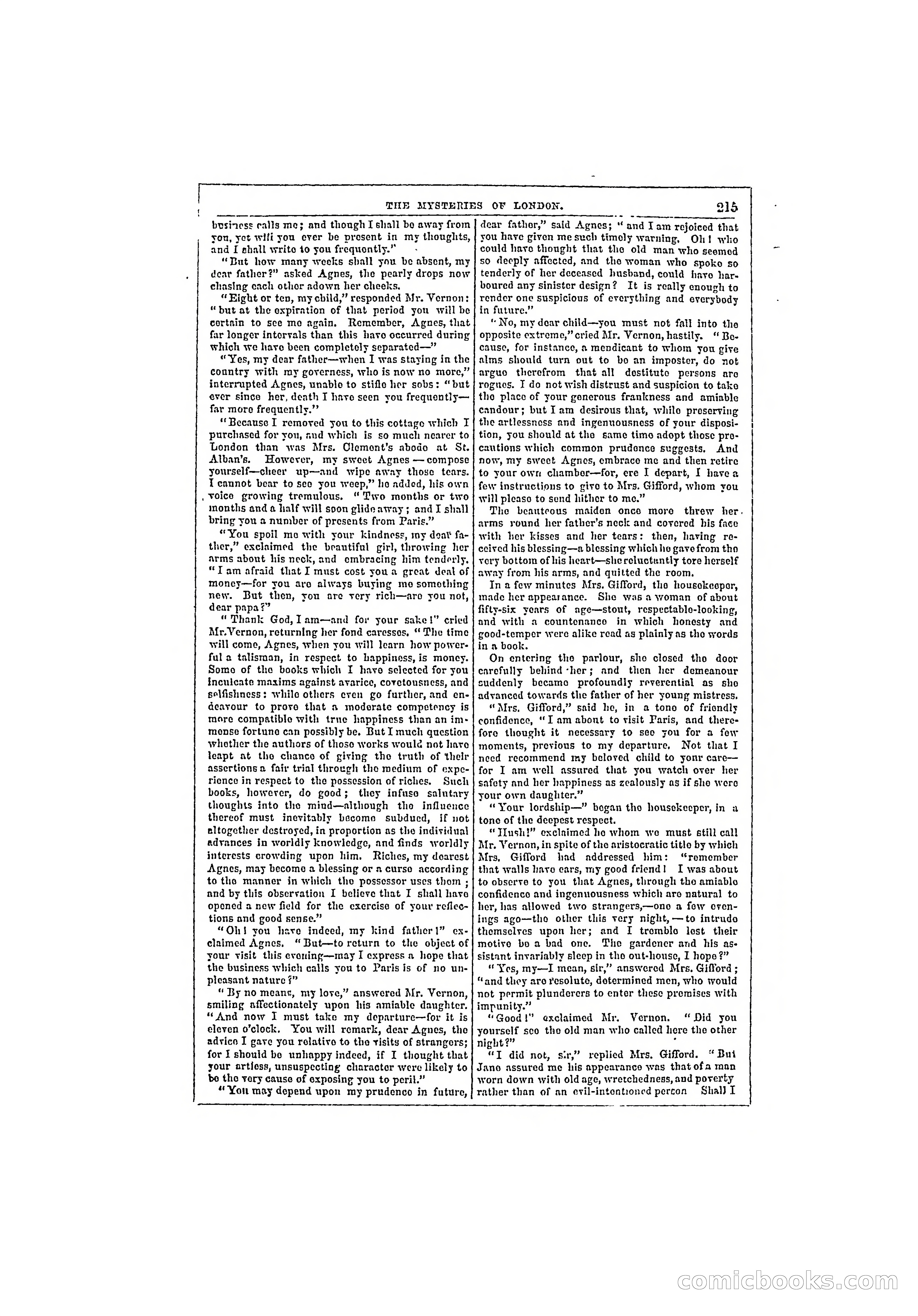
A restored page from Penny Dreadfuls, 1846. Page through the whole issue in the reader above.
📄 Transcribed text from this page (OCR, searchable)
Machine-transcribed from the original scan — historical spelling and the odd misread are preserved.
—— { N Ato copes business calls me; and thoagh [ shall be away from vou, yet wifi you ever be present in my thoughts, and I shall write 10 you frequently.” “But how many weeks shall you be absent, my dear father?” asked Agnes, the pearly drops now chasing each other adown her cheeks. “Right or ten, my child,” responded Mr. Vernon: “but at the expiration of that period yon will be cortnin to see me again. Remember, Agnes, that far longer intervals than this havo occurred during which we have been completely separated—” “Yes, my dear father—when I was Staying in the country with my governess, who is now no more,” interrupted Agnes, unable to stifle her sobs: “but ever since her, death I hare seen you frequently— far more frequently.”’ ** Because I removed you to this cottage which I purchased for you, and which is so much nearer to London than was Mrs. Clement’s abode at St. Alban’s. However, my sweet Agnes — compose yourself—cheer up—and wipe away those tears. T cannot bear to see you weep,” ho added, his own voice growing tremulous. “Two months or two months and a half will soon glide away; and I shall bring you a number of presents from Paris.” “You spoil mo with your kindness, my deat fa- ther,” exclaimed the beautiful girl, throwing her arms about his neck, and embracing him tenderly, “Tam afraid that I must cost youa great deat of money—for you are always buying me somothing new. But then, you are very rich—aro you not, dear papa?” “Thank God, Iam—and for your sake!” cried Mr. Vernon, returning her fond caresses, “ The time will come, Agnes, when you will learn how power. ful a talisman, in respect to happiness, is money. Somo of the books which I have selected for you incuicate maxims against avarice, covetousness, and slfistiness: while others even go further, and en- aeayour to prove that a modorate competency is more compatible with true happiness than an im- mense fortuna can possibly be. But I much question whother the authors of those works would not have leapt at the chance of giving the truth of thelr assertions a fair trial through the medium of expe- rience in respect to the possession of riches. Such books, however, do good; they infuso salutary thoughts into the mind—although the influence thereof must inevitably become subducd, if not altogether destroyed, in proportion as the individual advances in worldly knowledge, and finds worldly interests crowding upon him. Riches, my doarest Agnes, may become a blessing or a curso according to the manner in which the possessor uses thom ; and by this observation I believe that I shall have opened a new field for the exercise of your reflec- tions and good sense.” “Oh! you have indeed, my kind father!” ex- claimed Agnes. “ But—to return to the object of your visit this evoning—may I express a hope that the business which calls you to Paris is of no un- pleasant nature ¢” “ By no means, my love,” answered Mr. Vernon, smiling affectionately upon his amiable daughter. ‘And now I must take my departure—for it is eleven o’clock. You will remark, dear Agnes, the advice I gave you rolative to the visits of strangers; for I should be unhappy indeed, if I thought that your artiess, unsuspecting character were likely to bo the very cause of exposing you to peril.” ““You may depend upon my predenco in future, THE MYSTERIES OF LONDON, als dear fathor,” said Agnes; * “ond Tam rejoiced that you have given me such timely warning, Oht who could havo thought that the old man who seemed so deeply affected, and the woman who spoke so tenderly of her deceased husband, could have har- boured any sinister design? It is really enough to render one suspicious of everything and everybody in future.” « No, my dear child—you must not fall into the opposite extreme,” cried Mr. Vernon, hastily. “ Be- cause, for instance, 2 mendicant to whom you give alms should turn out to bo an imposter, do not arguo therefrom that all dostitute Persons aro rogues. I do not wish distrust and suspicion to take the place of your generous frankness and amiable candour; but Iam desirous that, while preserving the artlessnoss and ingenuousness of your disposi- tion, you should at the same timo adopt those pro- cautions which common prudence suggests, And now, my sweet Agnes, embrace me and then retire to your own chamber—for, ere I depart, I havea few instructions to give to Mrs. Gifford, whom you will pleaso to send hither to me.” The beauteous maiden once more threw her. arms round her father’s neck and covered his face with her kisses and her tears: then, having re- ceived his blessing—a blessing which hoe gave from tho very bottom of his heart—shercluctuntly tore herself away from his arms, and quitted the room. In afew minutes Mrs. Gifford, tha housekeeper, made her appearance. She was a woman of about fifty-six years of age—stout, respectable-looking, and with a countenance in which honesty and good- temper were alike read as plainly as tho words in « book. On entering the parlour, she closed tho door carefully behind -her; and then her demeanour suddenly became profoundly reverential as sho advanced towards the father of her young mistress, “Mrs. Gifford,” said he, in a tono of friondly confidence, ‘I am about to visit Paris, and there- fore thought it necessary to see you for a few moments, previous to my departure, Not that J need recommend my beloved child to yonr care— for I am well assured that you watch over her safety nnd her happiness as zealously as if she were your own daughter.” “Your lordship—” began tho housekeeper, in a tone of the deepest respect. *TIush!” exclaimed ho whom we must still call Mr. Vernon, in spite of the aristocratic title by which Mrs, Gifford had addressed him: “remember that walls have cars, my good friend! I was about to observe to you that Agnes, through the amiable confidence and ingennuousness which aro natural to her, has allowed two strangers,—one a few oven- ings ago—tho other this very night, —to intrudo themselres upon her; and I tremblo lest their motive bo a bad one, The gardener and his as- sistant invariably sleep in the out-house, I hope ?” -Yos, my—I mean, sir,” answered Mrs. Gifford ; “and they aro resolute, dofermined men, who vould not permit plunderers to enter these premises with impunity.” “Good!” exclaimed Mr. Vernon. “ Did you yourself sco the old man whio called here the other night?” “T did not, sir,’ replied Mrs. Gifford. “Bui Jano assured me his appearance was that ofa man worn down with old age, wretchedness, and poverty rather than of an evil-intentioned Suneeeeea ye EEA 4 ShalJ I ; i (C(O) (C DOO <S LL (SO)