
Penny Dreadfuls, 1846 · page 213 of 399
The Mysteries of London, Vol. IV — page 213: what you’re looking at
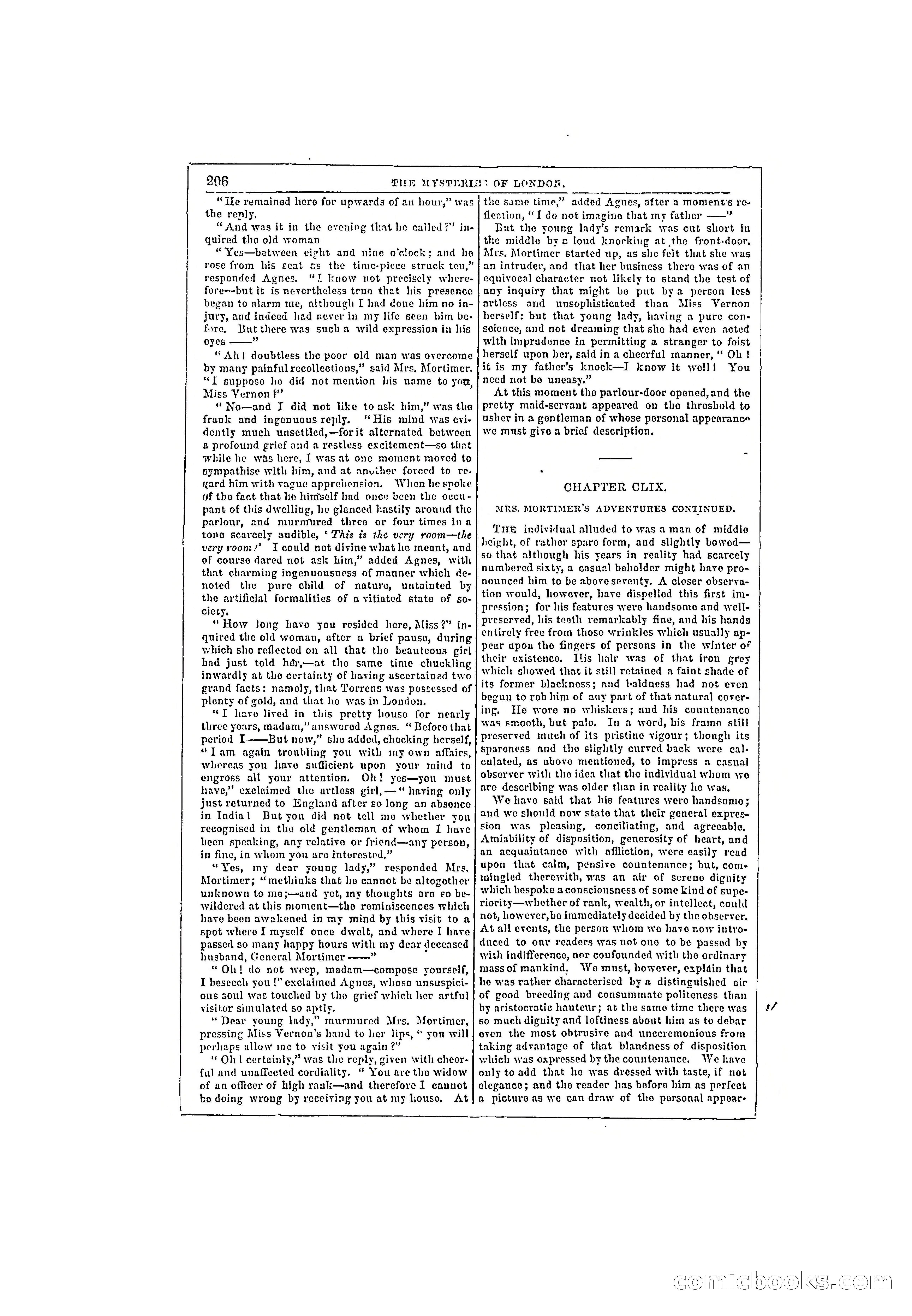
A restored page from Penny Dreadfuls, 1846. Page through the whole issue in the reader above.
📄 Transcribed text from this page (OCR, searchable)
Machine-transcribed from the original scan — historical spelling and the odd misread are preserved.
206 TIIE MYSTERIG “He remained hero for upwards of an hour,” was the renly. “And was it in the evening that he called?” in- quired the old woman “Yes—between cight and nine o'clock; and he rose trom his seat ss the time-picce struck ten,” responded Agnes. “{Y know not precisely where- fore—but it is nevertheless true that his presence began to alarm me, although [ had done him no in- jury, and indeed lad never in my life seen him be- fore, Butthere was such a wild expression in his oyes i “Ah! doubtless the poor old man was overcome by mang painful recollections,” said Mrs. Mortimer. “I supposo he did not mention his name to yor, Miss Vernon {”’ “ No—and I did not like to ask him,” was the frank and ingenuousreply. ‘His mind was evi- dently much unsettled,—forit alternated betwoon 8 profound grief and a restless excitement—so that while he was here, I was at one moment moved to sympathise with him, and at anuther forced to re- gard him with vague apprehension. When he snoke Of the fact that he hiniself had once been the occu- pant of this dwelling, he glanced hastily around the parlour, and murntured threo or four times ina tono scarcely audible, ‘ This is the very room—the very room?’ J could not divine what he meant, and of course dared not ask him,” added Agnes, with that charming ingenuousness of manner which de- noted the pure child of nature, untainted by the artificial formalities of a vitiated state of so- ciety, ‘“How long have you resided here, Miss?” in- quired the old woman, after a brief pause, during which sho reflected on all that tho beautecous girl had just told hey,—at tho same timo chuckling inwardly at the certainty of having ascertained two grand facts: namely, that Torrens was possessed of plenty of gold, and that he was in London, “T have lived in this pretty houso for nearly three years, madam,” answered Agnas. “ Beforothat period I But now,” she added, checking herself, “Tam again troubling you with my own affairs, wheroas you have sufficient upon your mind to engross all your attention. Oh! yes—you must have,” exclaimed the artless girl, — “ having only just returned to England aftcr s0 long an absence in Indial But you did not tell me whether you recognised in the old gentleman of whom I have been speaking, any relative or friend—any porson, in fine, in whom you are interested.” “Yes, my dear young lady,” responded Mrs, Mortimer; “methinks that he cannot be altogether unknown to me;—and yet, my thoughts are so be- wildered at this moment—tho reminiscences which have been awakened in my mind by this visit to a spot where I myself once dwolt, and where I have passed so many happy hours with my dear deceased husband, General Mortimer ——” *“ Oh! do not weep, madam—compose rourself, I beseech you!” exclaimed Agnes, whose unsuspici- ous soul was touched by tho grief which her artful visitor simulated so aptly. * Dear young lady,” murmured Mrs. Mortimer, pressing Miss Vernon's hand to her lips, © you will perhaps allow me to visit you again ?” “ Oh! certainly,” was the reply, given with cheor- ful and unaffected cordiality. “ You are the widow of an officer of high rank—~and therefore I cannot bo doing wrong by receiving you at my liouse. At \ OF LONDON, the same time,’ added Agnes, after a moment's re wees Loreueers On See a ee flection, “I do not imagine that my father ——” But the young lady’s remark was cut short in the middle by a loud knocking at the front-door. Mrs. Mortimer started up, as she felt that she was an intruder, and that her business there was of an equivocal character not likely to stand the test of any inquiry that might be put bya person less artless and unsophisticated than Miss Vernon herself: but that young lady, having a pure con- science, and not dreaming that she had even acted with imprudence in permitting a stranger to foist herself upon her, said in a cheerful manner, “ Oh ! it is my father’s knock—I know it well! You need not be uneasy.” At this moment the parlour-door opened,and the pretty maid-servant appeared on tho threshold to usher in a gontleman of whose personal appearance we must give a brief description. CHAPTER CLIX. MRS, MORTIMER'’S ADVENTURES CONTINUED. THe individual alluded to was a man of middle height, of rather spare form, and slightly bowed— so that although his years in reality had scarcely numbered sixty, a casual beholder might have pro- nounced him to be aboveseventy. A closer observa- tion would, however, have dispelled this first im- pression; for his features were handsome and well- preserved, his teeth remarkably fine, and his hands entirely free from those wrinkles which usually ap- peur upon tho fingers of porsons in the winter of their existence, Tis hair was of that iron grey which showed that it still retained a faint shade of its former blacknoss; and baldness had not even begun to rob him of any part of that natural cover- ing. Ile wore no whiskers; and his countenanco was smooth, but palo. In a word, his framo still preserved much of its pristine vigour; though its sparoness and tho slightly curved back were cal- culated, as above mentioned, to impress a casnal observer with tho idea that tho individual whom we are describing was older than in reality ho was. Wo havo said that his features wero handsomo; and we should now state that their gencral expres. sion was pleasing, conciliating, and agreeable, Amiability of disposition, gencrosity of heart, and an acquaintance with affliction, were easily read upon that calm, ponsive countenance; but, com- mingled therewith, was an air of serene dignity which bespoke a consciousness of some kind of supe- riority—whethor of rank, wealth, or intellect, could not, however, bo immediately decided by the observer. At all events, the person whom we havo now intro- duced to our readers was not ono to be passed by with indifferenco, nor confounded with the ordinary massof mankind. We must, however, explain that he was rathor characterised bya distinguished air of good breeding and consummate politeness than by aristocratic hauteur; at the samo time there was | ¢/ so much dignity and loftiness about him as to debar even the most obtrusive and unceremonious from taking advantage of that blandness of disposition which was oxpressed by the countenance. We havo only to add that he was dressed with taste, if not elegance; and tho reader has beforo him as perfect a picture as we can draw of tho personal appear. ee ee EConnicloooks (SO)