
Penny Dreadfuls, 1846 · page 207 of 399
The Mysteries of London, Vol. IV — page 207: what you’re looking at
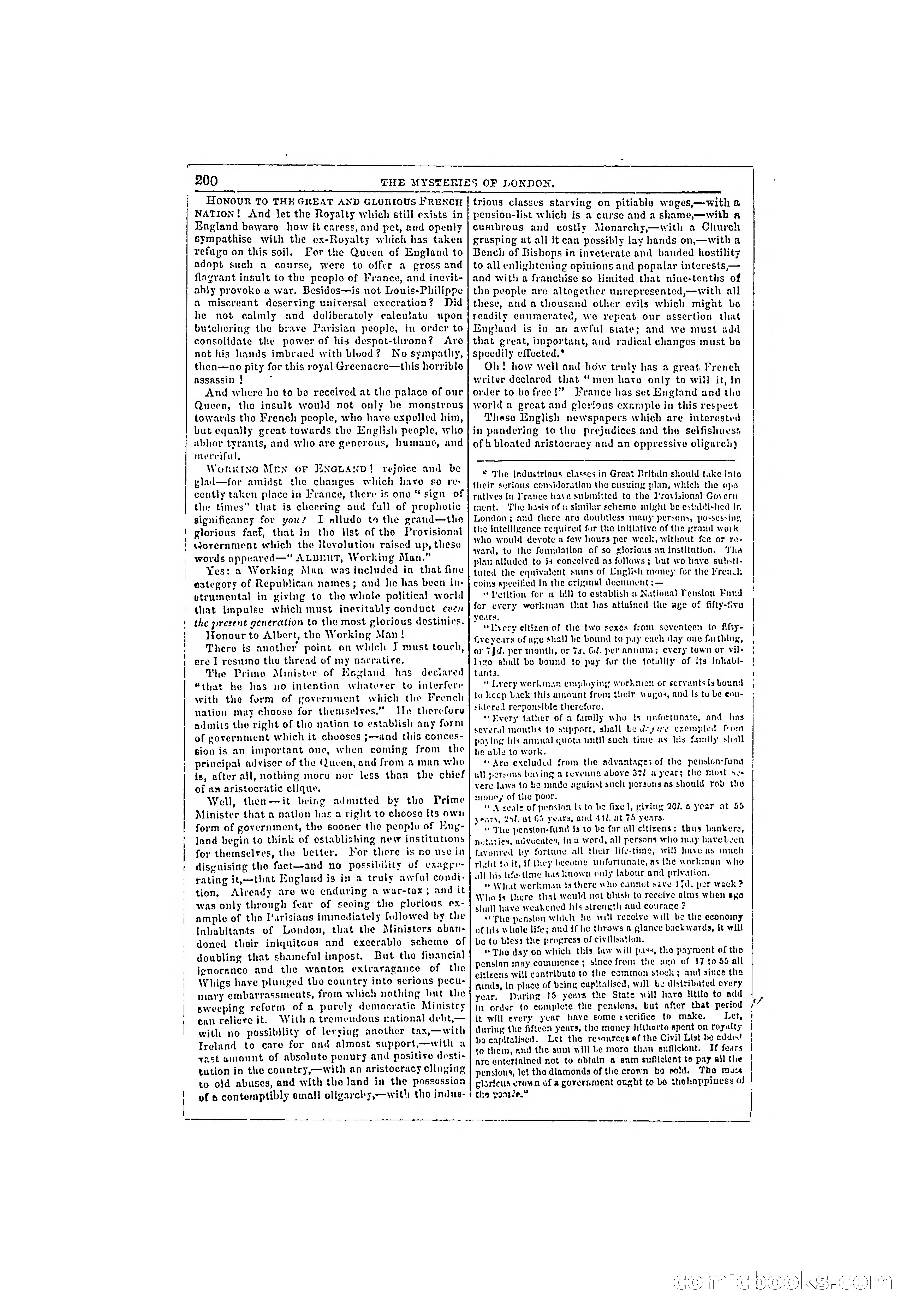
A restored page from Penny Dreadfuls, 1846. Page through the whole issue in the reader above.
📄 Transcribed text from this page (OCR, searchable)
Machine-transcribed from the original scan — historical spelling and the odd misread are preserved.
f errr AN CT eo 200 THE MYSTERIZS OF LONDON, HONOUR TO THE GREAT AND GLORIOUS FRENCH NATION! And let the Royalty which still exists in England bewaro how it caress, and pet, and openly sympathise with the ex-Royalty which has taken refuge on this soil. For the Queen of England to adopt such a course, were to offer a gross and flagrant insult to the peoplo of France, and inevit- ably provoke a war. Besides—is not Louis-Philippe a miscreant deserving universal exccration? Did he not calmly and deliberately calculate upon butchering the brave Parisian people, in order to consolidate the power of his despot-throne? Aro not his hands imbrued with bluod ? No sympathy, then—no pity for this royal Greenacre—this horrible ngsassin ! And where he to bo received at tho palace of our Queen, tho insult would not only be monstrous towards the French people, who have expelled him, but equally great towards the English people, who abhor tyrants, and who are generous, humane, and mereifal, Working Mrx oF ENGLAND! rejoice and be glad—for amidst the changes which have so re: cently taken place in France, there is ono “ sign of the times” that is cheering and full of prophetic significancy for yous I allude to tho grand—thiec glorious fact, that in the list of the Provisional cyorernment which the Revolution raised up, these words appeared—* ALBERT, Working Man.” Yes: a Working Man was included in that fine eatepory of Republican names; and he has been in- strumental in giving to the whole political world that impulse which must inevitably conduct cven the present generation to the most glorious destinics. Honour to Albert, tho Working Man ! There is another point on which J must touch, ere I resume tho thread of my narrative, Nhe Prime Minister of England has declared “that he has no intention whatever to interfere with the form of government which the French nation may choose for themselves.” He therefore admits the right of the nation to establish any form of government which it chvoses ;—and this concvs- gion is an important one, when coming from the principal adviser of the Queen, and from a man who is, after all, nothing more nor less than the chief of an aristocratic clique. Well, then—it being admitted by tho Prime Minister that a nation has a right to cliooso its own form of government, tho sooner the people of Eng- land begin to think of establishing new institutions for themselves, the better. Lor there is no use in disguising the fact—and no possibility of exagre- rating it—that England ig in a truly awful condi- tion, Already aro wo enduring a war-tax; and it was only through fear of seoing the glorious ex- ample of tho Parisians immediately followed by the inliabitants of London, that the Ministers aban- doned their iniquitous and execrable schemo of doubling that shameful impost. Bat tho financial ignoranco and the wanton extravagance of the Whigs have plunged tho country into serious pecu- nary embarrassiments, from which nothing but the sweeping reform of o purely democratic Ministry can reliore it. With a tremendous rational debt,— with no possibility of levying another tax,—with Ireland to care for and almost support,—with a vast umount of absolute penury and positive desti- tution in the country,—with an aristocracy clinging to old abuses, and with tho land in the possession of s contomptibly small oligarchy,—with tho indus- pension-list which is a curse and a shame,—with a cumbrous and costly Monarchy,—with a Church grasping ut all itcan possibly lay hands on,—with a Bench of Bishops in inveterate and banded hostility to all enlightening opinions and popular interests,— and with a franchise so limited that nine-tenths of the people are altogether unrepresented,—with all these, and a thousand other evils which might be readily cnumerated, we repeat our assertion that England is in an awful state; and wo must add that great, important, and radical changes must bo speedily cffected.* Oh! how well and how truly has a great Prench writer declared that “men have only to will it, in order to bo free!” France has set England and the world a great and glerious example in this respect Theso English newspapers which are interested in pandering to the prejudices and tho selfishuess of & bloated aristocracy and an oppressive oligarchy * The Industrious classes in Great Britatn should take into their serious consiioration the cusuing plan, which the ope ratives In Trance have sutinitted to the Provisional Govern ment. The basis of & similar schemo might be established in London; and there are doubtless many persons, possessing, the intelligence required for the initiative of the grand work who would devote a few hours per week, without fee or re- svard, to the foundation of so glorious an institutsun. The plan alluded to is conceived as follows ; but wo have substl- tuted the equivalent suing of English money for the French coins apeeliied In the original dectunent:— “Petition for a bill to establish a National Pension Fund for every workman that has attained the age of fifty-tive years, “Dsery eltizen of the two sexes from seventeen to fifty- fiveveurs ofnge shall be bound to pay each day one farthing, or 74d. per month, or 7s. Gd. per annum; cvery town or vil- ligo shall be bound to pay fur the totality of its Inhabl- tants. * Lyery workhinan employing workmicn or servants is bound tu kcep back this amount from their wages, and is to be eon- sidered responsible therefore. “Every father of a farly who fs anfortunate, and lias several mouths to support, shall be deyire exempted from paying lifs annital quota until such time as Lis family shall be able to work. “Are excluded from the advantages of the pension-fund all persons haying a sevenue above 322 a year; the most se- vere luws to be made uguinst such persons as should rob the mouey of the poor. 4 scale of pension $3 to he fixe !, giving 207.4 year at 55 years, Zl. at GS years, and 44. at 75 years. “The pension-fund js to be for all citizens: thus bankers, notaties, advucates, ina word, all persons who may have boen favonred by fortune all their life-time, will have as much rhvht to it, ifthey becume unfortunate, as the workman who all his Infe-time has known only lavour and privation. “What workniin is there who cannot save 14d. per week ? Who $s there that would not blush to receive alms when age shall have weakened his strength aud courage ? “The pension which ho will receive will be the economy of his whole life; and if he throws a glance backwards, it will be to bless the progress of civilisation. “Tho day on which this law will pass, the payment of the pension may commence ; since from the ago of 17 to 55 all citlzens will contribute to the common stock ; and since the hinds, in place of being capitalised, will be distributed every year, During 15 years the State will have little to add in order to complete the pensions, but after that period / it will every year have sume sacrifice to make. Let, | during the fifteen years, the moncy hitherto spent on royalty | | | | | trious classes starving on pitiable wages,—with a ' } a eo Bia See Se oS os a A SPSL a be capitalised. Let the resources af the Civil List bo added to them, and the sum will be more than suffictout. Jf fears are entertained not to obtain a sum suflicient to pay all the pensions, Ict the diamonds of the crown bo sold. Tho mu clsricus cruwn of a government ought to be ‘shehappincess ov) the panpie.” EConnicloooks (SO)