
Penny Dreadfuls, 1846 · page 204 of 399
The Mysteries of London, Vol. IV — page 204: what you’re looking at
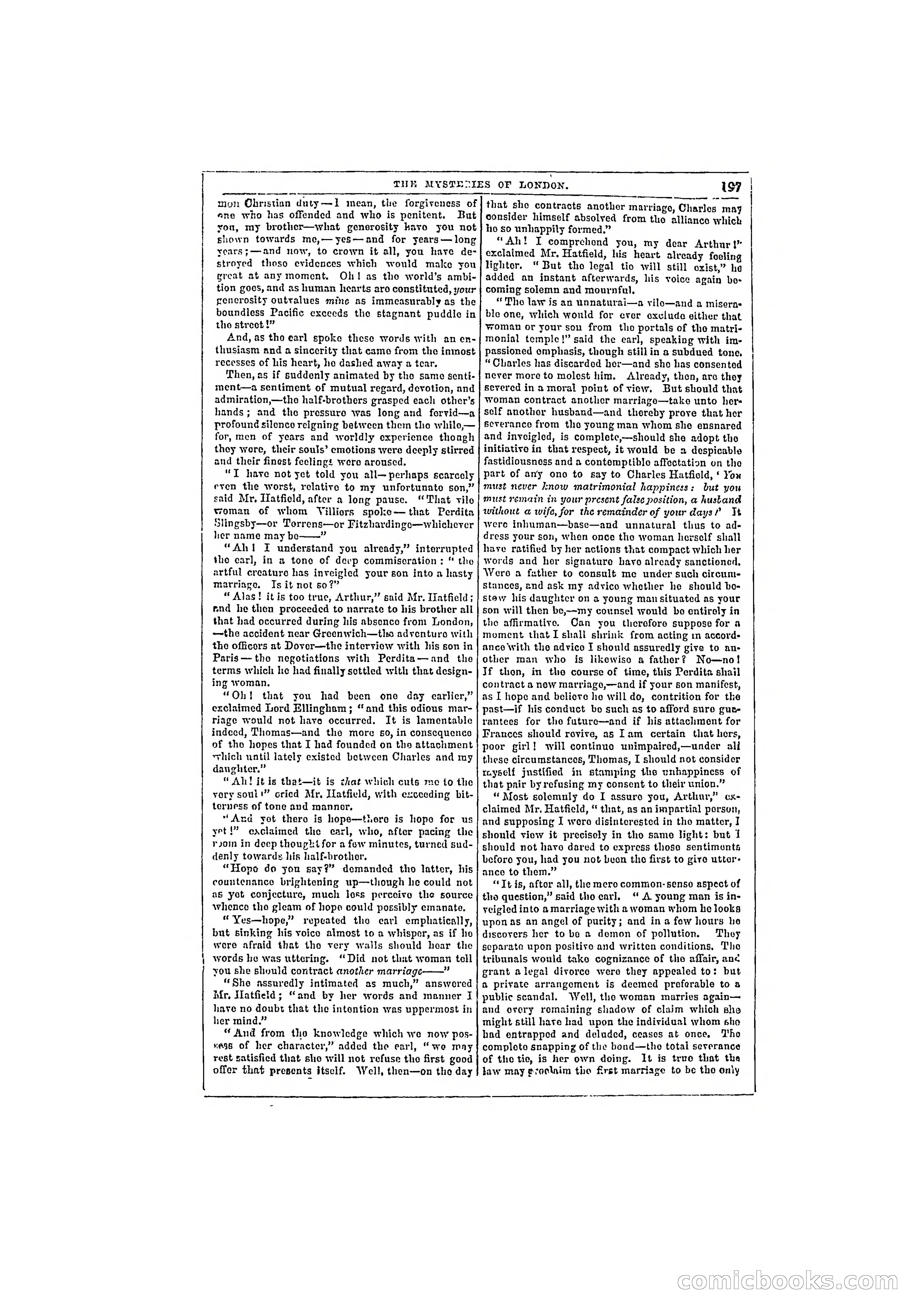
A restored page from Penny Dreadfuls, 1846. Page through the whole issue in the reader above.
📄 Transcribed text from this page (OCR, searchable)
Machine-transcribed from the original scan — historical spelling and the odd misread are preserved.
a terre cy oy oe. THE MYSTENIES OF LONDON. oo ae ome won Obristian duty —1 mean, the forgiveness of ane who has offended and who is penitent. But you, my brother—what generosity havo you not shown towards me,—yes—and for years— long years;—and now, to crown it all, you have de- stroyed thoso evidences which would make you great at any moment. Ohl as tho world’s ambi- tion goes, and as human hearts aro constituted, your fencrosity outvalues mine as immeasurably as the boundless Pacific exceeds the stagnant puddle in tho street !” And, as the earl spoke these words with an en- thusiasm and a sincerity that came from the inmost recesses of his heart, ho dashed away a tear. Then, as if suddenly animated by tho same senti- ment—a sentiment of mutual regard, devotion, and admiration,—the half-brothers grasped each other’s hands; and the pressure was long and forvid—a profound silenco reigning between them tho while— for, men of years and worldly experience though they wore, their souls’ emotions were deeply stirred and their finest feelings wero aroused. “T have not yet told you all—perhaps scarcely even the worst, relative to my unfortunate son,” said Mr, Hatfield, after a long pause. “'That vile vroman of whom Villisrs spoke—that Perdita slingsby-—-or Torrens—or Fitzhardingo—whichever her name may be “Ah! YT understand you already,” interrupted tho carl, in a tone of devp commiseration : “ the artful creature has inveigled your son into a hasty marriage. Is it not so?” “Alas! itis too truce, Arthur,” said Mr. Iatfield ; end he then proceeded to narrate to his brother all that had occurred during his absence from London, —the accident near Greenwich—tho adyenturo with the officers at Dover—the interviow with his son in Paris — tho negotiations with Perdita—and the terms which he had finally settled with that dcesign- ing woman. “Oh! that you had been one day earlier,” exclaimed Lord Ellingham; “and this odious mar- riage would not have occurred. It is lamentable indeed, Thomas—and the more 50, in consequence of tho hopes that I had founded on the attachment which until lately existed between Charles and my daughter.” “Ah! itis that—it is that which cuts me to the vory soul!” cried Mr, Hatfield, with exceeding bit- terness of tone and mannor. “Ard yot there is hope—tiere is hope for us yet!” exclaimed the earl, who, after pacing the rjom in decp thought for a few minutes, turned sud- denly towards his half-brother. “Hone do you say?” demanded tho latter, his countenance brightening up—though he could not as yot conjecture, much Iers perceive the source whence the gleam of hopo could possibly emanate, “Yes—hope,” repeated the carl emphatically, but sinking his voico almost to a whisper, as if he were afraid that the very walls should bear the words he was uttering. “Did not that woman tell you she should contract another marriage——” “She assuredly intimated as much,” answered Mr, Jlatfield; “and by her words and manner J have no doubt that the intention was uppermost in her mind.” * And from tho knowledge which we now pos- ness of her character,” added the earl, “we may rest satisfied that she will not refuse the first good offer that presents itsclf. Well, then—on tho day 1S7 so. ee SY that she contracts another marriage, Charles may consider himself absolved from the alliance which ho so unhappily formed.” “Ah! I comprehend you, my dear Arthur |” exclaimed Mr. Hatfield, his heart already foeling lightor. “ But tho legal tio will still exist,” ha added an instant afterwards, his voice again Dos coming solemn and mournful. “Tho law is an unnaturai—a vilo—and a miseras ble one, which would for ever oxclude either that woman or your son from the portals of the matri- monial temple!” said the earl, speaking with im- passioned omphasis, though stillin a subdued tone, “Charles has discarded her—and she has consented never more to molest him. Already, than, are they severed in amoral point of view. But should that woman contract another marriage—take unto here self anothor husband—and thereby prove that her severance from the young man whom she ensnared and inycigled, is complete,—should she adopt the initiative in that respect, it would be 2 despicable fastidiousness and a contemptiblo affectation on the part of any ono to say to Charles Hatfiold, ‘ You must never know matrimonial happiness: but you must remain in your present false position, a hustand without a wife, for the remainder of your days’ Jt were inhuman—base—and unnatural thus to ad- dress your son, when once tho woman herself shall have ratified by her actions that compact which her words and hor signature havo already sanctioned, Wero a father to consult me under such circume stances, end ask my advico whether he should bo-« stow his daughtcr on a young man situated as your s0n will then be,—my counsel would bo entirely in the affirmative. Can you therefore suppose for a moment that I shali shrink from acting m accord- ance with the advico I should assuredly give to an- other man who is likewiso a father? No—no! Jf thon, in the course of time, this Perdita shail contract a new marriage,—and if your son manifest, as I hope and belicre hoe will do, contrition for the past—if his conduct bo such as to afford sure gur- rantees for the future—and if his attachment for Irances should revive, as Lam certain that hers, poor girl! will continuo unimpaired,—under ali these circumstances, Thomas, I should not consider royself justified in stamping the wenhappincss of that pair by refusing my consent to their union.” “Most solemnly do I assure you, Arthur,” cx- claimed Mr. Hatfield, * that, as an impartial porsoun, and supposing I wero disinterested in tho matter, I shonld viow it preciscly in tho same light: but 1 should not havo dared to express those sentiments before you, had you not beon tho fivst to giro uttar- ance to them.” “Tt is, aftor all, the mero common-senso aspect of tho question,” said tho car]. ‘A young man is in- veigled into a marriage with a woman whom he looks upon as an angel of purity; and in a few hours he discorers her to be a demon of pollution. They separate upon positive and written conditions, The tribunals would take cognizance of the affair, anc grant a legal divorce were they appealed to: but a private arrangement is decmed preferable to a public scandal. Well, tho woman marries again— and overy romaining shadow of claim which she might still hare had upon the individual whom she had entrapped and deluded, ceases at once, Tho complete snapping of the bond—the total severance of the tie, is her own doing. 18 is true that tha law may groclnim tie first marriage to be the only (C(O) (C DOO <S LL (SO)