
Penny Dreadfuls, 1846 · page 196 of 399
The Mysteries of London, Vol. IV — page 196: what you’re looking at
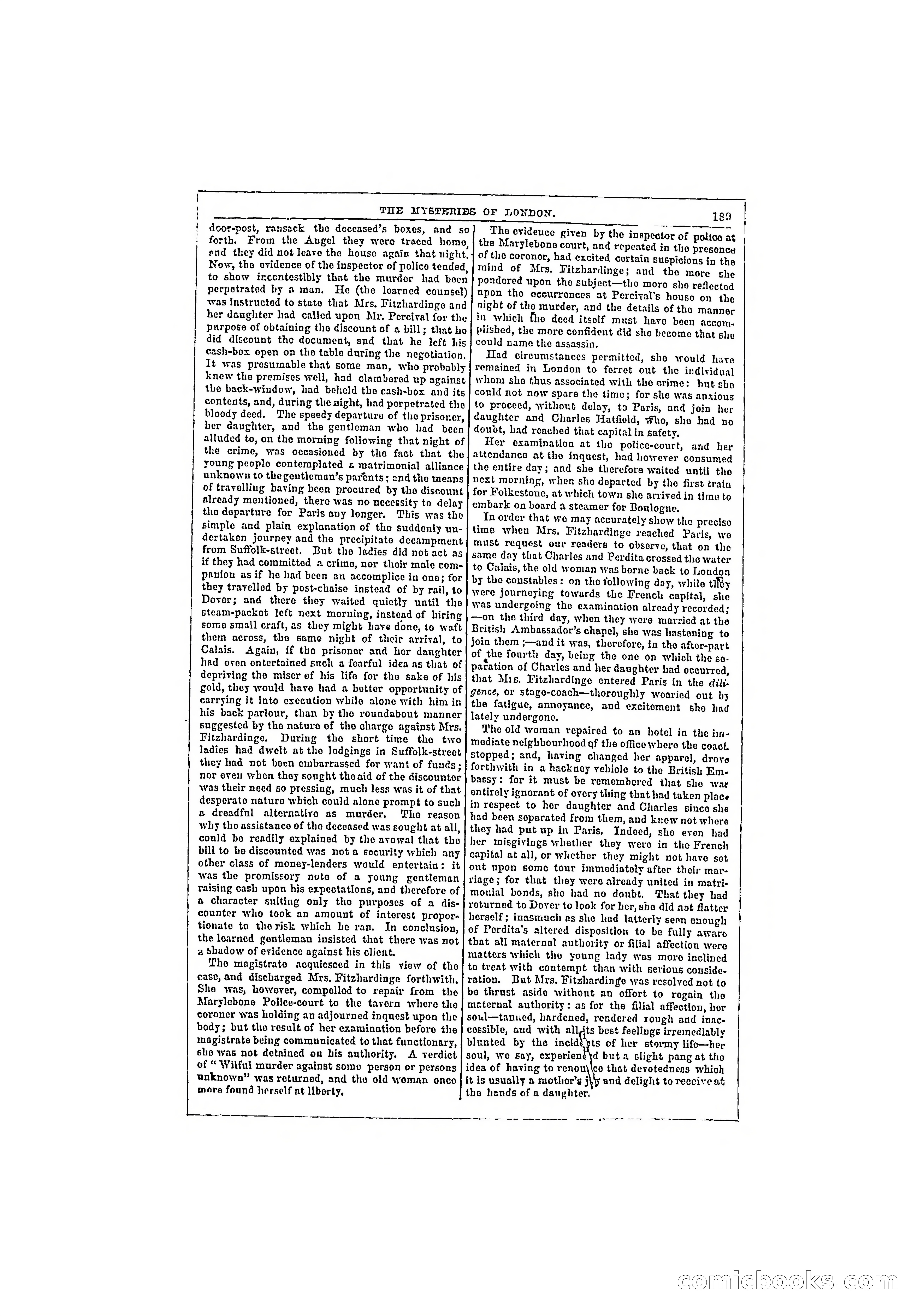
A restored page from Penny Dreadfuls, 1846. Page through the whole issue in the reader above.
📄 Transcribed text from this page (OCR, searchable)
Machine-transcribed from the original scan — historical spelling and the odd misread are preserved.
a Reg geese om. dcor-post, ransack the deceased’s boxes, and s0 forth. From the Angel they wero traced home, end they did not leave tho house again that night, Now, tho evidence of the inspector of police tended, to show irccntestibly that the murder had been perpotrated by a man. He (the learned counsel) was instructed to state that Mrs, Fitzhardinge and her daughter had called upon Mr. Percival for the purpose of obtaining the discount of a bill; that ho did discount the documont, and that he left his cash-box open on tho table during the negotiation. It was prosumable that some man, who probably knew the premises well, had clambored Up against the back-window, had beheld the cash-box and its contents, and, during the night, had perpetrated the bloody deed. The speedy departure of the prisoner, her daughter, and the gentleman who had beon alluded to, on the morning following that night of the crime, was occasioned by the fact that the young people contemplated s matrimonial alliance unknown to the gentleman’s parents; andthe means of travelling having been procured by the discount already mentioned, there was no necessity to delay tho departure for Paris any longer, This was the simple and plain explanation of the suddonly un- dertaken journey and the precipitate decampment from Suffolk-strect. But the ladies did not act as if they had committed a crimo, nor their male com- penion as if he had been an accomplice in one; for they travelled by post-chaise instead of by rail, to Dover; and there thoy waited quictly until the Steam-packet left next morning, instead of hiring some small craft, as they might have done, to waft them across, the same night of their arrival, to Calais. Again, if tho prisoner and her daughter had even entertained such a fearful idea as that of depriving the miser ef his life for the sake of his gold, they would have had a better opportunity of carrying it into execution while alone with him in his back parlour, than by the roundabout manner suggested by the nature of the charge against Mrs. Fitzhardinge. During the short time the two ladies had dwelt at the lodgings in Suffolk-street they had not boen embarrassed for want of funds: nor even! when they sought theaid of the discounter was their need so pressing, much less was it of that desperate nature which could alone prompt to such a dreadful alternative as murder, The reason why tho assistance of the deceased was sought at all, could be readily explained by the avowal that the bill to be discounted was nota security which any other class of money-lenders would entertain: it was the promissory nvte of a young gentleman raising cash upon his expectations, and therefore of & character suiting only the purposes of a dis- counter who took an amount of interest propor- tionate to thorisk which he ran. In conclusion, the loarned gentleman insisted that there was not a Shadow of evidence against his client. The magistrato acquiesced in this view of the case, and discharged Mrs, Fitzhardinge forthwith. She was, however, compolled to repair from the Marylebone Police-court to the tavern where the coroner was holding an adjourned inquest upon the body; but the result of her examination before the magistrate being communicated to that functionary, she was not detained on his authority. A verdict of “ Wilful murder against some person or persons unknown” was returned, and the old woman once mare found herself at liberty, THE MYSTERIBS OF LONDON. 89 | G 1 given by the inspeetor of police at the Marylebone court, and repeated in the presence of the coronor, had excited certain Suspicions in the mind of Mrs. Fitzhardinge; and tho more she pondered upon the subject—the more she reflected upon the occurrences at Percival’s house on the night of the murder, and the details of tho manner in which tho deed itself must have beon accom-~ plished, the more confident did she becomo that sho could name the assassin. Iiad circumstances permitted, sho would have remained in London to ferret out the individual whom she thus associated with the crime: but she could not now spare the time; for she was anxious to procecd, without delay, to Paris, and join her daughter and Charlies Hatfield, ho, sho had no doubt, had reached that capitalin safety. Her examination at the police-court, and her attendance at the inquest, had however consumed the entire day; and she therefore waited until tho next morning, when sho departed by the first train for Folkestone, at which town she arrived in time to embark on board a steamer for Boulogne. In order that we may accurately show the precise time when Mrs. Fitzhardinge reached Paris, we must request our readers to observe, that on thie same day that Charles and Perdita crossed the water to Calais, the old woman was borne back to London by the constables: on the following day, while tlfey Were journeying towards the French capital, she was undergoing the examination already recorded; ——on the third day, when they were married at the British Ambassador’s chapel, she was hastoning to join them ;—~and it was, thorefore, in the aftor-part of the fourth day, being the one on which the go- paration of Charles and her daughter had occurred, that Mis. Titzhardinge entered Paris in the dilt- gence, or stage-coach—thoroughly wearied out by the fatigue, annoyance, and excitoment sho had lately undergone. Tho old woman repaired to an hotel in the imn- mediate neighbourhood of the office whero the coact stopped; and, having changed her apparel, drove forthwith in a hackney vebicle to the British Em- bassy: for it must be remembered that she wav ontirely ignorant of overy thing that had taken place in respect to hor daughter and Charles ginco she had been separated from them, and knew not whera they had put up in Paris, Indeed, sho even had her misgivings whether they wero in the French capital at all, or whether they might not have set ont upon some tour immediately after their mare riage; for that they were already united in matri« monial bonds, sho had no doubt. That they had returned to Dover to look for her, she did not flatter herself ; inasmuch as she had latterly seen enough of Perdita’s altered disposition to be fully aware that all maternal authority or filial affection wero matters which the young lady was moro inclined to treat with contempt than with serious conside. ration. But Mrs. Fitzhardinge was resolved not to be thrust aside without an effort to regain the maternal authority: as for the filial affection, her soul—tanued, hardened, rendered rough and inac- cessible, and with allits best feelings irremediably blunted by the incidétts of her stormy life—her soul, we say, experiend}d buta slight pang at the idea of having to renou\\co that devotedness which it is usually a mother’s A and delight to receive at tho hands of a dauyhter, The crvidence ee ee Oe! at ee ee re Tod (C(O)