
Penny Dreadfuls, 1846 · page 193 of 399
The Mysteries of London, Vol. IV — page 193: what you’re looking at
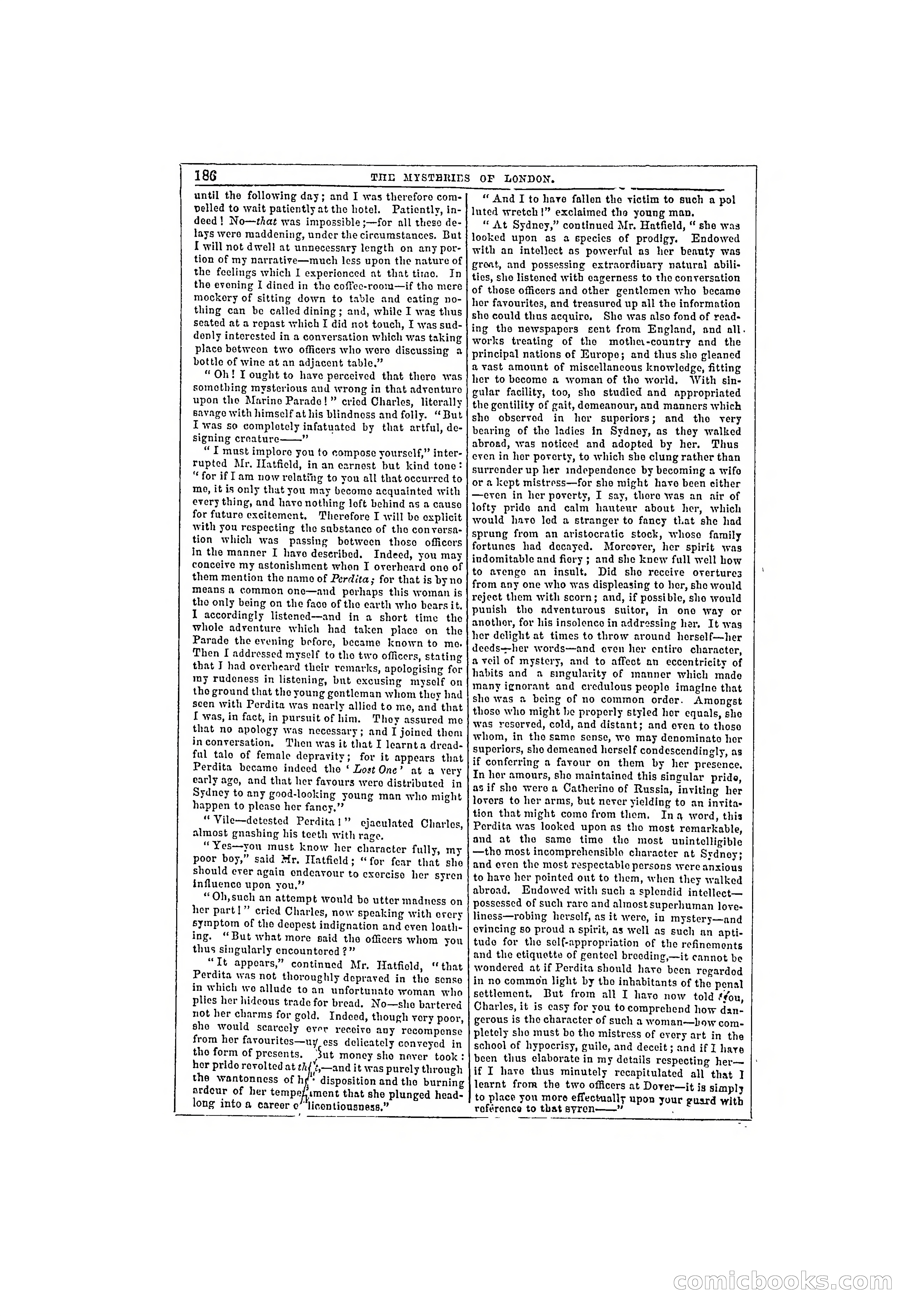
A restored page from Penny Dreadfuls, 1846. Page through the whole issue in the reader above.
📄 Transcribed text from this page (OCR, searchable)
Machine-transcribed from the original scan — historical spelling and the odd misread are preserved.
186 TMC MYSTBRIES OF LONDON. yer ggnecere, until the following day; and I was therefore com- velled to wait patiently at the hotel. Patiently, in- deed! No—that was impossible;—for all these de- lays were maddening, under the circumstances. But [ will not dwell at unnecessary length on any por- tion of my narrative—much less upon the nature of the feelings which I experionced at that tirao. In the evening I dined in the coffec-room—if tho mere mockery of sitting down to table and eating no- thing can be called dining; and, while I was thus seated at a repast which I did not touch, I was sud- donly interested in a conversation which was taking place between two officers who wero discussing a bottle of wine at an adjacent table.” “Oh! T ought to have perceived that thero was something mystcrious and wrong in that adventure upon the Marine Parade!” cried Charles, literally Bavage with himself at his blindnoss and folly. “But Iwas so completely infatuated by that artful, de- signing creature a “I must implore you to compose yoursclf,” inter- rupted Mr. Iatfield, in an cernest but kind tone: “for if am now relating to you all that occurred to me, itis only that you may become acquainted with every thing, and have nothing loft behind as a causo for future excitement, Therefore I will be explicit with you respecting the snbstance of the conversa- tion which was passing between thoso officors in the manner I have deseribed. Indeed, you may conceive my astonishment when I overheard ono of them mention the name of Perdita; for that is by no means & Common one—and perhaps this woman is tho only being on the face of the earth who bears it. I accordingly listened-—-and in a short time the whole adventure which had taken place on the Parade the evening before, became known to mo. Then I addressed myself to tho two officers, stating that J had overheard their remarks, apologising for my rudeness in listening, but excusing myself on the ground that the young gontleman whom they had scen with Perdita was nearly allied to mo, and that [ was, in fact, in pursuit of him. They assured me that no apology was necessary; and I joined thom inconversation, Then was it that I learnta dread- ful talo of female depravity; for it appears that Perdita became indeed the ‘ Lost One’ at a very early age, and that her favours wero distributed in Sydney to any good-looking young man who might happen to please her fancy,” ‘Vile—detested Perdita!” ejaculated Charles, almost gnashing his teeth with rage. ‘‘Yes—you must know her character fully, my poor boy,” said Mr, Hatfield; “for fear that she should ever again ondeavour to exerciso her syren influence upon you,” “Oh,such an attempt would bo utter madness on her part!” cried Charles, now speaking with orery symptom of the deopest indignation and even loath- ing. “But what more said the officers whom you thus singularly encountored 2?” “Tt appears,” continued Mr. Hatfield, ‘that Perdita was not thoroughly depraved in the sense in which we allude to an unfortunate woman who plies her hideous trade for bread. No—she bartered not her charms for gold. Indeed, though vory poor, she would scarcely ever receive any recompense from her favourites—uy ess delicately conveyed in the form of presents. ‘3ut money she never took: hor pride revolted at th and it was purcly through the wantonness of h¢* disposition and the burning ardeur of her tempefiment that she plunged head- long into a career o”'licontiousness.” = we * And I to have fallen the victim to such a pol Inted wretch!” exclaimed the young man. * At Sydney,” continued Mr. Hatfield, “ she was looked upon as a specics of prodigy. Endowed with an intellect as powerful as her beauty was groat, and possessing extraordivary natural abili- ties, she listened with eagerness to the conversation of those officers and other gentlemen who became hor favourites, and treasured up all the information she could thus acquire, She was also fond of read- ing the newspapers sent from England, and all. works treating of the mothe.-country and the principal nations of Europe; and thus she gleaned avast amount of miscellaneous knowledge, fitting her to become a woman of the world. With sin- gular facility, too, sho studied and appropriated the gentility of gait, demeanour, and manners which she observed in hor superiors; and the very bearing of the ladies in Sydney, as they walked abroad, was noticed and adopted by her. Thus even in her poverty, to which she clung rather than surrender up her independence by becoming a wifo or a kept mistress—for she might have been cither —eren in her poverty, I say, thore was an air of lofty pride and calm hauteur about her, which would havo led a stranger to fancy that she had sprung from an aristocratic stock, whose family fortunes had decayed. Moreover, her spirit was indomitable and fiory ; and she knew full well how to avengo an insult. Did she receive overtures | ' from any one who was displeasing to her, she would reject them with scorn; and, if possible, she would punish tho adventurous suitor, in one way or another, for his insolence in addressing har. It was her delight at times to throw around horself—her deeds—-her words—and cyven hey entire character, a veil of mystery, and to affect an eccentricity of habits and a singularity of manner which made many ignorant and credulous people imagine that sho was 2 being of no common order. Amongst those who might he properly styled hor equals, she was reserved, cold, and distant; and even to thoso whom, in the samo sense, wo may denominato her superiors, sho demeaned herself condescendingly, as if conferring a favour on them by her presence. In hor amours, sho maintained this singular pride, as if sho were a Catherine of Russia, inviting her lovers to her arms, but never yielding to an invitae tion that might como from them, Ina word, this Perdita was looked upon as tho most remarkable, and at the same time the most unintelligible —tho most incomprehensible character nt Srdney; and oven the most respectable persons were anxious to have her pointed ont to them, when they walked abroad. Endowed with such a splendid intellect— possessed of such rare and almost superhuman love- liness—robing herself, as it were, in mystery—and evincing so proud a spirit, as well as such an apti- tude for the self-appropriation of the refinements and the etiquette of genteel brecding,—it cannot be wondered at if Perdita should havo been regardod in no common light by the inhabitants of the penal settlement. But from all I havo now told fou, Charles, it is casy for you tocomprehend how dan- gerous is the character of such a woman—bow com- pletely sho must bo tho mistress of every art in the school of hypocrisy, guile, and deceit; and if I have been thus elaborate in my details respecting her— | ' if I have thus minutely recapitulated all that I learnt from the two officers at Dover—it is simply to place you moro effectually upon your guard with reference to that syren——” EConnicloooks (CO)