
Penny Dreadfuls, 1846 · page 179 of 399
The Mysteries of London, Vol. IV — page 179: what you’re looking at
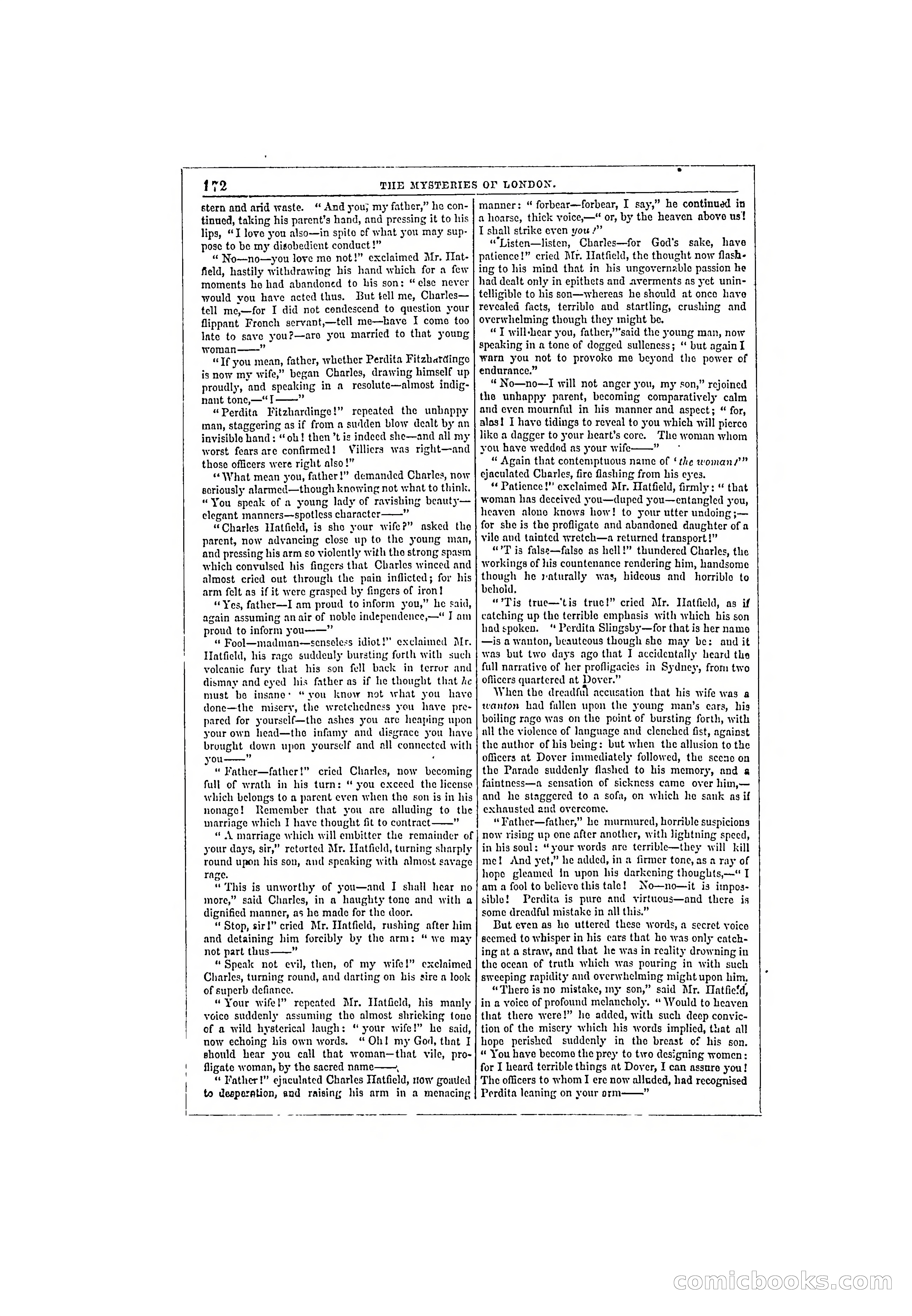
A restored page from Penny Dreadfuls, 1846. Page through the whole issue in the reader above.
📄 Transcribed text from this page (OCR, searchable)
Machine-transcribed from the original scan — historical spelling and the odd misread are preserved.
a 172 MIE MYSTERIES OF LONDON. stern and arid waste. ‘ And you, my father,” he con- tinued, taking his parent’s hand, and pressing it to his lips, “I love you also—in spite of what you may sup- pose to be my disobedient conduct !” “ No—no—you love me not!” exclaimed Mr. Hat- field, hastily withdrawing his hand which for a few moments he had abandoned to his son: “else never would vou have acted thus. But tell me, Charles— tell me,—for I did not cendescend to question your flippant French servapt,—tell me—kave I come too Inte to save you?—are you married to that young woman——”’ “Tf you mean, father, whether Perdita Fitzhardinge is now my wife,” began Charles, drawing himself up proudly, and speaking in a resolute—almost indig- nant tone,—“ I ——~” “Perdita Fitzhardinge!” repeated the unhappy man, staggering as if from a sudden blow dealt by an invisible hand: “ob! then ’t is indeed she—and all my worst fears are confirmed! Villiers was right—and those officers were right also!” “What mean you, father!” demanded Charles, now soriously alarmed—though knowing not what to think. “You speak of a young lady of ravishing beauty— elegant manners—spotless character——” ‘Charles Hatfield, is sho your wife?” asked the parent, now advancing close up to the young man, and pressing his arm so violently with the strong spasm which conyulsed his fingers that Charles winced and almost cried out through the pain inflicted; for his arm felt as if it were grasped by fingers of iron! “Yes, father—I am proud to inform you,” he said, again assuming anair of noble independence,—* J am proud to inform you—-—”’ “ Fool—madman—senseless idiot? exclaimed Mfr. Hatfield, his rage suddenly bursting forth with such volcanic fury that his son fell back in terror and dismay and eyed his father as if he thought that he must be insane: “ you know not what you have done—the misery, the wretchedness you have pre- pared for yourself—the ashes you are heaping upon your own head—the infamy and disgrace you have brought down upon yoursclf and all connected with you-—” é “ Father—father!” cried Charles, now becoming full of wrath in his turn: “ you exceed the license which belongs to a parent even when the son is in his nonage! Remember that you are alluding to the marriage which I have thought fit to contract——” “A marriage which will embitter the remainder of your days, sir,” retorted Mr. Hatfield, turning sharply round upon his son, and speaking with almost savage rage. “ This is unworthy of you—and I shall hear no more,” said Charles, in a haughty tone and with a dignified manner, as he made for the door. “ Stop, sir!” cried Mr. Hatfield, rushing after him and detaining him forcibly by the arm: “ we may not part thus——” “Speak not evi), then, of my wife!” exclaimed Charles, turning round, and darting on his sire a look of superb defiance. “Your wifel” repeated Mr. Watfield, his manly voice suddenly assuming tho almost shricking tone of a wild hysterical Jaugh: “ your wife!” he said, now echoing his own words. “ Oh! my God, that I should hear you call that woman—that vile, pro- fligate woman, by the sacred name——, “ Father!” ejaculated Charles Hatfield, stow gouued to deeporation, and raising; his arm in a menacing - rte ee ee manner: “ forbear—forbear, I say,” he continued in a hoarse, thick voice,—‘ or, by the heaven above us! I shall strike even you 2” “"Listen—listen, Charles—for God's sake, have patience!” cried Mr. Iatficld, the thought now flash- ing to his mind that in his ungovernable passion he had dealt only in epithets and averments as yet unin- telligible to his son—wwhereas he should at once have revealed facts, terrible and startling, crushing and overwhelming though they might be. “T will-hear you, father,’’said the young man, now speaking in a tone of dogged sulleness; “ but again I warn you not to provoke me beyond the power of endurance.” “ No—no—I will not anger you, my son,” rejoined the unhappy parent, becoming comparatively calm and even mournfil in his manner and aspect; “ for, alos! I have tidings to reveal to you which will pierce like a dagger to your heart’s core. The woman whom you have weddod as your wife——” - “ Again that contemptuous name of ‘the womans” ejaculated Charles, fire flashing from his eyes. “Patience!” exclaimed Mr. Hatfield, firmly: “ that woman has deceived you—duped you—entangled you, heaven alono knows how! to your utter undoing ;— for she is the profligate and abandoned daughter of a vile and tainted wretch—a returned transport!” “PT is false—falso as hell!” thundered Charles, the workings of his countenance rendering him, handsome though he »aturally was, hideous and horrible to behold. “Tis true—'tis true!” cried Mr. Tlatficld, as if catching up the terrible emphasis with which his son had spoken. ‘“ Perdita Slingsby—for that is her name —is a wanton, beauteous though she may be: and it was but two days ago that I accidentally heard the full narrative of her profligacies in Sydney, from two oflicers quartered at Dover.” When the dreadful accusation that his wife was a wanton had fallen upon the young man’s ears, his boiling rage was on the point of bursting forth, with all the violence of Janguage and clenched fist, against the author of his being: but when the allusion to the officers at Dover immediately followed, the sceno on the Parade suddenly flashed to his memory, and a faintness—na sensation of sickness came over him,— and he staggered to a sofa, on which he sank as if exhausted and overcome. “Father—father,” he murmured, hornble suspicions now rising up one after another, with lightning speed, in his soul: “your words are terrible—they will kill me! And yet,” he added, in a firmer tone, as a ray of hope gleamed {n upon his darkening thoughts,“ I am a fool to believe this tale! No—no—it is impos- siblo! Perdita is pure and virtuous—and there is some dreadful mistake in all this.” But even as ho uttered these words, a secret voice secmed to whisper in his ears that ho was only catch- ing at a straw, and that he was in reality drowning in the ocean of truth which was pouring in with such sweeping rapidity and overwhelming might upon him. “There is no mistake, my son,” said Mr. Hatfie'd, in a voice of profound melancholy. “ Would to heaven that there were!” he added, with such deep convic- tion of the misery which his words implied, that all hope perished suddenly in the breast of his son. “ You have become the prey to two designing women: for I heard terrible things at Dover, I can assure you! The officers to whom I ere now alluded, had recognised Perdita leaning on your orm—” me a re EConnicloooks (SO)