
Penny Dreadfuls, 1846 · page 175 of 399
The Mysteries of London, Vol. IV — page 175: what you’re looking at
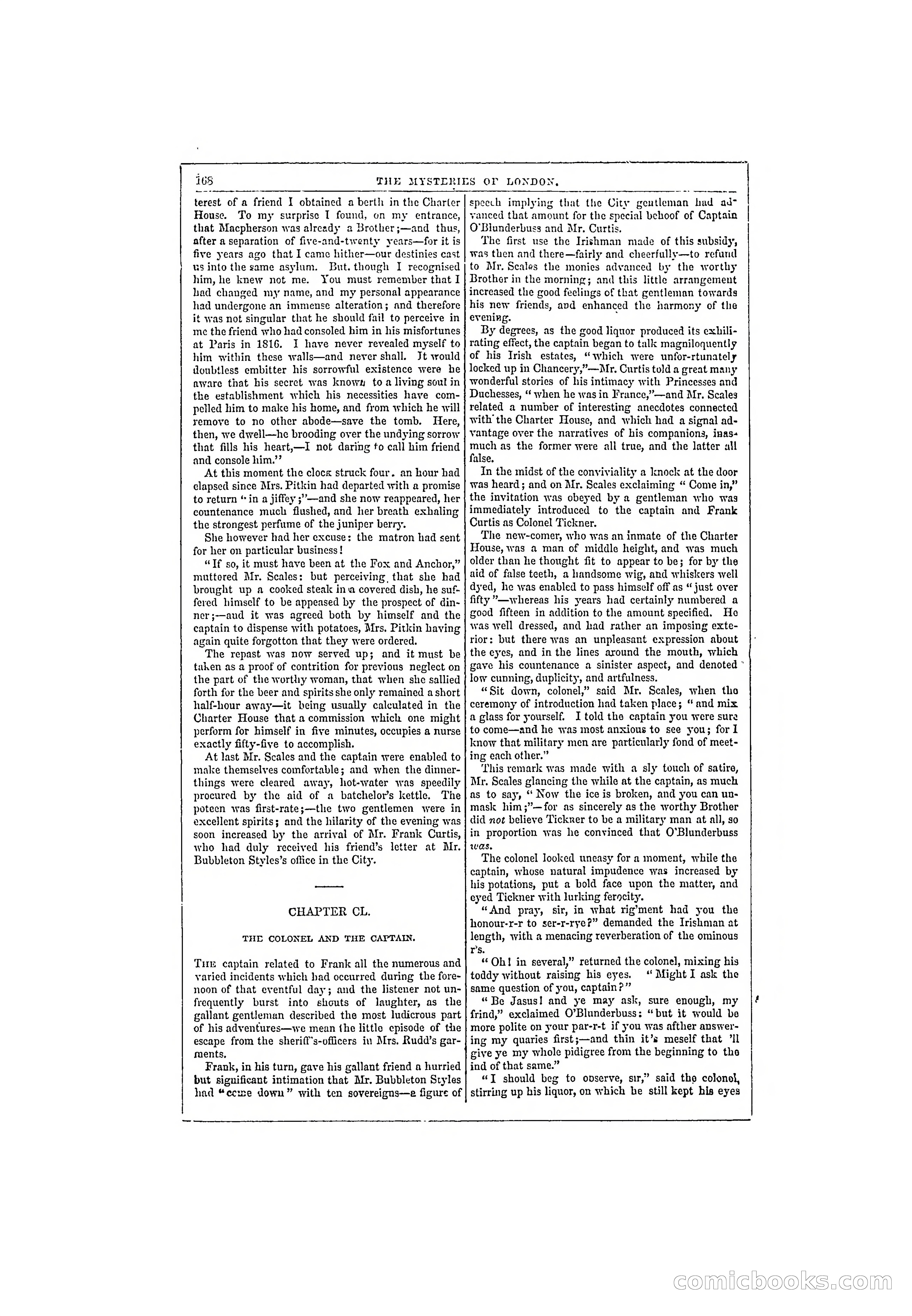
A restored page from Penny Dreadfuls, 1846. Page through the whole issue in the reader above.
📄 Transcribed text from this page (OCR, searchable)
Machine-transcribed from the original scan — historical spelling and the odd misread are preserved.
168 THE MYSTERIES OF LONDON, ew ee ee terest of a friend I obtained a berth in the Charter House. To my surprise I found, on my entrance, that Macpherson was already a Brother;—and thus, after a separation of five-and-twenty years—for it is five years ago that I came hither—our destinies cast us into the same asylum. But. though I recognised him, he knew not me. You must remember that I had changed my name, and my personal appearance had undergone an immense alteration; and therefore it was not singular that he should fail to perceive in me the friend who had consoled him in his misfortunes at Paris in 1816. I have never revealed myself to him within these walls—and never shall. Jt would doubtless embitter his sorrowful existence were he nware that his seerct was known to a living soul in the establishment which his necessities have com- pelled him to make his home, and from which he will remove to no other abode—save the tomb. Here, then, we dwell—he brooding over the undying sorrow that fills his heart,—I not daring to call him friend and console him.’’ At this moment the clocg struck four. an hour had elapsed since Mrs. Pitkin had departed with a promise to return “ in a jiffey ;’—-and she now reappeared, her countenance much flushed, and her breath exhaling the strongest perfume of the juniper berry. She however had her excuse: the matron had sent for her on particular business! “Tf so, it must have been at the Fox and Anchor,” muttered Mr. Scales: but perceiving that she had brought up a cooked steak ina covered dish, he suf- fered himself to be appeased by the prospect of din- ner;—aud it was agreed both by himself and the captain to dispense with potatoes, Mrs. Pitkin having again quite forgotton that they were ordered. The repast was now served up; and it must be taken as a proof of contrition for previous neglect on the part of the wortly woman, that when she sallied forth for the beer and spirits she only remained a short half-hour away—it being usually calculated in the Charter House that a commission which one might perform for himself in five minutes, occupies a nurse exactly fifty-five to accomplish. At last Mr. Scales and the captain were enabled to make themselves comfortable; and when the dinner- things were cleared away, hot-water was speedily procured by the aid of a batchelor’s kettle. The poteen was first-rate;—the two gentlemen were in excellent spirits; and the hilarity of the evening was soon increased by the arrival of Mr. Frank Curtis, who had duly received his friend’s letter at Mr. Bubbleton Styles’s office in the City. Cr rd CHAPTER CL. THE COLONEL AND THE CAPTAIN. Tu captain related to Frank all the numerous and varied incidents which had occurred during the fore- noon of that eventful day; and the listener not un- frequently burst into shouts of laughter, as the gallant gentleman described the most ludicrous part of his adventures—we mean the little episode of the escape from the sheriff’s-officers in Mrs. Rudd’s gar- ments, Frank, in his turn, gave his gallant friend a hurried but significant intimation that Mr. Bubbleton Styles had “ecwse down” with ten sovereigns—e figure of =D speech implying that the Citw gentleman had ad- vanced that amount for the special behoof of Captain O'Biunderbuss and Mr. Curtis. The first use the Irishman made of this subsidy, was then and there—fairly and cheerfully—to refund to Mr. Scales the monies advanced by the worthy Brother in the morning; and this little arrangement increased the good feelings of that gentleman towards his new friends, avd enhanced the harmony of the evening. By degrees, as the good liquor produced its exhili- rating effect, the captain began to talk magniloquently of his Irish estates, “which were unfor-rtunately locked up in Chancery,”—Mr. Curtis told a great many wonderful stories of his intimacy with Princesses and Duchesses, “‘ when he was in France,”—and Mr. Scales related a number of interesting anecdotes connected with the Charter House, and which had a signal ad- vantage over the narratives of his companions, inas-« much as the former were all true, and the latter all false. In the midst of the conviviality a knock at the door was heard; and on Mr. Scales exclaiming “ Come in,” the invitation was obeyed by a gentleman who was immediately introduced to the captain and Frank Curtis as Colonel Tickner. The new-comer, who was an inmate of the Charter House, was a man of middle height, and was much older than he thought fit to appear to be; for by the aid of false teeth, a handsome wig, and whiskers well dyed, he was enabled to pass himself off as “just over fifty ’”’—whereas his years had certainly numbered a good fifteen in addition to the amount specified. He was well dressed, and had rather an imposing exte- rior: but there was an unpleasant expression about the eyes, and in the lines around the mouth, which gave his countenance a sinister aspect, and denoted ° low cunning, duplicity, and artfulness. “Sit down, colonel,” said Mr. Scales, when tlio ceremony of introduction had taken place; “and mix a glass for yourself. I told the captain you were sure to come—and he was most anxious to see you; for 1 know that military men are particularly fond of meet- ing each other.” This remark was made with a sly touch of satire, Mr. Scales glancing the while at the captain, as much as to say, ‘ Now the ice is broken, and you can un- mask him;”—for as sincerely as the worthy Brother did not believe Tickrer to be a military man at all, so in proportion was he convinced that O*Blunderbuss was. The colonel looked uneasy for a moment, while the captain, whose natural impudence was increased by his potations, put a bold face upon the matter, and eyed Tickner with lurking ferocity. “And pray, sir, in what rig’ment had you the honour-r-r to ser-r-rye?” demanded the Irishman at length, with a menacing reverberation of the ominous r’s. ‘Oh! in several,” returned the colonel, mixing his toddy without raising his eyes. ‘“ Might I ask the same question of you, captain?” “Be Jasus! and ye may ask, sure enough, my j|é frind,” exclaimed O’Blunderbuss: “but it would be more polite on your par-r-t if you was afther answer- ing my quaries first;—and thin it’s meself that Il give ye my whole pidigree from the beginning to the ind of that same.” “J should beg to ooserve, sir,” said the cojonol, stirring up bis liquor, on which he still kept his eyes EConnicloooks (SO)