
Penny Dreadfuls, 1846 · page 171 of 399
The Mysteries of London, Vol. IV — page 171: what you’re looking at
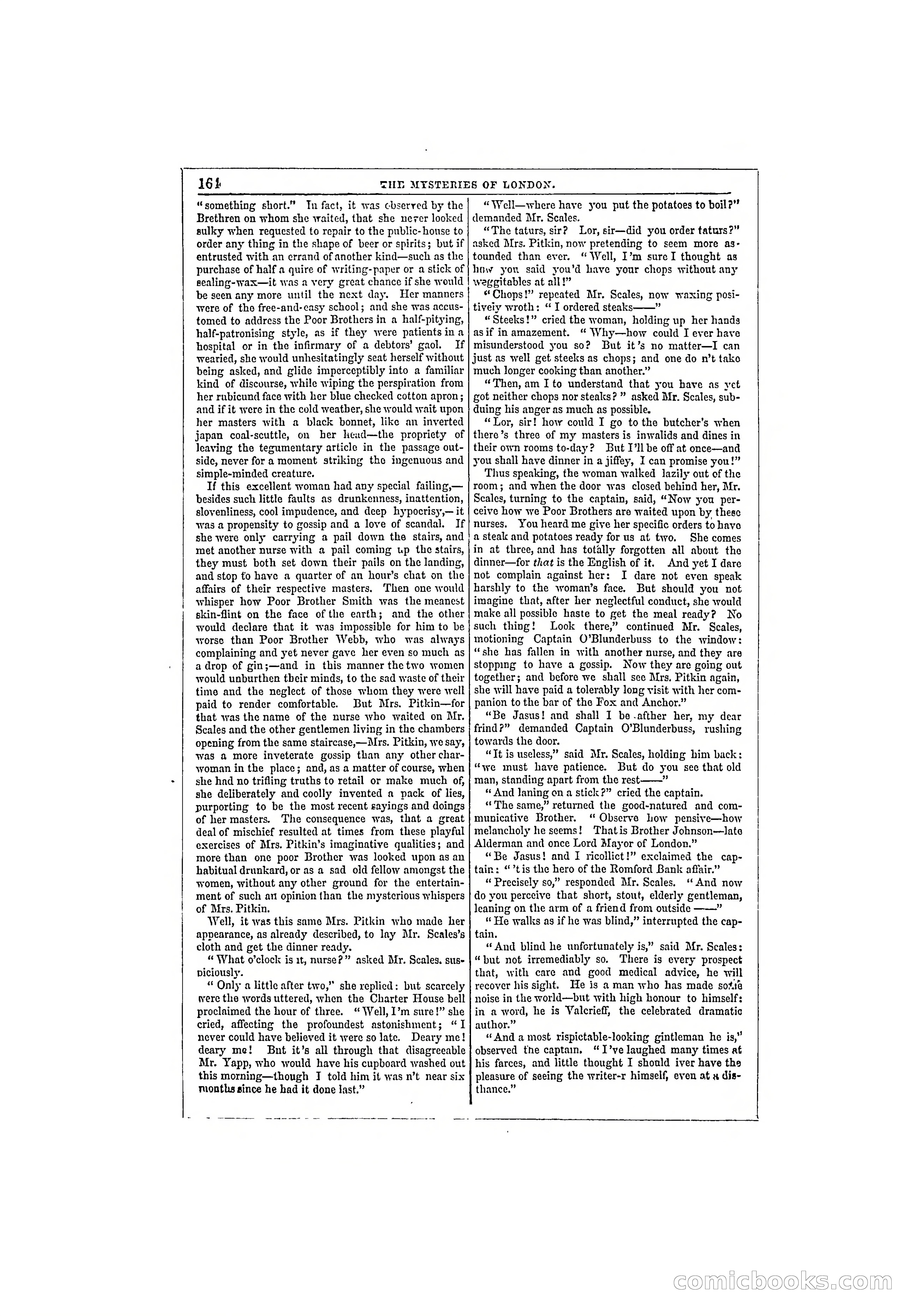
A restored page from Penny Dreadfuls, 1846. Page through the whole issue in the reader above.
📄 Transcribed text from this page (OCR, searchable)
Machine-transcribed from the original scan — historical spelling and the odd misread are preserved.
tena A EE I I ay a a i PO 16: THD MYSTERIES OF LONDON. “something short.” Yn fact, if was cbserved by the Brethren on whom she waited, that she never looked sulky when requested to repair to the public- house to order any thing in the shape of beer or spirits; but if entrusted with an crrand of another kind—sucbh as the purchase of half a quire of writing-paper or a stick of sealing-wax—it was a very great chance if she would be seen any more until the next day. Her manners were of the free-and-easy school; and she was accus- tomed to address the Poor Brothers in a half-pitying, half-patronising style, as if they were patients ina hospital or in the infirmary of a debtors’ gaol. If wearied, she would unhesitatingly seat herself without being asked, and glide imperceptibly into a familiar kind of discourse, while wiping the perspiration from her rubicund face with her blue checked cotton apron; and if it were in the cold weather, she would wait upon her masters with a black bonnet, like an inverted japan coal-scuttle, on her khead—the propriety of leaving the tegumentary article in the passage out- side, never fora moment striking the ingenuous and simple-minded creature. If this excellent woman had any special failing,— besides such little faults as drunkenness, inattention, slovenliness, cool impudence, and deep hypocrisy,— it was a propensity to gossip and a love of scandal. If she were only carrying a pail down the stairs, and met another nurse with a pail coming up the stairs, they must both set down their pails on the landing, and stop to have a quarter of an hour’s chat on the affairs of their respective masters. Then one would whisper how Poor Brother Smith was the meanest skin-flint on the face of the earth; and the other would declare that it was impossible for him to be worse than Poor Brother Webb, who was always complaining and yet never gave her even so much as a drop of gins;—and in this manner the two women would unburthen their minds, to the sad waste of their time and the neglect of those whom they were well paid to render comfortable. But Mrs. Pitkin—for that was the name of the nurse who waited on Mr. Scales and the other gentlemen living in the chambers opening from the same staircase,—Mrs. Pitkin, we say, was a more inveterate gossip than any other char- woman in the place; and, as a matter of course, when she had no trifling truths to retail or make much of, she deliberately and coolly invented a pack of lies, purporting to be the most recent sayings and doings of her masters. The consequence was, that a great deal of mischief resulted at times from these playful exercises of Mrs. Pitkin’s imaginative qualities; and more than one poor Brother was looked upon as an habitual drunkard, or as a sad old fellow amongst the women, without any other ground for the entertain- ment of such an opinion than the mysterious whispers of Mrs. Pitkin. Well, it was this same Mrs. Pitkin who made her appearance, as already described, to lay Mr. Scales’s cloth and get the dinner ready. “ What o’clock is 1t, nurse?” asked Mr. Scales. sus- piciously. “ Only a little after two,” she replicd: but scarcely were the words uttered, when the Charter House bell proclaimed the hour of three. ‘ Well, 1’m sure!” she cried, affecting the profoundest astonishment; “I never could have believed it were so late. Deary me! deary me! Bunt it’s all through that disagreeable Mr. Yapp, who would have his cupboard washed out this morning—though I told him it was n’t near six months since he had it done last.” ~ ——— ee a ee ee “Well—where have you put the potatoes to boil?” demanded Mr. Scales. “The taturs, sir? Lor, sir—did you order taturs?” asked Mrs. Pitkin, now pretending to seem more as- tounded than ever. “ Well, I’m sureI thought as how you said you'd have your chops without any wergitables at all!” “Chops!” repeated Mr. Scales, now waxing posi- tivety wroth: “ I ordered steaks——” “Steeks!” cried the woman, holding up her hands asif in amazement. “ Why—how could I ever have misunderstood you so? But it’s no matter—I can just as well get steeks as chops; and one do n’t tako much longer cooking than another.” “Then, am Ito understand that you have as yet got neither chops nor steaks? ” asked Mr. Scales, sub- duing his anger as much as possible. “Lor, sir! how could I go tothe butcher’s when there’s three of my masters is inwalids and dines in their own rooms to-day? But I'll be off at once—and you shall have dinner in a jiffey, I can promise you!” Thus speaking, the woman walked lazily out of the room; and when the door was closed behind her, Mr. Scales, turning to the captain, said, “Now you per- ceive how we Poor Brothers are waited upon by these nurses. You heard me give her specific orders to havo a steak and potatoes ready for us at two. She comes in at three, and has totally forgotten all about the dinner—for that is the English of it. And yet I dare not complain against her: I dare not even speak harshly to the woman’s face. But should you not imagine that, after her neglectful conduct, she would make all possible haste to get the meal ready? No such thing! Look there,” continued Mr. Scales, motioning Captain O’Blunderbuss to the window: “she has fallen in with another nurse, and they are stopping to have a gossip. Now they are going out together; and before we shall see Mrs, Pitkin again, she will have paid a tolerably long visit with her com- panion to the bar of the Fox and Anchor.” “Be Jasus! and shall 1 be-afther her, my dear frind?” demanded Captain O’Blunderbuss, rushing towards the door. “Tt is useless,” said Mr. Scales, holding him back: ‘we must have patience. But do you see that old man, standing apart from the rest-——” “ And laning on a stick?” cried the captain. “The same,” returned the good-natured and com- municative Brother. ‘‘ Observe how pensive—how melancholy he seems! Thatis Brother Johnson—late Alderman and once Lord Mayor of London.” “Be Jasus! and I ricollict!” exclaimed the cap- tain: “’tis the hero of the Romford Bank affair.” “Precisely so,” responded Mr. Scales. ‘And now do you perceive that short, stout, elderly gentleman, leaning on the arm of a friend from outside ——” ‘ He walks as if he was blind,” interrupted the cap- tain. ‘And blind he unfcrtunately is,” said Mr. Scales: “but not irremediably so. There is every prospect that, with care and good medical advice, he will recover his sight. He is a man who has made sow1@ noise in the world—but with high honour to himself: in a word, he is Valcrieff, the celebrated dramatic author.” ‘And a most rispictable-looking gintleman he is,” observed the captain. “I’ve laughed many times af his farces, and little thought I should iver have the pleasure of seeing the writer-r himself, even at « dis- thance.” _ te IRAE TH (SO) 5} a yg NR GIOOKS (SO) >