
Penny Dreadfuls, 1846 · page 155 of 399
The Mysteries of London, Vol. IV — page 155: what you’re looking at
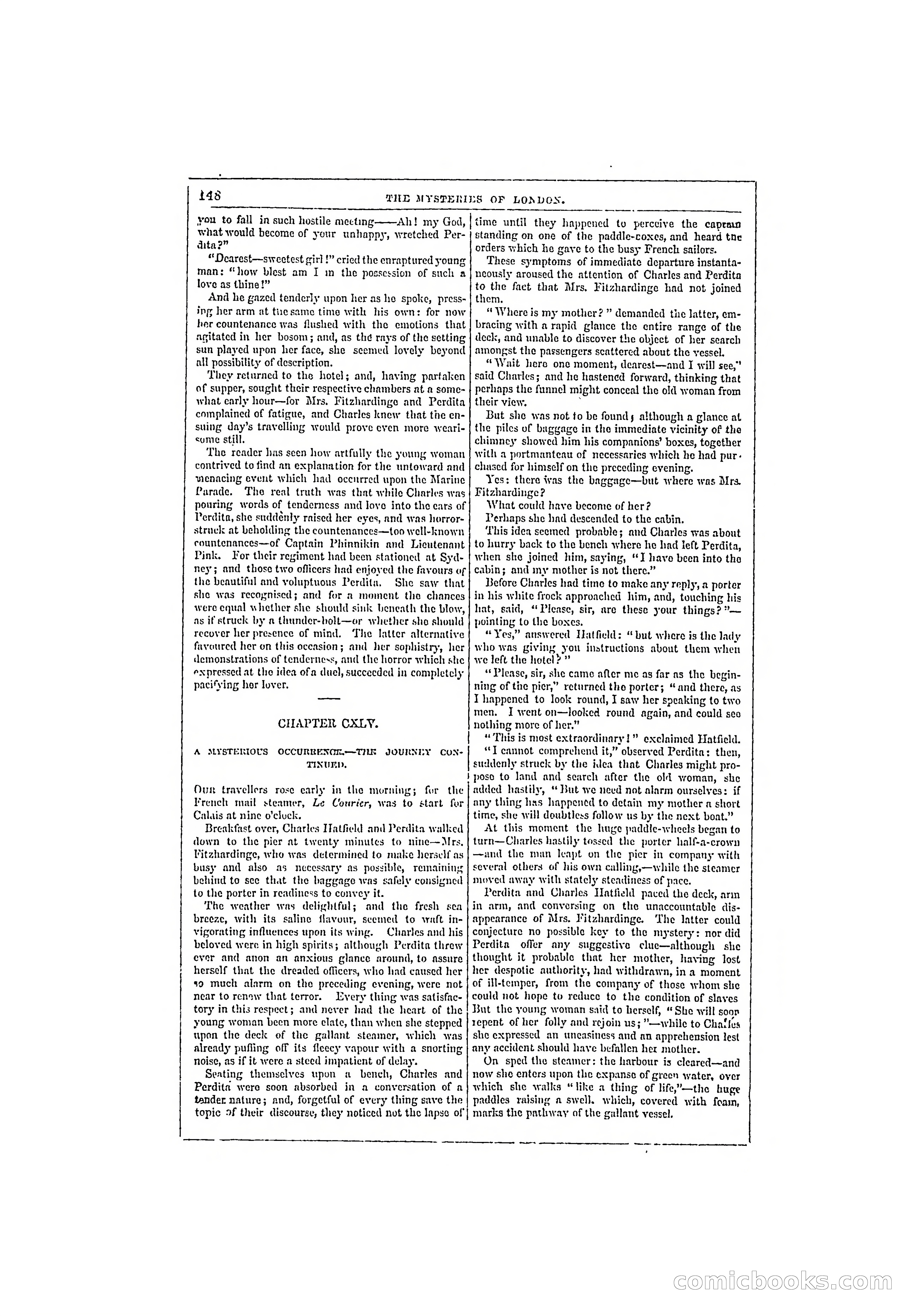
A restored page from Penny Dreadfuls, 1846. Page through the whole issue in the reader above.
📄 Transcribed text from this page (OCR, searchable)
Machine-transcribed from the original scan — historical spelling and the odd misread are preserved.
£438 you to fall in such hostile meeting——Ah! my God, what would become of your unhappy, wretched Per- dita 2” “Dearest—sweetest girl!” cried the enraptured young man: “how blest am I in the possession of such a love as thine!” And he gazed tenderly upon her as he spoke, press- ing her arm at ticsame time with his own: for now her countenance was flushed with the emotions that agitated in her bosom; and, as the rays of the setting sun played upon her face, she seemed lovely beyond all possibility of description. They returned to the hotel; and, having partaken of supper, sought their respective chambers at a some- what early hour—for Mrs. Fitzhardinge and Perdita complained of fatigue, and Charles knew that the en- suing day’s travelling would prove cyen more weari- sunie still. The reader has seen how artfully the youny woman contrived to find an explanation for the untoward and wenacing event which had ocenrred upon the Marine Parade. The real truth was that while Charles was pouring words of tenderness and Jove into the cars of Perdita, she suddenly raised her eyes, and was horror- struck at beholding the countenances—too well-known countenances—of Captain Phinnikin and Lieutenant Pink. Lor their regiment had been stationed at Syd- ney; and those two officers had enjoyed the favours of the beautiful and voluptuous Perdita. She saw that she was recognised; and for 2 moment the chances were equal whether she should sink beneath the blow, as if struck by a thunder-bolt—or whether sho should recover her presence of mind. The latter alternative favoured her on this oceasion; and her sophistry, her demonstrations of tenderness, and the horror which: she expressed at the idea ofa duel, succecded in completely pacifying her Jover. CHAPTER CALY. A MYSTERIOUS OCCURRENOE.—TILE JOURNEY COoN- TINUED. Our travellers rose early in the morning; for the French mail steamer, Ze Courter, was to start fer Calais at nine o’cluck. Breakfast over, Charles Tfatfeld and Perdita walked down to the pier at twenty minutes to nine—~Mrs, Vitzhardinge, who was determined to make herself as busy and also as necessary as posible, remaining behind to see that the baggage was safely consigned to the porter in readiness to convey it. The weather was delightful; and the fresh sea breeze, with its saline flavour, seemed to waft in- Vigorating influences upon its wing. Charles and his beloved were in high spirits; although Perdita threw ever and anon an anxious glance around, to assure herself that the dreaded officers, who had caused her so much alarm on the preceding evening, were not near to renew that terror. very thing was satisfac- tory in this respect; and never had the heart of the young woman been more elate, than when she stepped upon the deck of the gallant steamer, which was already puffing off its fleecy vapour with a snorting noise, as if it were a steed impatient of delay. Seating themselyes upon a bench, Charles and Perdita were soon absorbed in a conversation of a tender nature; and, forgetful of every thing save the THE MYSTERIES OF LONDON. ae time until they happened to perceive the capran standing on one of the paddle-coxes, and heard tne orders which he gave to the busy French sailors. These symptoms of immediate departure instanta- neously aroused the attention of Charles and Perdita to the fact that Mrs, Fitzhardinge had not joined them. “Where is my mother? ” demanded the latter, em- bracing with a rapid glance the entire range of the deck, and unable to discover the object of her search amongst the passengers scattercd about the vessel. “Wait here one moment, dearest—and I will see,” said Charles; and he hastencd forward, thinking that perhaps the funnel might conceal the old woman from their view. But she was not to be founds althongh a glance at the piles of baggage in the immediate vicinity of the chimney showed him his companions’ boxes, together with a portmanteau of necessaries which he had pur- chased for himself on the preceding evening. Yes: there ivas the baggage—but where was Mrs. Fitzhardinge ? What could have become of her? Perhaps she had descended to the cabin. This idea seemed probable; and Charles was about to hurry back to the bench where he had left Perdita, when she joined him, saying, ‘J have been into the cabin; and my mother is not there.” Before Charles had time to make any reply, a porter in his white frock approached him, and, touching his hat, said, “Picase, sir, are these your things? °— pointing to the boxes. “Yes,” answered Uatfield: “but where is the lady who was giving you instructions about them when we left the hotel?” ‘Please, sir, she came after me as far as the begin- ning of the pier,” returned the porter; “and there, as T happened to look round, I saw her speaking to two men. I went on—looked round again, and could seo nothing more of her,” “This is most extraordinary!” exclaimed Hatfield. “Y cannot comprehend it,” observed Perdita: then, suddenly struck by the idea that Charles might pro- ee ees }pose to land and search after the old woman, she added hastily, “But we need not alarm ourselves: if any thing has happened to detain my mother a short time, she will doubtless follow us by the next boat.” At this moment the huge paddle-wheels began to turn—Charles hastily tossed the porter half-a-crown —and the man Icapt on the pier in company with several others of his own calling,—while the steamer moved away with stately steadiness of pace. Perdita and Charles Hatfield paced the deck, arm in arm, and conversing on the unaccountable dis- appearance of Mrs. Vitzhardinge. The latter could conjecture no possible key to the mystery: nor did Perdita offer any suggestive clue—although she thought it probable that her mother, having lost her despotic authority, had withdrawn, in a moment of ill-temper, from the company of those whom she could not hope to reduce to the condition of slaves But the young woman said to herself, “She will soon repent of her folly and rejoin us; "—wwhile to Chafles she expressed an uneasiness and an apprehension lest any accident should have befallen her mother. On sped the steamer: the harbour is cleared—~and now she enters upon the expanse of green water, over which she walks “like a thing of life,"—the huge paddles raising a swell. which, covered with foam, topic of their discourse, they noticed not the lapse of] marks the pathway of the gallant vessel. GIOOKS (SO) (SO)