
Penny Dreadfuls, 1846 · page 151 of 399
The Mysteries of London, Vol. IV — page 151: what you’re looking at
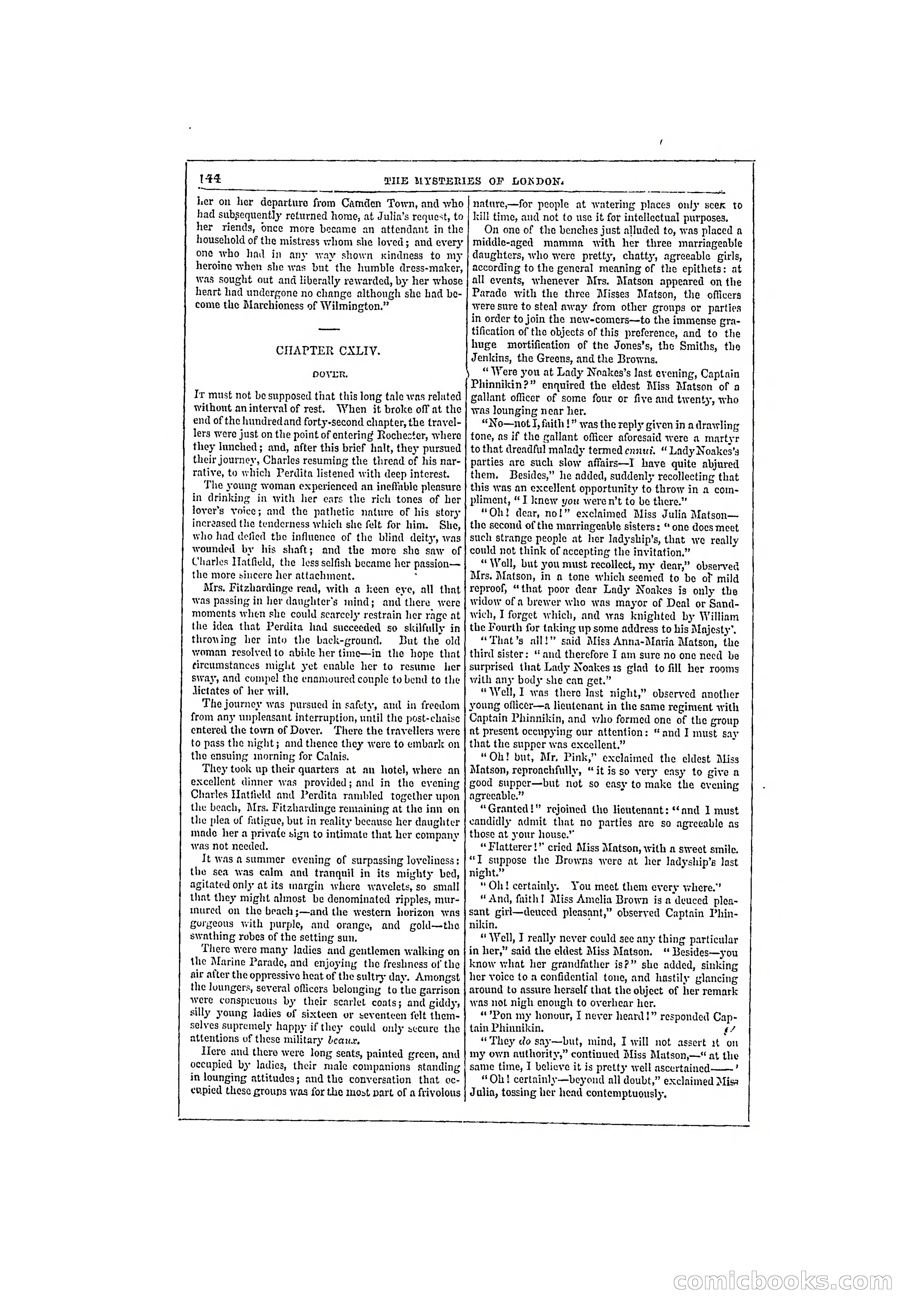
A restored page from Penny Dreadfuls, 1846. Page through the whole issue in the reader above.
📄 Transcribed text from this page (OCR, searchable)
Machine-transcribed from the original scan — historical spelling and the odd misread are preserved.
144 THE BMYSTERIES OF LONDON. el = . her on her departure from Camden Town, and who | nature,—for people at watering places only seek to had subsequently returned home, at Julia’s request, to her riends, once more became an attendant in the household of the mistress whom she loved; and every one who had in any way shown xindness to my heroine when she was but the humble dress-maker, was sought out and liberally rewarded, by her whose heart had undergone no change although she had be- come the Marchioness of Wilmington.” CHAPTER CXLIV. DOVER. Ir must not be supposed that this long tale was related withont an interval of rest. When it broke off at the end of the hundredand forty-second chapter, the travel- lers were just on the point of entering Rochester, where they Innched; and, after this brief halt, they pursued their journey, Charles resuming the thread of his nar- rative, to which Perdita listened with deep interest. The young woman experienced an ineffable pleasure in drinking in with her ears the rich tones of ber lover’s voice; and the pathetic nature of his story increased the tenderness which she felt for him. She, who had defied the influence of the blind deity, was wounded by his shaft; and the more she saw of Charles Hatfield, the less selfish became her passion— the more sincere her attachment. ; Mrs. Fitzhardinge read, with a keen eye, all that was passing in her daughter's mind; and there were moments when she could scarcely restrain her rage at the idea that Perdita had succeeded so skilfully in throwing her into the back-ground. But the old woman resolved to abide her time—in the hope that fircumstances might yet enable her to resume her sway, and compel the enamoured couple to bend to the dictates of her will, The journey was pursued in safety, and in freedom from any unpleasant interruption, until the post-chaise entered the town of Dover. There the travellers were to pass the night; and thence they were to embark on the ensuing morning for Calais. They took up their quarters at an hotel, where an excellent dinner was provided; and in the evening Charles Hatfield and Perdita rambled together upon the beach, Mrs. Fitzhardinge remaining at the inn on the plea of fatigue, but in reality because her daughter made her a private sign to intimate that her company was not needed. It was a summer evening of surpassing loveliness: the sea was calm and tranquil in its mighty bed, agitated only at its margin where wavelets, so small that they might almost be denominated ripples, mur- inured on the beach ;—and the western horizon was gergeous with purple, and orange, and gold—the swathing robes of the setting sun. There were many ladies and gentlemen walking on the Marine Parade, and enjoying the freshness of the air after the oppressive heat of the sultry day. Amongst the loungers, several officers belonging to the garrison were conspicuous by their scarlet coats; and giddy; silly young ladies of sixteen or seventeen felt them- selyes supremely happy if they could only secure the attentions of these military beaus, Ilere and there were long seats, painted ereen, and occupied by ladies, their male companions standing in lounging attitudes; and the conversation that oc- cupied these grouns was for the most part of a frivolous kill time, and not to use it for intellectual purposes. On one of the benches just alluded to, was placed a middle-aged mamma with her three marriageable daughters, who were pretty, chatty, agreeable girls, according to the general meaning of the epithets: at all events, whenever Mrs. Matson appeared on the Parade with the three Misses Matson, the officers were sure to steal away from other groups or parties in order to join the new-comers—to the immense gra- tification of the objects of this preference, and to the huge mortification of the Jones’s, the Smiths, the Jenkins, the Greens, and the Browns. “Were you at Lady Noakes’s last evening, Captain Phinnikin?” enquired the eldest Miss Matson of a gallant officer of some four or five and twenty, who was lounging near her. “No—not I, faith !” was the reply given in a drawling tone, as if the gallant officer aforesaid were a martyr to that dreadful malady termed ennui. “ Lady Noakes’s parties are such slow affairs—I have quite abjured them. Besides,” he added, suddenly recollecting that this was an excellent opportunity to throw in a com- pliment, “I knew you weren’t to be there.” “Qh! dear, no!” exclaimed Miss Julian Matson— the second of the marriagenble sisters: “ one does meet such strange people at her Iadyship’s, that we really could not think of accepting the invitation.” “Well, but you must recollect, my dear,” observed Mrs. Matson, in a tone which seemed to be of mild reproof, “that poor dear Lady Noakes is only the widow of a brewer who was mayor of Deal or Sand- wich, I forget which, and was knighted by William the Fourth for taking up some address to his Majesty’. “That’s all!” said Miss Anna-Maria Matson, the third sister: “and therefore I am sure no one need be surprised that Lady Noakes 1s glad to fill her rooms with any body she can get.” “Well, I was there last night,” observed another young oflicer—a lieutenant in the same regiment with Captain Phinnikin, and who formed one of the group at present occupying our attention: “and I must say that the supper was excellent.” “Oh! but, Mr. Pink,” exclaimed the eldest Miss Matson, repronchfully, “it isso very easy to give a good supper—but not so easy to make the evening agreeable.” “Granted!” rejoined tho Hentenant: “and 1 must candidly admit that no parties are so agreeable as those at your house.” “Flatterer!” cried Miss Matson, with a sweet smile. “I suppose the Browns were at her ladyship’s last night.” “Oh! certainly. You meet them every where.” “And, faith! Miss Amelia Brown is a deuced plea- sant girl—deuced pleasant,” observed Captain Phin- nikin. “Well, J really never could see any thing particular in her,” said the eldest Miss Matson. ‘ Besides—you know what her grandfather is?” she added, sinking her voice to a confidential tone, and hastily glancing around to assure herself that the object of her remark was not nigh enough to overhear her. “Pon my honour, I never heard!” responded Cap- tain Phinnikin. £7 “They do say—but, mind, I will not assert 2t on my own authority,” continued Miss Matson,—* at the same time, I believe it is pretty well ascertained ——?’ “Oh! certainly—beyond all doubt,” exclaimed Misa Julia, tossing her head contemptuously. A I Png deena pe EConnicloooks (SO)