
Penny Dreadfuls, 1846 · page 147 of 399
The Mysteries of London, Vol. IV — page 147: what you’re looking at
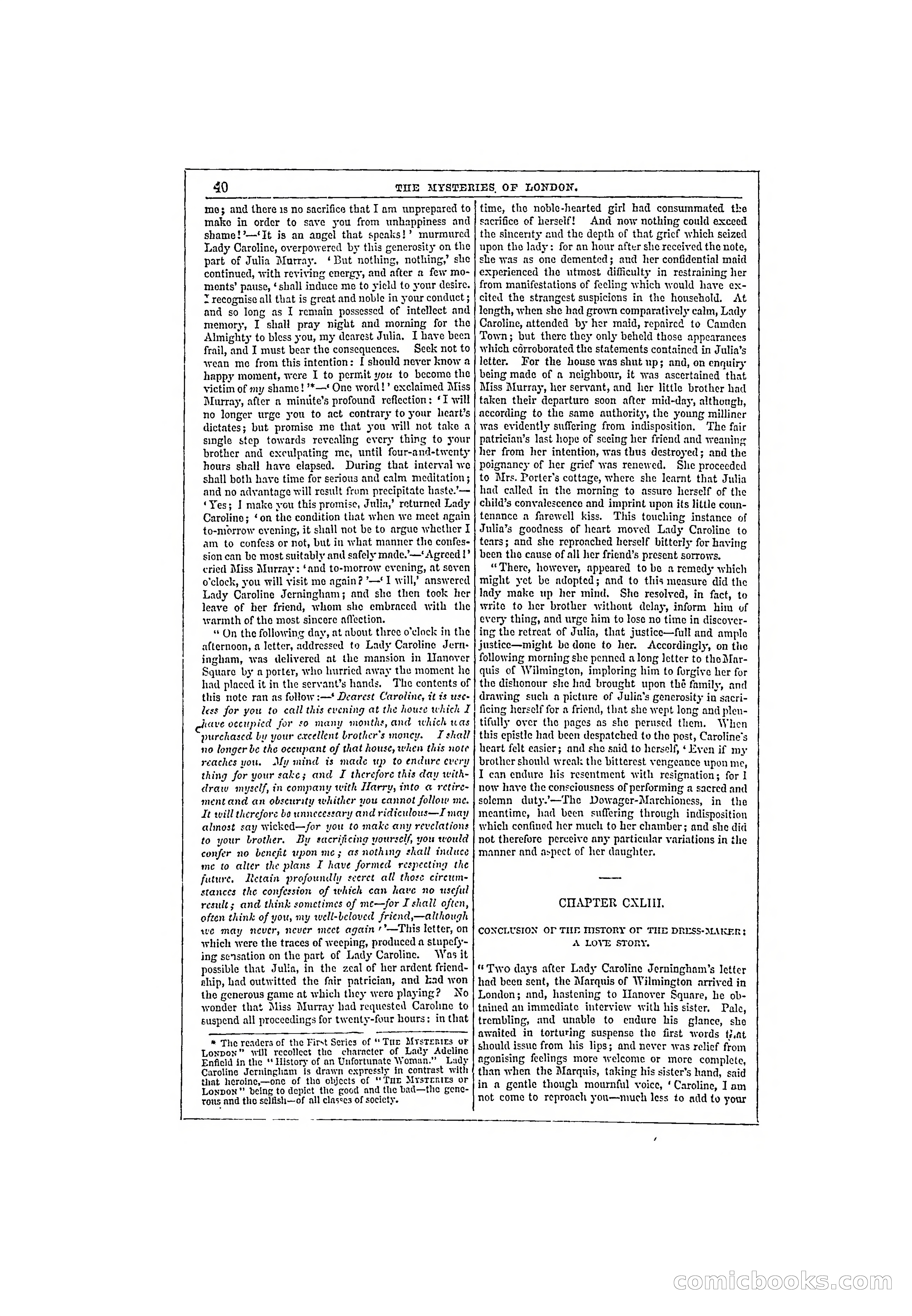
A restored page from Penny Dreadfuls, 1846. Page through the whole issue in the reader above.
📄 Transcribed text from this page (OCR, searchable)
Machine-transcribed from the original scan — historical spelling and the odd misread are preserved.
40) THE MYSTERIES OF LONDON, me; and there 1s no sacrifice that I am unprepared to make in order to save you from unhappiness and shame!’—‘I¢ is an angel that speaks!’ murmured Lady Caroline, overpowered by this generosity on the part of Julia Murray. ‘But nothing, nothing,’ she continued, with reviving energy, and after a few mo- ments’ pause, ‘shall induce me to yield to your desire. x recognise all that is great and noble in your conduct ; and so long as I remain possessed of intellect and memory, I shall pray night and morning for the Almighty to bless you, my dearest Julia, I have been frail, and I must bear the consequences. Seek not to wean me from this intention: I should never know a happy moment, were I to permit you to become the victim of my shame! ’*—* One word!’ exclaimed Miss Murray, after a minute's profound reffection: ‘I will no longer urge you to act contrary to your heart's dictates; but promise me that you will not take a single step towards revealing every thing to your brother and exculpating me, until four-and-twenty hours shall have elapsed. During that interval we shall both have time for serious and calm meditation ; and no advantage will result from precipitate haste.’— ‘Yes; J make vou this promise, Julia,’ returned Lady Caroline; ‘on the condition that when we meet again to-morrow evening, it shall not be to argue whether I am to confess or not, but in what manner the confes- sion can be most suitably and safely made.’—‘ Agreed 1’ cried Miss Murray: ‘and to-morrow cvening, at seven o'clock, you will visit me again? ’—*1I will,’ answered Lady Caroline Jerningham; and she then took her leave of her friend, whom she embraced with the warmth of the most sincere affection. “ On the following day, at about three o'clock in the afternoon, a Ietter, addressed to Lady Caroline Jern- ingham, was delivered at the mansion in Hanover Square by a porter, who hurried away the moment he had placed it in the servant’s hands. The contents of this note ran as follow :—* Dearest Caroline, tt ts use- less for you to call this evening at the house which I Rave occupied for so many months, and iwhich was purchased bu your excellent brother's money. I shall no longer be the occupant of that house, when this note reaches vou. My mind ts made tp to endure every thing for your sake; and JI therefore this day with- draw myself, in company with Harry, into @ retire- mentand an obscurity whither vou cannot follow me. It will therefore be unnecessary and ridiculous—I may almost say wicked—/for you to make any revelations to your brother. By sacrificing yourself, you would confer no benejit upon me; as nothing shall induce me to alter the plans I have formed respecting the future, Lctain profoundly seerct all those cireum- stances the confession of which can have no useful result; and think sometimes of me—for I shail often, often think of you, my well-beloved friend,—although we may neuer, never meet again ’’—This letter, on which were the traces of weeping, produced a stupely- ing sensation on the part of Lady Caroline. Was it possible that Julia, in the zeal of her ardent friend- ship, had outwitted the fair patrician, and Lad won the generous game at which they were playing? No wonder that Miss Murray had requested Caroline to suspend all proceedings for twenty-four hours: in that * Tho readers of the First Series of Tur M{ysTERIEs oF Lonpox” will recollect the character of Lacy Adeline Enfield in the * History of an Unfortunate Woman.” Lady Caroline Jerningham is drawn expressly in contrast with that heroine,—one of the objects of ‘' Tur MYSTERIES oF Loxpon” being to depict the good and the bad—the gene- rous and the se)fish—of all classes of socicty. - sar yaa = time, the noble-hearted girl had consummated the eacrifice of herself! And now nothing could exceed the sincerity and the depth of that gricf which seized upon the lady: for an hour after she received the note, she was as one demented; and her confidential maid experienced the utmost difficulty in restraining her from manifestations of fecling which would have ex- cited the strangest suspicions in the household. At length, when she had grown comparatively calm, Lady Caroline, attended by her maid, repaircd to Camden Town; but there they only beheld those appearances which corroborated the statements contained in Julia’s letter. For the house was shut up; and, on enquiry being made of a neighbour, it was ascertained that Miss Murray, her servant, and her little brother had taken their departure soon after mid-day, although, according to the same authority, the young milliner was evidently suffering from indisposition. The fair patrician’s last hope of sceing her friend and weaning her from her intention, was thus destroyed; and the poignancy of her grief was renewed. Shie proceeded to Mrs. Porter's cottage, where she learnt that Julia had called in the morning to assure herself of the child’s convalescence and imprint upon its little coun- tenance a farewell kiss. This touching instance of Julia’s goodness of heart moved Lady Caroline to tears; and she reproached herself bitterly for having been the cause of all her friend’s present sorrows. “There, however, appeared to be a remedy which might yet be adopted; and to this measure did the lady make up her mind. She resolved, in fact, to write to her brother without delay, inform him of every thing, and urge him to lose no time in discover- ing the retreat of Julta, that justice—full and ample justice—might be done to her. Accordingly, on the following morning she penned along letter to the Mar- quis of Wilmington, imploring him to forgive her for the dishonour she had brought upon thé family, and drawing such a picture of Julie’s generosity in sacri- ficing herself for a friend, that she wept long and plen- tifully over the pages as she perused them. When this epistle had been despatched to the post, Caroline's heart felt easier; and she said to herself, ‘Even if my brother should wreak the bitterest vengeance upon me, I can endure his resentment with resignation; for I now haye the consciousness of performing a sacred and solemn duty.’—-The Dowager-Marchioness, in the meantime, had been suffering through indisposition which confined her much to her chamber; and she did not therefore perceive any particular variations in the manner and aspect of her daughter. CHAPTER CXLII. CONCLUSION OF THE MISTORY OF THE DRESS-MAKER? a LOVE STORY. “Two days after Lady Caroline Jerningham’s letter had been sent, the Marquis of Wilmington arrived in London; and, hastening to Ianover Square, he ob- tnined an immediate interview with his sister. Pale, trembling, and unable to endure his glance, she awnited in torturing suspense the first words ti.at should issue from his lips; and never was relief from agonising feelings more welcome or more complete, than when the Marquis, taking his sister’s hand, said in a gentle though mournful voice, ‘Caroline, J am not come to reproach you—miuch less to add to your a I e, é EConnicloooks (SO)