
Penny Dreadfuls, 1846 · page 133 of 399
The Mysteries of London, Vol. IV — page 133: what you’re looking at
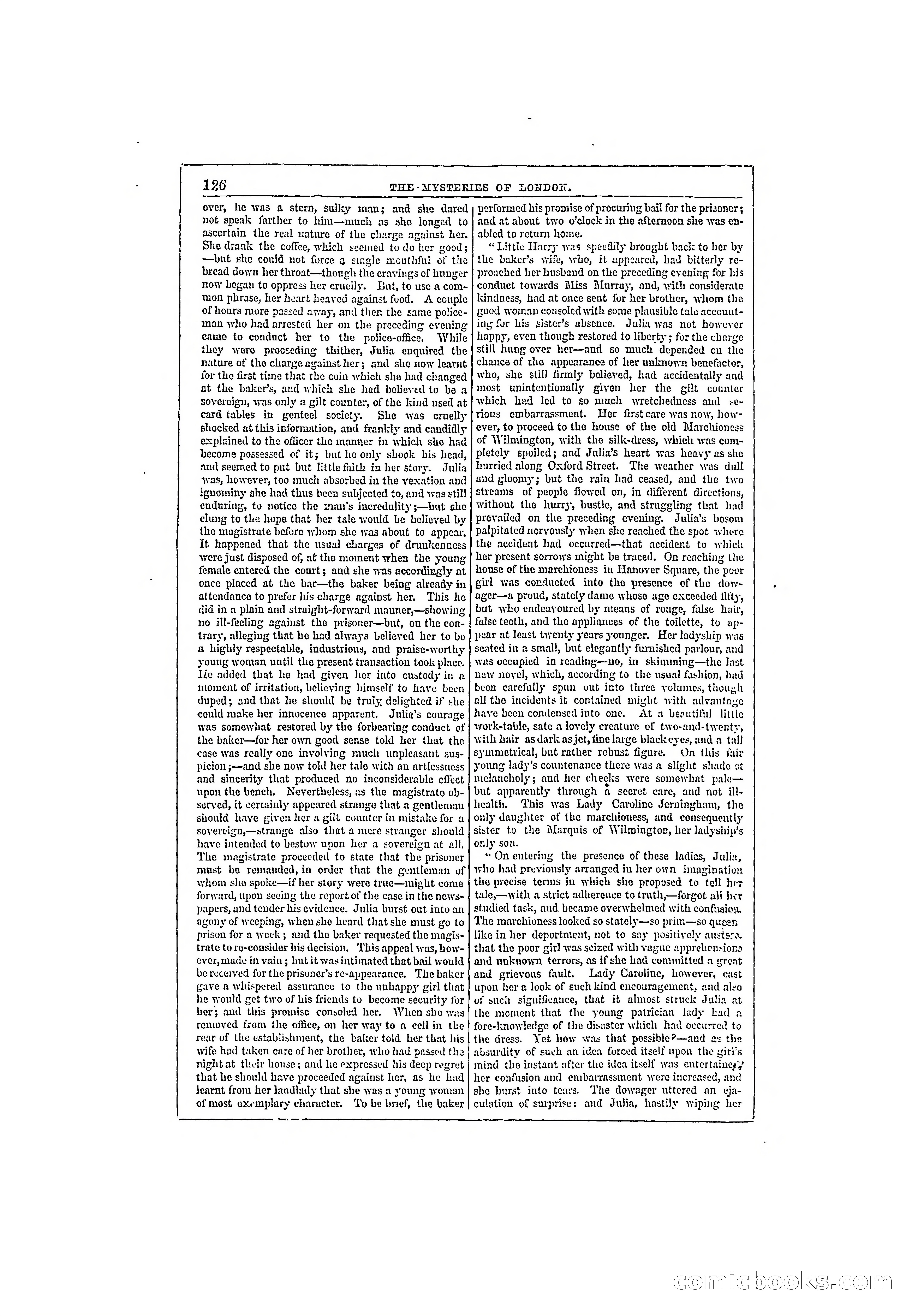
A restored page from Penny Dreadfuls, 1846. Page through the whole issue in the reader above.
📄 Transcribed text from this page (OCR, searchable)
Machine-transcribed from the original scan — historical spelling and the odd misread are preserved.
126 THE-MYSTERIES OF LONDON, over, he was a stern, sulky man; and she dared not speak farther to him—much as she longed to ascertain the real nature of the charge aguinst her. She drank the coffee, which seemed to do “her good; —bnt she could not force g single mouthful of the bread down her throat—thouch the cravings of hunger now begau to oppress her cruelly. Dut, to use & com~ nion phrase, her heart heaved against food. A couple of hours more passed away, and then the same police- man who had arrested her on the preceding evening came to conduct her to the police-office. While they were procseding thither, Julia enquired the nature of the charge against her; and she now learnt for the first time that the coin which she had changed at the baker’s, and which she had believed to be a sovereign, was only a gilt counter, of the kind used at card tables in gentecl society. She was cruelly shocked at this information, and frankly and candidly explained to the officer the manner in which sho had become possessed of it; but he only shook his head, and seemed to put but little faith in her story. Julia was, however, too much absorbed in the vexation and ignominy she had thus been subjected to, and was still enduring, to notice the zan's incredulity ;—but che clung to the hope that her tale wonld be believed by the magistrate before whom she was about to appear. It happened that the usual charges of drunkenness were just disposed of, af the moment when the young female entered the court; and she was accordingly at once placed at the bar—the baker being already in attendance to prefer his charge against her. This he did in a plain and straight-forward manner,—showing no ill-feeling against the prisoner—but, on the con- trary, alleging that he had always believed her to be a highly respectable, industrious, and praise-worthy young woman until the present transaction took place. Ife added that he had given her into custody in a moment of irritation, belicving himself to have been duped; and that he should be truly, delighted if she could make her innocence apparent. Julia’s courage was somewhat restored by the forbearing conduct of the baker—for her own good sense told her that the case was really one involving much unpleasant sus- picion ;—and she now told her tale with an artlessness and sincerity that produced no inconsiderable effect wpon the bench. Nevertheless, as the magistrate ob- served, it certainly appeared strange that a gentleman should have given her a gilt counter in mistake for a sovercign,—strange also that a mere stranger should have intended to bestow upon her a sovereign at all, The magistrate proceeded to state that the prisoner must be remanded, in order that the gentleman of whom she spoke—if her story were true—might come forward, upon seeing the report of the case in the news- papers, and tender his evidence. Julia burst out into an agony of weeping, when she heard that she must go to prison for a weck; and the baker requested the magis- trate tore-consider his decision. ‘This appeal was, how- ever, made in vain; butit was intimated that bail would be received for the prisoner’s re-appearance. The baker gave a whispered assurance to the unhappy girl that he would get two of his friends to become security for her; and ‘this promise consoled her. When she was renioved from the office, on her way to a cellin the rear of the establishment, the baker told her that his wife had taken care of her brother, who had passed the night at their house; and he expressed his decp regret that he should have proceeded against her, as he had learnt from her landlady that she was a young woman of most exemplary character. To be brief, the baker = ve ‘ and at about two o’clock in the afternoon she was en- abled to return home. “Little Harry was speedily brought back to her by the baker’s wife, who, it appeared, had bitterly re- proached her husband on the preceding evening for his conduct towards Miss Murray, and, with considerate liindoess, had at once sent for her brother, whom the good woman consoled with some plausible tale account- ing for his sister’s absence. Julia was not however happy, even though restored to liberty ; for the charge still hung over her—and so much depended on the chance of the appearance of her unknown benefactor, who, she stil) firmly believed, had accidentally and most unintentionally given her the gilt counter which had Iced to so much wretchednuess and se- rious embarrassment. Her first care was now, how- ever, to proceed to the house of the old Marchioness of Wilmington, with the sillk-dress, which was com- pletely spuiled; and Julia’s heart was heavy as she hurried along Oxford Street. The weather was dull and gloomy ; but the rain had ceased, and the two streams of people flowed on, in different dircctions, without the hurry, bustle, and struggling that dad prevailed on the preceding evening. Julia’s bosom palpitated nervously when she reached the spot where the accident had occurred—that accident to which her present sorrows might be traced. On reaching the house of the marchioness in Hanover Square, the : poor girl was conducted into the presence of the dow- ager—a proud, stately dame whose age excecded fifty, but who endearoured by means of rouge, false hair, fulse teeth, and the appliances of the toilette, to ap- pear at least twenty years younger. Her ladyship was seated in a small, but elegantly furnished parlour, and was occupied in reading—no, in skimming—the Jast ew novel, which, according to the usual fashion, had es carefully spun out into three volumes, though all the incidents it contained might with advantage have been condenscd into one. At a beautiful little work-table, sate a lovely creature of two-and-twenty with hair as dark asjet, fine large black cyes, and a tall syinmetrical, but rather robust figure. On this fair young lady’s countenance there was a slight shade ot melancholy ; aud her cheeks were somewhat pale—- but apparently through a secret care, and not ill- health. This was Lady Caroline Jerningham, the only daughter of the marchioness, and consequently sister to the Marquis of Wilmington, her ladyship’s only son. “Qn entering the presence of these ladies, Julia, who had previously arranged in her own jmagination the precise terms in which she proposed to “tell her tale,—with a strict adherence to truth,—forgot all her studied tasx, and became overwhelmed with confusiow. The marchioness looked so stately—so prim—so queen like in her deportment, not to say positively austsra that the poor girl was seized with vague appr ehensiong and unknown terrors, as if she had committed a great and grievous fault. Lady Caroline, however, cast upon her a Jook of such kind encouragement, and also uf such significance, that it almost struck Julia at the moment that the young patrician Jady Lad a fore-knowledge of the disaster which had occurred to the dress. Yet how was that possible?—and as the absurdity of such an idea forced itself upon the girl's mind the instant after the idea itself was entertainesy her confusion and embarrassment were increased, and she burst into tears. The dowager uttered an eja- performed his promise of procuring bail for the prisoner ; culation of surprise: and Julia, hastily wiping her See Samara | EConnicloooks (SO)