
Penny Dreadfuls, 1846 · page 130 of 399
The Mysteries of London, Vol. IV — page 130: what you’re looking at
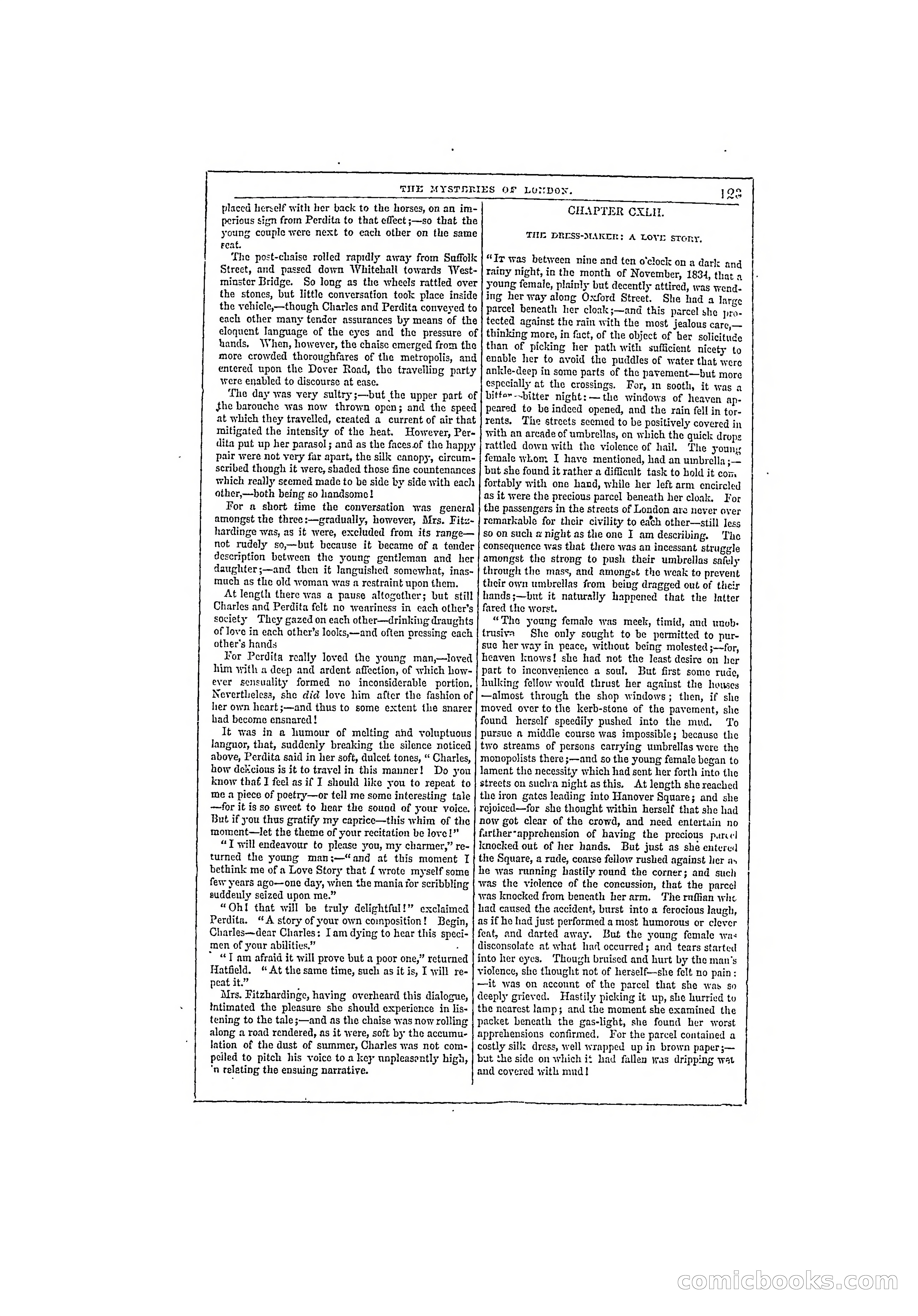
A restored page from Penny Dreadfuls, 1846. Page through the whole issue in the reader above.
📄 Transcribed text from this page (OCR, searchable)
Machine-transcribed from the original scan — historical spelling and the odd misread are preserved.
[eo > | a, eS a ae er cere WMYSTHRIES OF Luirpon }O38 placed herself with her back to the horses, on an im- CHAPTER CXL. perious sign from Perdita to that effect ;—so that the young couple were next to each other on the same Feat. The post-chaise rolled rapidly away from Suffolk Street, and passed down Whitehall towards West- minster Bridge. So long as the wheels rattled over the stones, but little conversation took place inside the vehicle,—though Charles and Perdita conveyed to each other many tender assurances by means of the eloquent language of the eyes and the pressure of hands, When, however, the chaise emerged from the more crowded thoroughfares of the metropolis, and entered upon the Dover Road, the travelling party were enabled to discourse at ease. The day was very sultry ;—-but the upper part of the barouche was now thrown open; and the speed at which they travelled, created a current of air that mitigated the intensity of the heat. However, Per- dita put up her parasol; and as the facesof the happy pair were not very far apart, the silk canopy, circum- scribed though it were, shaded those fine countenances which really seemed made to be side by side with each other,—both being so handsome! Tor a short time the conversation was general amongst the three:—gradually, however, Mrs. Fitz- hardinge was, as it were, excluded from its range— not rudely s0,—but because it became of a tender description between the young gentleman and her daughter;—and then it languished somewhat, inas- much as the old woman was a restraint upon them. At length there was a pause altogether; but still Charles and Perdita felt no weariness in each other’s society They gazed on each other—drinking draughts of Jove in each other’s looks,~-and often pressing each other's hands Vor Perdita really loved the young man,—loved him with a deep and ardent affection, of which how- ever sensuality formed no inconsiderable portion. Nevertheless, she did love him after the fashion of her own heart ;—and thus to some extent the snarer had become ensnared ! It was in a humour of melting and voluptuous languor, that, suddenly breaking the silence noticed above, Perdita said in her soft, dulcct tones, “ Charles, how dekcious is it to travel in this manner! Do you know that I feel as if I should like you to repeat to me 2 piece of poetry—or tell me some interesting tale —for it is so sweet to hear the souad of your voice. But if you thus gratify my caprice—this whim of the moment—let the theme of your recitation be love!" “Twill endeavour to please you, my charmer,” re- turned the young man;—“and at this moment I bethink me of a Love Story that { wrote myself some few years ago—one day, when the mania for scribbling suddenly seized upon me.” “Oh! that will be truly delightful!” exclaimed Perdita. “A story of your own composition! Begin, Charles—dear Charles: Iam dying to hear this apeels men of your abilities.” ““T am afraid it will prove but a poor one,” returned Hatfield. ‘At the same time, such as it is, I will re- peat it.” Mrs. Fitzhardinge, having overheard this dialogue, intimated the pleasure she should experience in lis- tening to the tale;—and as the chaise was now rolling along a road rendered, as it were, soft by the accumu- lation of the dust of summer, Charles was not com- peiled to pitch his voice to a key unpleasently high, "na relating the ensuing narrative. THE DRESS-MAKEE: A Loyr STORY, “Ir was between nine and ten o'clock on a dark: and Tainy night, in the month of November, 1834, that a young female, plainly but decently attired, was wend- ing her way along Oxford Street. She had a large parcel beneath her cloak;—and this parcel she pro- tected against the rain with the most jealous care,— thinking more, in fact, of the object of ber solicitude than of picking her path with sufficient nicety to enable her to avoid the puddles of water that were ankle-deep in same parts of the pavement—but more especially at the crossings. For, in sooth, it was a bitter -~bitter night: — the windows of heaven ap- peared to be indeed opened, and the rain fell in tor- rents. The streets seemed to be positively covered in with an arcade of umbrellas, on which the quick drops rattled down with the violence of hail. The younys female whom I have mentioned, had an umbrella ;— but she found it rather a difficult task to hold it corm fortably with one hand, while her left arm encircled as it were the precious parcel beneath her cloak. For the passengers in the streets of London are never over remarkable for their civility to each other—still less so on such z night as the one I am describing. The consequence was that there was an incessant struggle amongst the strong to push their umbrellas safely through the mass, and amongst the weak te prevent their own umbrellas from being dragged out of their hands ;—bnt it naturally happened that the latter fared the worst. “The young female was meek, timid, and wnvb- trusiva She only sought to be permitted to pur- sue her way in peace, without being molested ;—for, heaven knows! she had not the Icast desire on her part to inconvenience a soul, But first some rude, hulking fellow would thrust her against the houses —almost through the shop windows; then, if she moved over to the kerb-stone of the pavement, she found herself speedily pushed into the mud. ‘To pursue a middle course was impossible ; because the two streams of persons carrying umbrellas were the monopolists there ;—and so the young female began to lament the necessity which had sent her forth into the streets on suclra night as this. At length she reached the iron gates leading into Hanover Square; and she rejoiced—for she thonght within herself that she had now got clear of the crowd, and need entertain no farther-apprehension of having the precious parcel knocked out of her hands. But just as she entered the Square, a rade, coarse fellow rushed against her as he was running hastily round the corner; and such was the violence of the concussion, that the parcel was knocked from beneath her arm. The rffian whe had caused the accident, burst into a ferocious laugh, as if he had just performed a most humorous or clever feat, and darted away. But the young female was disconsolate at what had occurred; and tears started into her eyes. Though bruised and hurt by the man’s violence, she thought. not of herself—she felt no pain: —it was on acconnt of the parcel that she was so deeply grieved. Hastily picking it up, she hurried to the nearest lamp; and the moment she examined the packet beneath the gas-light, she found her worst apprehensions confirmed. Yor the parcel contained a costly silk dress, well napped up in brown paper ;— but the side on ict if had fallen tras dripping wat and covered with mud! ‘ CTC LL OO CIT I I CT OCCT NA Ca a A nt te ey “Py CON (C DOO SS (SO)