
Penny Dreadfuls, 1846 · page 123 of 399
The Mysteries of London, Vol. IV — page 123: what you’re looking at
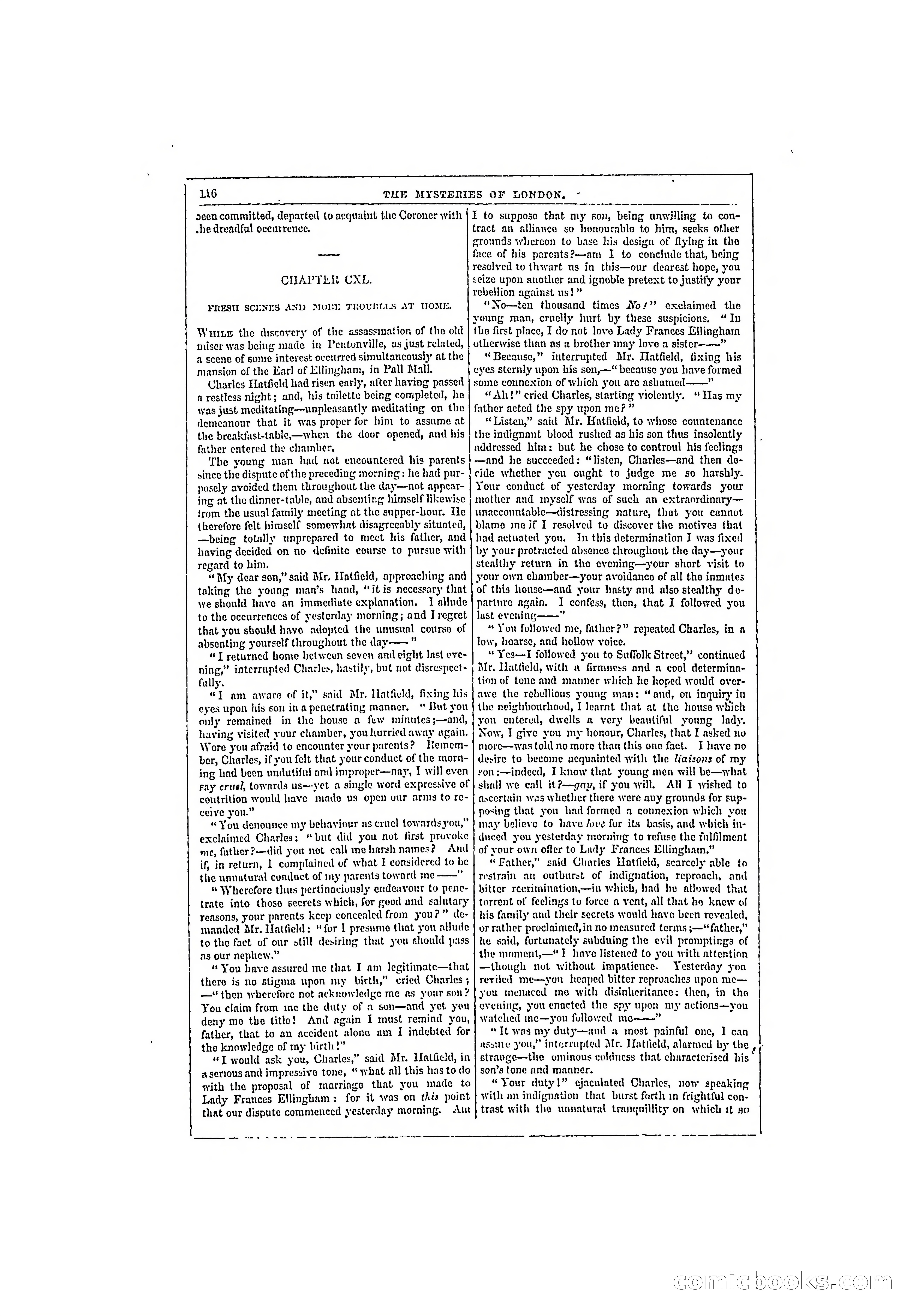
A restored page from Penny Dreadfuls, 1846. Page through the whole issue in the reader above.
📄 Transcribed text from this page (OCR, searchable)
Machine-transcribed from the original scan — historical spelling and the odd misread are preserved.
116 ; THE MYSTERIES OF LONDON, ~- 2 rete ee ae eee eaten oeencommitted, departed to acquaint the Coroner with | I to suppose that my son, being unwilling to con- whe dreadful occurrence. CHAPTLEK CAL. FRESH SCENES AND MOK TROUBLLS AT TOME. Wu the discovery of the assassiuation of the old tiser was being made in Pentonville, as just related, a scene of some interest occurred simultancously at the mansion of the Earl of Ellingham, in Pall Mall. Charles Uatfield bad risen early, after having passed a restless night; and, his toilette being completed, he was just meditating—unpleasantly meditating on the demeanour that it was proper for him to assume at the breakfust-table,—when the door opened, and his father entered the chamber. The young man had not encountered his parents since the dispute of the preceding morning : he had pur- posely avoided them throughout the day—not appear- ing at the dinner-table, and absenting himself likewise trom the usual family meeting at the supper-hour. Ue therefore felt himself somewhat disagreeably situated, —being totally unprepared to mect his father, and having decided on no definite course to pursue with regard to him. “My dear son,” said Mr. Uatfield, approaching and taking the young man’s hand, ‘itis necessary that we should have an immediate explanation. 1 allude to the occurrences of yesterday morning; and IJ regret that you should have adopted the unusual course of absenting yourself throughout the day—— ” “T returned home betweon seven and eight last eve- ning,” interrupted Charles, hastily, but not disrespect- fully. “J am aware of it,” said Mr. Hatfield, fixing lis eyes upon his sou ina penetrating manner,“ But you only remained in the house a few minutes ;—and, having visited your chamber, you hurried away again. Were you afraid to encounter your parents? Remem- ber, Charles, if you felt that your conduct of the morn- ing had been undutiful and improper—nay, I will even gay cruel, towards us—yet a single word expressive of contrition would have made us open our arms to re- ceive you.” “You denounce my behaviour as crucl towards you,” exclaimed Charles: “but did you not first provoke me, father ?—did you not call me harsh names? And if, in return, 1 complained of what I considered to be the unnatural conduct of my parents toward me——" * Wherefore thus pertinaciously endeavour to pene- trate into thoso secrets which, for good and ealutary reasons, your parents keep concealed from you?” cde- manded Mr. Hatfield; “for I presume that you allude to the fact of our otill desiring that you should pass as our nephew.” © You have assured me that I am legitimate—that there is no stigma upon my birth,” eried Charles ; — then wherefore not acknowledge me as your son? You claim from me the duty of a son—and yet you deny moe the title! And again I must remind you, father, that to an accident alone am I indebted for the knowledge of my birth!” “JT would ask you, Charles,” said Mr. Hatfield, in aserious and impressive tone, * what all this has to do with the proposal of marringe that you made ta Lady Frances Ellingham: for it was on this point that our dispute commenced yesterday morning. Am tract an alliance so honourable to him, seeks other grounds whereon to base his design of flying in the face of his parents?—am J to conclude that, being resolyed to thwart us in this—our dearest hope, you seize upon another and ignoble pretext to justify your rebellion against us!” “No—ten thousand times Wo!’ exclaimed the young man, cruelly hurf by these suspicions. “In the first place, I do not love Lady Frances Ellinghain utherwise than as a brother may Jove a sister-——” “ Because,” interrupted Mr. Iatfield, fixing his eyes sternly upon his son,— because you have formed some connexion of which you are ashamed———” “Ah!” cricd Charles, starting violently. “las my father acted the spy upon me? ” “Tasten,’ said Mr. Hatfield, to whose countenance the indignant blood rushed as his son thus insolently addressed him: but he chose to controul his feelings —and he succeeded: “listen, Charles—and then de- cide whether you ought to judge me so harshly. Your conduct of yesterday morning towards your mother and myself was of such an extraordinary— unaccountable—distressing nature, that you cannot blame ine if I resolved to discover the motives that had actuated you. In this determination I was fixed by your protracted absence throughout the day—your stealthy return in the evening—your short visit to your own chamber—your avoidance of all the inmates of this house—and your hasty and also stealthy de- parture again. I confess, then, that I followed you last evening: i. “You fullowed me, father?” repeated Charles, in a low, hoarse, and hollow voice. “Yes—I followed you to Suffolk Street,” continued Mr. Iattield, with a firmness and a cool determina- tion of tone and manner which he hoped would over- awe the rebellious young man: “and, on inquiry in the neighbourhood, I learnt that at the house which you centered, dwells a very beautiful young Jady. Now, I give you my honour, Charles, that I asked no more—was told no more than this one fact. I have no desire to become acquainted with the liatsons of my son :—indeed, I know that young men will be—what shall we call it?—gay, if you will. All I wished to ascertain was whether there were any grounds for sup- posing that you had formed a connexion which vou may believe to have Jove for its basis, and which in- duced you yesterday morning to refuse the mlfilment of your own offer to Lady Frances Ellingham.” “Father,” said Charles Hatfield, scarcely able to restrain an outburst of indignation, reproach, and bitter recrimination,—in which, had he allowed that torrent of feclings tu furce a vent, all that ha knew of his family and their secrets would have been revealed, or rather proclaimed, in no measured terms ;—“ father,” he said, fortunately subduing the evil promptings of the moment,—" I have listened to you with attention —though not without impatience. Yesterday you reviled me—yon heaped bitter reproaches upon me— you menaced me with disinheritance: then, in the evening, you enacted the spy upon my actions—you watclied me—you followed me——” “Tt was my duty—and a most painful one, I can assure you,” interrupted Mr. Ufattield, alarmed by the strange—the ominous coldness that characterised his son’s tone and manner. “Your duty!” ejaculated Charles, now speaking with an indignation that burst forth in frightful con- trast with the unnatural tranquillity on which it so COA teen eee ee ee eee “m TT, TT CS I IT I > GIOOKS (SO)