
Penny Dreadfuls, 1846 · page 116 of 399
The Mysteries of London, Vol. IV — page 116: what you’re looking at
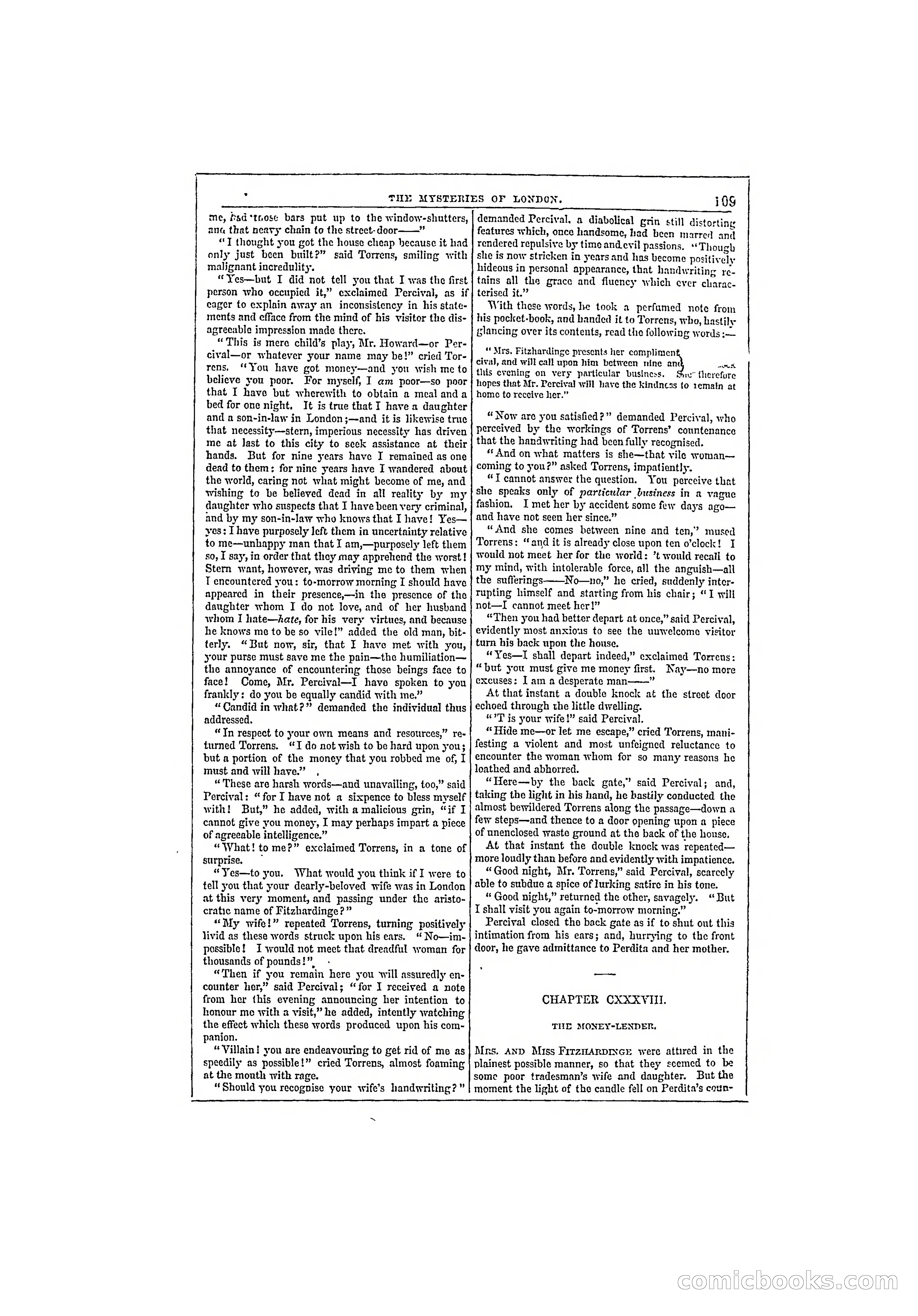
A restored page from Penny Dreadfuls, 1846. Page through the whole issue in the reader above.
📄 Transcribed text from this page (OCR, searchable)
Machine-transcribed from the original scan — historical spelling and the odd misread are preserved.
e THE MYSTERIES OF LONDON, me, fad ‘those bars put up to the window-shutters, ana that neavy chain to the street-door———” “T thought you got the house cheap because it had only just been built?” said Torrens, smiling with malignant incredulity. “Yes—but I did not tell you that I was the first person who occupied it,” exclaimed Percival, as if eager to explain away an inconsistency in his state- ments and efface from the mind of his visitor the dis- agreeable impression made there. “This is mere child’s play, Mr. Howard—or Per- cival—or whatever your name may be!” cried Tor- rens. ‘You have got money—and you wish me to believe you poor. For myself, I am poor—so poor that I have but wherewith to obtain a meal anda bed for one night. It is true that I have a daughter and a son-in-law in London ;—-and it is likewise true that necessity—stern, imperious necessity has driven me at last to this city to seek assistance at their hands. But for nine years have I remained as one dead to them: for nine years have I wandered about the world, caring not what might become of me, and wishing to be believed dead in all reality by my daughter who suspects that I have been very criminal, and by my son-in-law who knows that I have! Yes— yes; I have purposely left them in uncertainty relative to me—unhappy man that I am,—purposely left them so, I say, in order that they may apprehend the worst! Stern want, however, was driving me to them when T encountered you: to-morrow morning I should have nppeared in their presence,—in the presence of the daughter whom I do not love, and of her husband whom I hate—hate, for his very virtues, and because he knows me to be so vile!” added the old man, bit- terly. “But now, sir, that I have met with you, your purse must save me the pain—the humiliation~ the annoyance of encountering those beings face to face! Come, Mr. Percival—I havo spoken to you frankly: do you be equally candid with me.” “ Candid in what?” demanded the individual thus addressed. “Tn respect to your own means and resources,” re- turned Torrens. “TI do not wish to be hard upon you; but a portion of the money that you robbed me of, I must and will have.” “These are harsh words—and unavailing, too,” said Percival: “for I have not a sixpence to bless myself with! But,” he added, with a malicious grin, “if I cannot give you money, I may perhaps impart a piece of agreeable intelligence.” “What! to me?” exclaimed Torrens, in a tone of surprise, “Yes—to you. What would you think if I were to tell you that your dearly-beloved wife was in London at this very moment, and passing under the aristo- cratic name of Fitzhardinge?” “My wife!” repeated Torrens, turning positively livid as these words struck upon his ears. “ No—im- possible! JI would not meet that dreadful woman for thousands of pounds!” “Then if you remain here you will assuredly en- counter her,” said Percival; “for I received a note from her this evening announcing her intention to honour me with a visit,” he added, intently watching the effect which these words produced upon his com- panion. “Villain! you are endeavouring to get rid of me as speedily as possible!” cried Torrens, almost foaming at the mouth with rage. ‘Should you recognise your wife’s handwriting? ” 109 demanded Percival, a diabolical grin still distorting features which, once handsome, had been marred and rendered repulsive by time andevil passions. «*T hough she is now stricken in years and has become positively hideous in personal appearance, that handwriting re- tains all the grace and fluency which ever charac- terised it.” With these words, he took a perfumed note from his pocket-book, and handed it to Torrens, who, hastily glancing over its contents, read the following words :— cival, and will call upon him between nine anc er this evening on very particular business. Strum (herefure hopes that Mr. Percival will have the kindness to 1emain at home to receive her.” ‘Mrs. Fitzhardinge presents her en nine “ Now are you satisfied?” demanded Percival, who perceived by the workings of Torrens’ countenance that the handwriting had been fully recognised. ‘And on what matters is she—that vile woman— coming to you?” asked Torrens, impatiently. “J cannot answer the question. You perceive that she speaks only of particular business in a vague fashion. I met her by accident some few days ago— and have not seen her since.” “And she comes between nine and ten,’ mused Torrens: “and it is already close upon ten o’clock! I would not meet her for the world: ’t would recall to my mind, with intolerable force, all the anguish—all the sufferings——No—no,” he cried, suddenly inter- rupting lumself and starting from his chair; “I will not—I cannot meet her!” “Then you had better depart at once,” said Percival, evidently most anxious to see the uuwelcome visitor turn his back upon the house. “Yes—I shall depart indeed,” exclaimed Torrens: “but you must give me money first. Nay—no more excuses: J am a desperate man——” At that instant a double knock at the street door echoed through the little dwelling. “Tis your wife!” said Percival. “Hide me—or let me escape,” cried Torrens, mani- festing a violent and most unfeigned reluctance to encounter the woman whom for so many reasons he loathed and abhorred. “Were—by the back gate,’ said Percival; and, taking the light in his hand, he hastily conducted the almost bewildered Torrens along the passage—down a few steps—and thence to a door opening upon a piece of unenclosed waste ground at the back of the house. At that instané the double knock was repeated— more loudly than before and evidently with impatience. “Good night, Mr. Torrens,” said Percival, scarcely able to subdue a spice of lurking satire in his tone. “ Good night,” returned the other, savagely. “But I shall visit you again to-morrow morning.” Percival closed the back gate as if to shut out this intimation from his ears; and, hurrying to the front door, he gave admittance to Perdita and her mother. ? CHAPTER CoOCCXVITI. THE MONEY-LENDER. Mrs. and Miss FirzHArRpDINGE were attired in the plainest possible manner, so that they scemed to be some poor tradesman’s wife and daughter. But the moment the light of the candle fell on Perdita’s coun- So en (C(O) (C DOO <S LL (SO)