
Penny Dreadfuls, 1846 · page 111 of 399
The Mysteries of London, Vol. IV — page 111: what you’re looking at
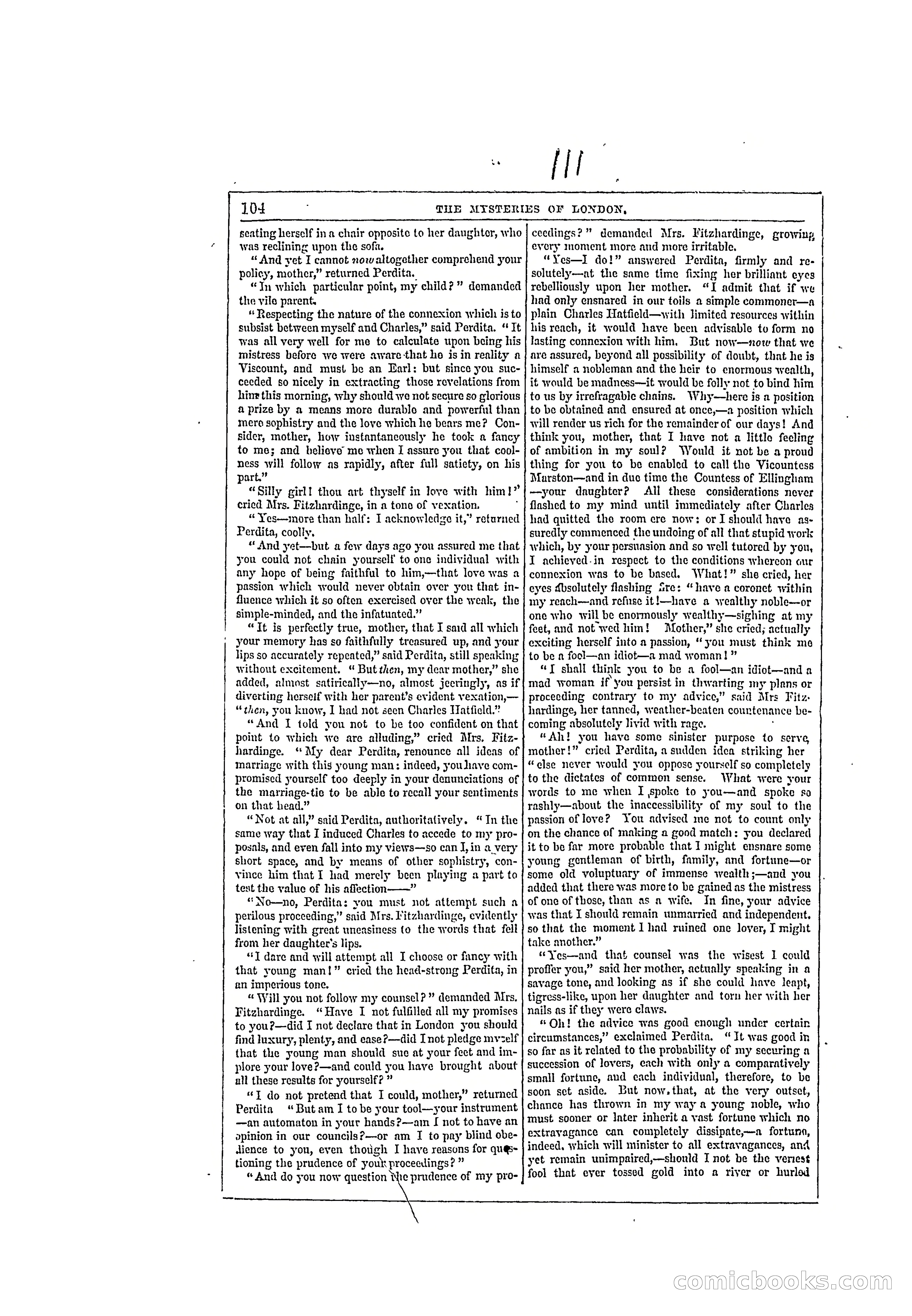
A restored page from Penny Dreadfuls, 1846. Page through the whole issue in the reader above.
📄 Transcribed text from this page (OCR, searchable)
Machine-transcribed from the original scan — historical spelling and the odd misread are preserved.
2 tr AE at a ~ 104 THE MYSTERIES OF LONDON, seating herself ina chair opposite to her daughter, who was reclining upon the sofa. “ And yet I cannot now altogether comprehend your policy, mother,” returned Perdita. “Yn which particular point, my child?” demanded the vile parent. “ Respecting the nature of the connexion whicli is to subsist between myself and Charles,” said Perdita. “ It was all very well for me to calculate upon being his mistress before we were aware that he is in reality a Viscount, and must be an Darl: but since you suc- ceeded so nicely in extracting those revelations from hint this morning, why should we not secure so glorious a prize by a means more durablo and powerful than mere sophistry and the love which he bears me? Con- sider, mother, how instantaneously he took a fancy to me; and helieve me when I assure you that cool- ness will follow as rapidly, after full satiety, on his part.” “Silly girl! thou art thyself in love with him!” cried Mrs. Titzhardinge, in a tono of vexation. “ Yes—more than half: I acknowledge it,’ retarned Perdita, coolly, “And yet—but a few days ago you assured me that you could not chain yourself to one individual with any hope of being faithful to him,—that love was a passion which would never obtain over you that in- fluence which it so often exercised over the weak, the simple-minded, and the infatuated.” “It is perfectly true, mother, that I said all which your memory has so faithfully treasured up, and your lips so accurately repeated,” said Perdita, still speaking without excitement. “ But then, my dear mother,” she added, almost satirically—no, almost jeeringly, as if diverting herself with her parent’s evident vexation,— “then, you know, I had not seen Charles Hatfield.” “And I told you not to be too confident on that point to which we are alluding,” cried Mrs. Fitz- hardinge. “ My dear Perdita, renounce all ideas of marriage with this young man: indeed, you liave com- promised yourself too deeply in your denunciations of the marriage-tie to be able to recall your sentiments on that head.” “Not at all,” said Perdita, authoritatively. “In the same way that I induced Charles to accede to my pro- posals, and even fall into my views—so can I, in a very short space, and by means of other sophistry, con- vince him that I had merely been playing a part to test the value of his affection ———” * No—no, Perdita: you must not attempt such a perilous proceeding,” said Mrs. Fitzhardinge, evidently listening with great uneasiness to the words that fell from her daughter's lips. “J dare and will attempt all I choose or fancy with that young man!” cried the head-strong Perdita, in gn Imperious tone. “ Will you not follow my counsel?” demanded Mrs. Vitzhardinge. “Have I not fulfilled all my promises to you?—did I not declare that in London you should find luxury, plenty, and ease?—did Inot pledge mvzelf that the young man should sue at your fect and im- plore your love?—and could you have brought about all these results for yourself? ” «J do not pretend that I could, mother,” returned Perdita ‘“Butam I to be your tool—your instrument —an automaton in your hands?—am [ not to have an opinion in our councils?—or am I to pay blind obe- dience to you, even thotigh I have reasons for que@s- tioning the prudence of youk proceedings? ” “And do you now question Wie prudence of my pro- ere ay eae | ceedings?” demanded Mrs. Vitzhardinge, growing every moment more and more irritable. “Yes—I do!” answered Perdita, firmly and re- solutely—at the same time fixing her brilliant eyes rebelliously upon her mother. “I admit that if we had only ensnared in our toils a simple commoner—a plain Charles Hatfield—with limited resources within his reach, it would have been advisable to form no lasting connexion with him. But now—now that we are assured, beyond all possibility of doubt, that he is himself a nobleman and the heir to enormous wealth, if would be madness—it would be folly not to bind him to us by irrefragable chains. Why—here is a position to be obtained and ensured at once,—a position which will render us rich for the remainder of our days! And think you, mother, that I have not a little feeling of ambition in my soul? ‘ould it not be a proud thing for you to be enabled to call the Vicountess Marston—and in duc time the Countess of Ellingham —your daughter? All these considerations never flashed to my mind until immediately after Charles had quitted the room cre now: or I should have as- suredly conimenced the undoing of all that stupid work which, by your persuasion and so well tutored by you, J achieved-in respect to the conditions whereon aur connexion was to be based. What!” she cried, her eyes Absolutely flashing are: “ have a coronct. within my reach—and refuse it!—have a wealthy noble—or one who will be enormously wealthy—sighing at my feet, and not wed him! Mother,” she cried; actually exciting herself into a passion, “you must think moe to be a foocl—an idiot—a mad woman!” “T shall think you to be a fool—an idiot—and a mad woman. if you persist in thwarting my plans or proceeding contrary to my advice,” said Mrs Fitz hardinge, her tanned, weather-beaten countenance be- coming absolutely livid with rage. “Ah! you have some sinister purpose to serve, mother!” cried Perdita, a sudden idea striking her “else never would you oppose yourself so completely to the dictates of common sense. What were your words to me when I spoke to you—and spoke sa rashly—about the inaccessibility of my soul to the passion of love? You advised me not to count only on the chance of making a good match: you declared it to be far more probable that I might ensnare some young gentleman of birth, family, and fortune—or some old voluptuary of immense wealth ;—and you added that there was more to be gained as the mistress of one of those, than as a wife. In fine, your advice was that I should remain unmarried and independent. so that the moment I] had ruined one loyer, I might take another.” ‘Yes—and that counsel was the wisest 1 could proffer you,” said her mother, actually speaking in a savage tone, and looking as if she could have leapt, tigress-like, upon her daughter and torn her with her nails as if they were claws. “Oh! the advice was good enough under certain circumstances,” exclaimed Perdita. “It was good in so far as it related to the probability of my securing a succession of lovers, each with only a comparatively small fortune, aud each individual, therefore, to be soon set aside. But now,.that, at the very outset, chance has thrown In my way a young noble, who must sooner or Jater inherit a vast fortune which no extravagance can completely dissipate,—a fortuna, indeed, which will minister to all extravagances, and yet remain unimpaired,—should I not be the veriest fool that ever tossed gold into a river or hurled GIOOKS 5} (CO) (CO) >