
Penny Dreadfuls, 1846 · page 109 of 399
The Mysteries of London, Vol. IV — page 109: what you’re looking at
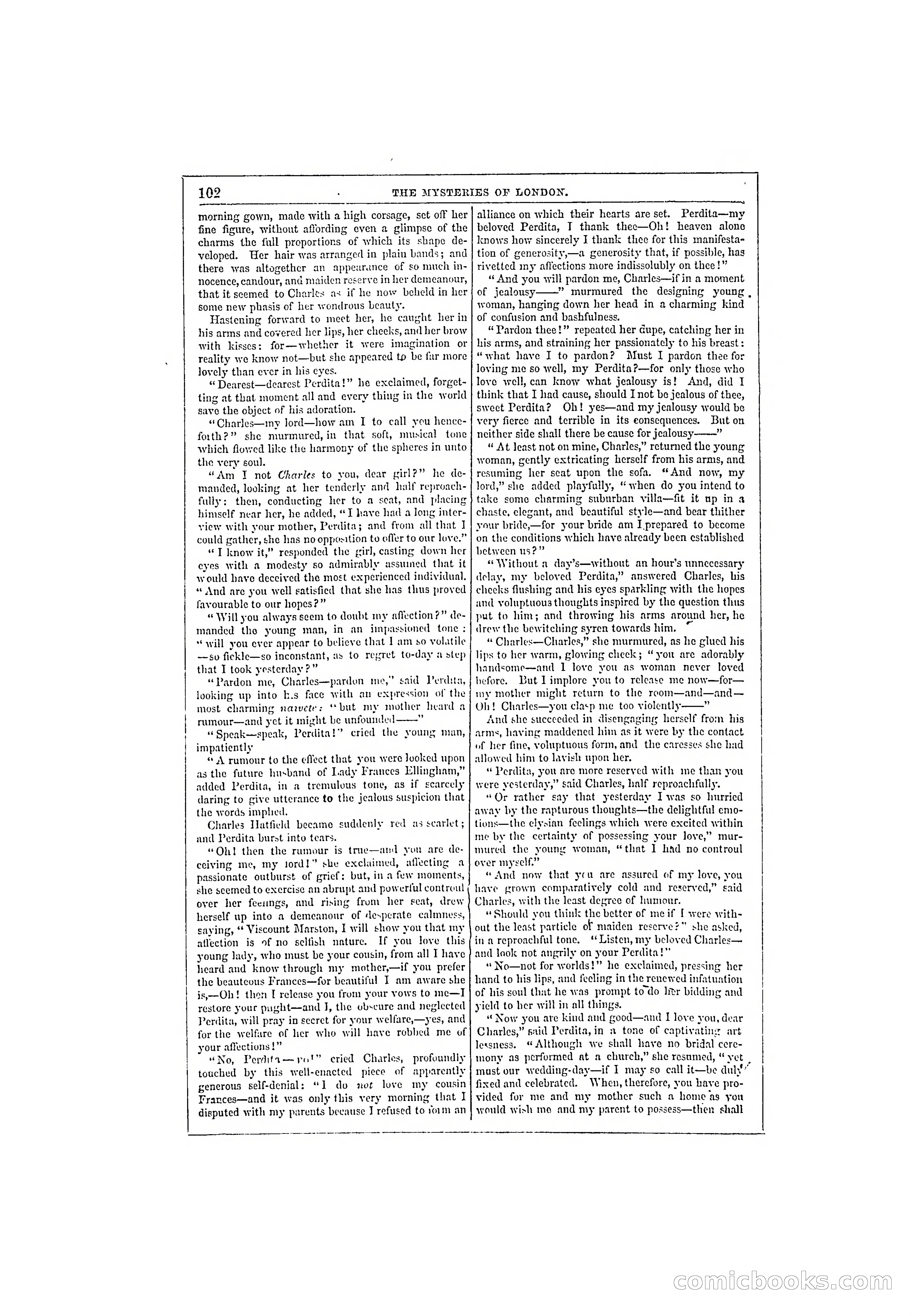
A restored page from Penny Dreadfuls, 1846. Page through the whole issue in the reader above.
📄 Transcribed text from this page (OCR, searchable)
Machine-transcribed from the original scan — historical spelling and the odd misread are preserved.
ee A 102 THE MYSTERIES OF LONDON. morning gown, made with a high corsage, set off her fine figure, without affording even a glimpse of the charms the full proportions of which its shape de- veloped. Wer hair was arranged in plain bands; and there was altogether an appeurance of so much in- nocence, candour, and maiden reserve in her demeanour, that it seemed to Charles asx if he now beheld in her some new phasis of her wondrous beauty. Hastening forward to meet her, he ‘caught her in his arms and covered her lips, her cheeks, and her brow with kisses: for—whether it were imagination or reality we know not—but she appeared to be fur more lovely than ever in his eyes. “Dearest—dearest Perdita!” he exclaimed, forget- ting at that moment all and every thing in the world save the object of his adoration. “Charles—imy lord—how am I to call you hence- fo.th?” she murmured, in that soft, musical tone Which flowed like the harmony of the spheres in unto the very soul. “Am I not Charles to you, dear girl?” he de- manded, looking at her tenderly and half reproach- fully: then, conducting her to a seat, and placing himself near her, he added, “I have had a Jong inter- yiew with your mother, Perdita; and from all that I could gather, she has no opposition to offer to our love.” “T know it,” responded the girl, casting down her eyes with a modesty so admirably assuined that it would have deccived the most experienced individual, “And are you well satisfied that she has thus proved favourable to our hopes?” “Will you always seem to doubt my affection?” de- manded the young man, in an impassioned tone : “will you ever appear to believe that 1 am so volatile —so fickle—so inconstant, as to regret to-day a step that I took yesterday ?” “Pardon me, Charles—parden me,” said Perdita, looking up into k.s face with an expression of the most charming nazvetes “but my mother heard a riumour—and yet it might be unfounded “ Speak—speak, Perdita! * cried the young man, impatiently « A rumour to the effect that you were looked upon as the future husband of Lady Frances Ellingham,” added Perdita, in a tremulous tone, as if scarcely daring to give utterance to the jealous suspicion that the words imphied. Charles Vatfield became suddenly red as scarlet and Perdita burst into tears. “Ohl! then the rumour is true—and you are de- ceiving me, my Jord!” she exclaimed, affecting a passionate outburst of grief: but, in a few moments, she scemed to exercise an abrupt and powerful controul over her feeungs, and rising from her seat, drew herself up into a demeanour of desperate calmness, saying, “ Viscount Marston, I will show you that my atlection is of no selfish nature. If you love this young lady, who must be your cousin, from all I have heard and know through my mother,—if you prefer the beautcous Frances—for beautiful I am aware she is-Oh! then [ release you from your vows to me—I restore your pught—and J, the obscure and neglected Perdita, will pray in secret for your welfare,—yes, and for the welfare of her who will have robbed me of your affections!” “No, Perdita—rol” cried Charles, profoundly touched by this well-enacted piece of apparently generous self-denial: “1 do not love my cousin Frances—and it was only this very morning that I disputed with my parents because J refused to vorm an a a Rt A rR ee alliance on which their hearts are set. Perdita—my beloved Perdita, JT thank thee—Oh! heaven alone knows how sincerely I thank thee for this manifesta tion of generosity,—a generosity that, if possible, has rivetted my affections more indissolubly on thee!” «“ And you will pardon me, Charles—if in a moment of jealousy ” murmured the designing young woman, hanging down her head in a charming kind of confusion and bashfulness. “ Pardon thee!” repeated her Gupe, catching her in his arms, and straining her passionately to his breast : “what have I to pardon? Must I pardon thee for loving me so well, my Perdita?—for only those who love well, can know what jealousy is! And, did I think that I had cause, should Inot be jealous of thee, sweet Perdita? Oh! yes—and my jealousy would be very fierce and terrible in its eonsequences. But on neither side shall there be cause for jealousy-—~” “ At Jeast not on mine, Charles,” returned the young woman, gently extricating herself from his arms, and resuming her seat upon the sofa. “And now, my lord,” she added playfully, “when do you intend to take some charming suburban villa—fit it up in a chaste, elegant, and beautiful style—and bear thither your bride,—for your bride am J prepared to become on the conditions which have already been established between us?” “Without a day’s—without an hour’s unnecessary delay, my beloved Perdita,” answered Charles, his cheeks flushing and his eyes sparkling with the hopes and voluptuous thoughts inspired by the question thus put to him; and throwing his arms around her, he drew the bewitching syren towards him. “ Charles—Charles,” she murmured, as he glued his lips to her warm, glowing cheek; “you are adorably handsome—and 1 love you as wornan never loved hefore. But Timplore you to release me now—for— my mother might return to the reom—and—and— Oh! Charles—you clasp me too violently-——” And she succeeded in disengaging herself from his arms, having maddened hiin as it were by the contact of her fine, voluptuous form, and the caresses she had allowed him to lavish upon her. “ Pordita, you are more reserved with me than you were yesterday,” said Charles, half reproachfully. “Or rather s say that yesterday Iwas so hurried away by the rapturous thoughts—the delightful emo- tions—the elysian feelings which were excited within me by the certainty of possessing your love,” mur- | mured the young woman, “that I had no controul over myself.” | « And now that you are assured of my love, you have grown comparatively cold and reserved,” said | Charles, with the least degree of humour. ) “Should you think the better of me if [ were with- out the least particle of maiden reserve?” she asked, in areproachful tone. ‘Listen, my beloved Charles— and look not angrily on your Perdita!” “ No—not for “worlds!” he exclaimed, pressing her hand to his lips, and fecling in the renewed infatuation of his soul that he was prompt to do ltr bidding and yield to her will in all things. “Now you are kind and good—and I love you, dear Charles,” said Perdita, in a tone of captivating art lessness. “Although we shall have no bridal cere- mony as performed at a church,” she resumed, “ yet. must our wedding-day—if I may so call it—be duly r fixed and celebrated. When, therefore, you have e pro- vided for me and my mother such a home as yon would wish me and my parent to possess—then shall EConnicloooks (SO)