
Penny Dreadfuls, 1846 · page 106 of 399
The Mysteries of London, Vol. IV — page 106: what you’re looking at
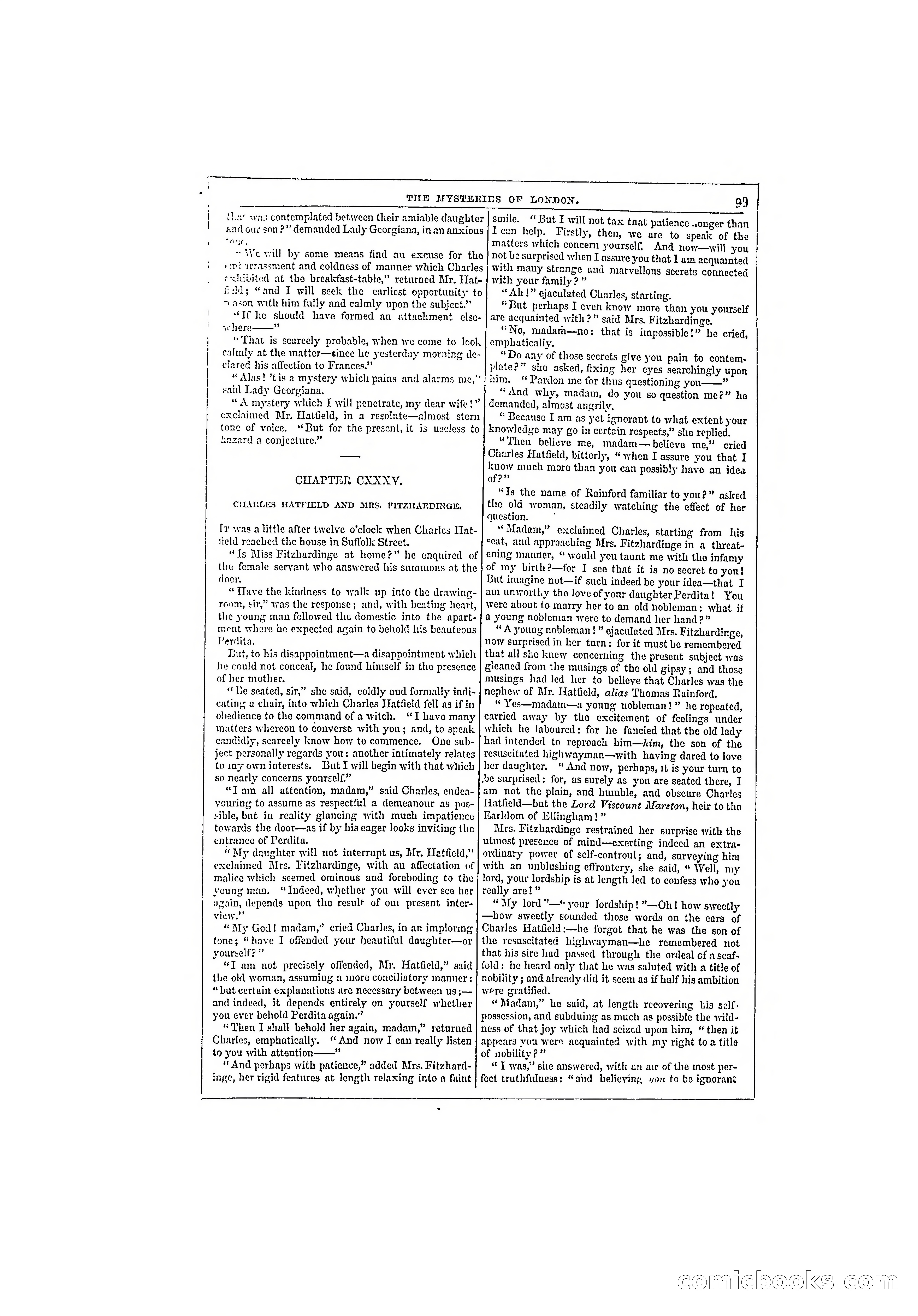
A restored page from Penny Dreadfuls, 1846. Page through the whole issue in the reader above.
📄 Transcribed text from this page (OCR, searchable)
Machine-transcribed from the original scan — historical spelling and the odd misread are preserved.
TIIE MYSTERIES OF LONDON, —" | {hat was contemplated between their amiable daughter | < . e ' and our son?” demanded Lady Georgiana, in an anxious + nye, ~ We will by some means find an excuse for the («int arrassment and coldness of manner which Charles exhibited at the breakfast-table,” returned Mr. Iat- Hild; “and TI will seek the earliest opportunity to ~ason with him fully and calmly upon the subject.” | “Tf he should have formed an attachment clse- where a ‘That is scarcely probable, when we come to look calnily at the matter—since he yesterday morning de- clared his affection to Frances.” “Alas! ’tis a mystery which pains and alarms me,” eaid Lady Georgiana. “A mystery which J will penetrate, my dear wife!” exclaimed Mr. Tatfield, in a resolute—almost stern tone of voice. “But for the present, it is useless to nazard a conjecture.” en, CHARLES HATFICLD AND MRS. FITZHARDINGEH, Ir was a little after twelve o’clock when Charles Iat- field reached the bouse in Suffolk Street. “Ts Miss Fitzhardinge at home?” he enquired of the female servant who answered his stramons at the door, “Have the kindness to walk up into the drawing- room, sir,” was the response; and, with beating heart, the young man followed the domestic into the apart- ment where he expected again to behold his beauteous Persita. But, to his disappointment—a disappointment which he could nof conceal, he found himself in the presence of her mother. “ Be seated, sir,” she said, coldly and formally indi- cating a chair, into which Charles Hatfield fell as if in obedience to the command of a witch. “I have many mnatters whereon to converse with you; and, to speak candidly, scarcely know how to commence. One sub- ject personally regards you: another intimately relates to m7 own interests. But I will begin with that which so nearly concerns yourself.” “Tam all attention, madam,” said Charles, endea- vourings to assume as respectful a demeanour as pos- sible, but in reality glancing with much impatience towards the door—as if by his eager looks inviting the entrance of Perdita. “My daughter will not interrupt us, Mr. Hatfield,” exclaimed Mrs. Fitzhardinge, with an affectation of malice which seemed ominous and foreboding to the young man. “Indeed, whether you will ever sce her again, depends upon the result of ou: present inter- view.” “My God! madam,” cried Charles, in an imploring tone; “have I offended your beautiful daughter—or yourself?” “T am not precisely offended, Mr. Hatfield,” said tlie old woman, assuming a more conciliatory manner; “but curtain explanations are necessary between us ;— and indeed, it depends entirely on yourself whether you ever behold Perdita again.’ “hen I shall behold her again, madam,” returned Charles, emphatically. ‘And now I can really listen | | | | CHAPTER CXXXV. to you with attention a ‘And perhaps with patience,” added Mrs. Fitzhard- inge, her rigid features at length relaxing into a faint smile. “But I will not tax taat patience .onger than Ican help. Firstly, then, we are to speak of the matters which concern yourself, And now—vwill you not be surprised whien I assure you that 1 am acquainted With many strange and marvellous sccrets connected with your family? ” “Ah!” ejaculated Charles, starting. “But perhaps I even know more than you yourself are acquainted with?” said Mrs. Fitzhardinge. “No, madam—no: that is impossible!” he cried, emphatically. “Do any of those secrets give you pain to contem- plate?” she asked, fixing her eyes searchingly upon him. “Pardon me for thus questioning you——” “And why, madam, do you so question me?” he demanded, almost angrily, “ Because I am as yet ignorant to what extent your knowledge may go in certain respects,” she replied. “Then believe me, madam— believe me,” cried Charles Hatfield, bitterly, “when I assure you that I know much more than you can possibly have an idea of?” “Ts the name of Rainford familiar to you?” asked the old woman, steadily watching the effect of her question. ‘* Madam,” cxclaimed Charles, starting from his ‘eat, and approaching Mrs. Fitzhardinge in a threat- enjug manner, “ would you taunt me with the infamy of my birth?—for I sce that it is no secret to you! But imagine not—if such indeed be your idea—that I am unworthy the love of your daughter Perdita! You were about to marry her to an old nobleman: what if a young nobleman were to demand her hand?” “A young nobleman!” ejaculated Mrs. Fitzhardinge, now surprised in her turn: for it must be remembered that all she knew concerning the present subject was gicaned from the musings of the old gipsy; and those musings had led her to belicye that Charles was the nephew of Mr. Watficld, alias Thomas Rainford. “ Yes—madam—a young nobleman!” he repeated, carried away by the excitement of feelings under which he laboured: for he fancied that the old lady had intended to reproach him—Aim, the son of the resuscitated highwayman—with having dared to love her daughter. “ And now, perhaps, tt is your turn to .be surprised: for, as surely as you are seated there, I am not the plain, and humble, and obscure Charles Hatfield—but the Lord Viscount Marston, heir to tho Karldom of Ellingham!” Mrs. Vitzhardinge restrained her surprise with the utmost presence of mind—cxerting indeed an extra- ordinary power of self-controul; and, surveying him with an unblushing effrontery, she said, “ Well, my lord, your lordship is at length led to confess who you really are!” “My lord ’—* your lordship! *—Oh! how sieetly —how sweetly sounded those words on the ears of Charles Hatfield:—he forgot that he was the son of the resuscitated highwayman—he remembered not that his sire had passed through the ordeal of ascaf- fold: he heard only that he was saluted with a title of nobility ; and already did it seem as if half his ambition were gratified. “Madam,” he said, at length recovering kis self- possession, and subduing as much as possible the wild- ness of that Joy which had seizcd upon him, “ then it appears vou were acquainted with my right toa fitle of nobility ?” “ T was,” sie answered, with en air of the most per- fect truthfulness: “and believing you to be ignorant (C(O) (C DOO <S LL (SO)