
Penny Dreadfuls, 1901 · page 251 of 400
I Forbid the Banns! — page 251: what you’re looking at
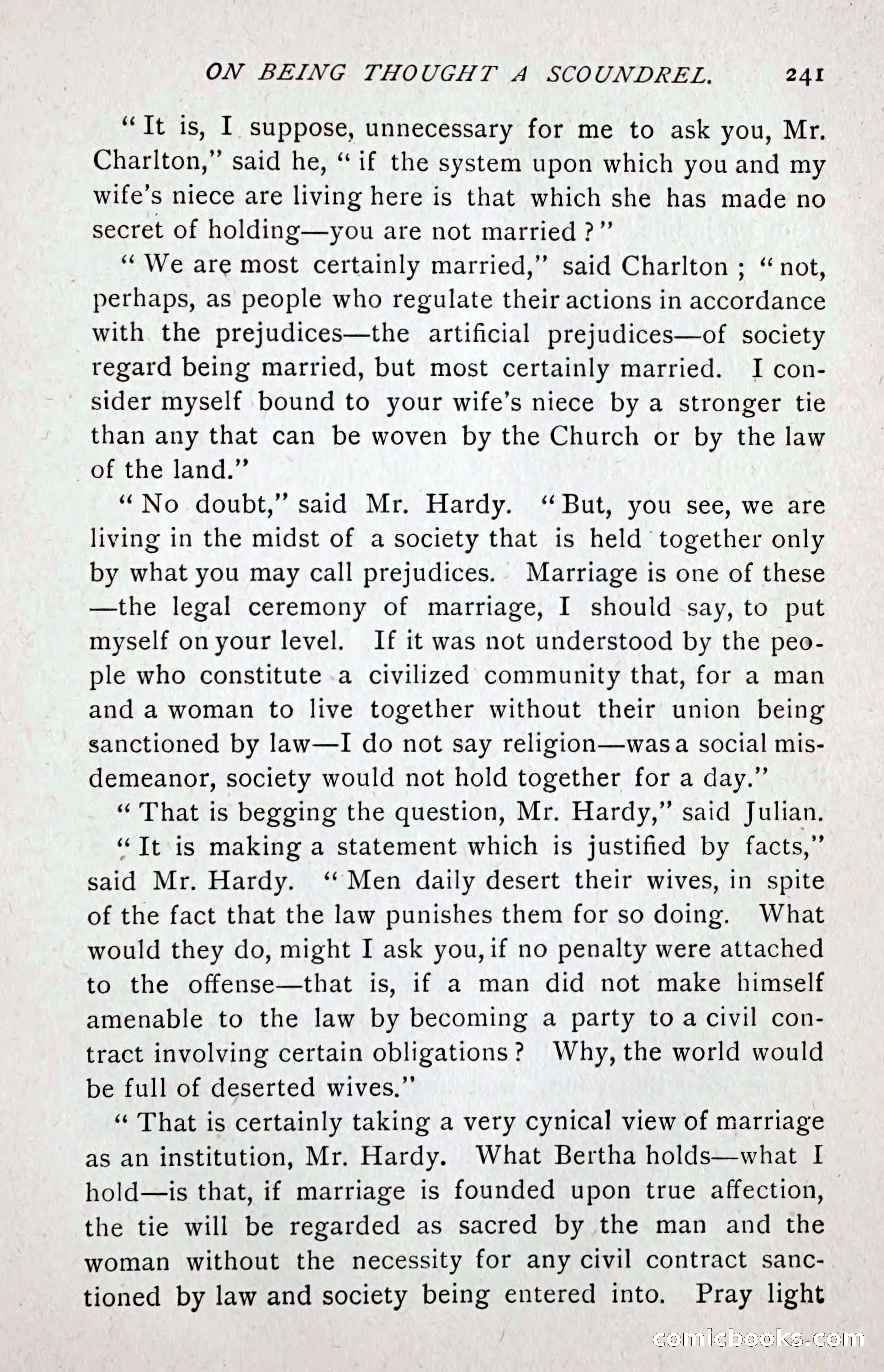
A restored page from Penny Dreadfuls, 1901. Page through the whole issue in the reader above.
📄 Transcribed text from this page (OCR, searchable)
Machine-transcribed from the original scan — historical spelling and the odd misread are preserved.
ON BEING THOUGHT A SCOUNDREL. 241 “It is, I suppose, unnecessary for me to ask you, Mr. Charlton,” said he, “if the system upon which you and my wife’s niece are living here is that which she has made no secret of holding—you are not married ?” _ ** We are most certainly married,” said Charlton ; “not, perhaps, as people who regulate their actions in accordance with the prejudices—the artificial prejudices—of society regard being married, but most certainly married. I con- sider myself bound to your wife’s niece by a stronger tie than any that can be woven by the Church or by the law of the land.” “No doubt,” said Mr. Hardy. ‘“ But, you see, we are living in the midst of a society that is held together only by what you may call prejudices. Marriage is one of these —the legal ceremony of marriage, I should say, to put myself on your level. If it was not understood by the peo- ple who constitute a civilized community that, for a man and a woman to live together without their union being sanctioned by law—I do not say religion—wasa social mis- demeanor, society would not hold together for a day.” “That is begging the question, Mr. Hardy,” said Julian. “Tt is making a statement which is justified by facts,” said Mr. Hardy. ‘‘ Men daily desert their wives, in spite of the fact that the law punishes them for so doing. What would they do, might I ask you, if no penalty were attached to the offense—that is, if a man did not make himself amenable to the law by becoming a party toa civil con- tract involving certain obligations? Why, the world would be full of deserted wives.”’ “That is certainly taking a very cynical view of marriage as an institution, Mr. Hardy. What Bertha holds—what I hold—is that, if marriage is founded upon true affection, the tie will be regarded as sacred by the man and the woman without the necessity for any civil contract sanc- tioned by law and society being entered into. Pray light (EMPMMICLYOOlKS4 (EC)