
Penny Dreadfuls, 1889 · page 3 of 32
The Human Vampire; Or, The Elixir of Life — page 3: what you’re looking at
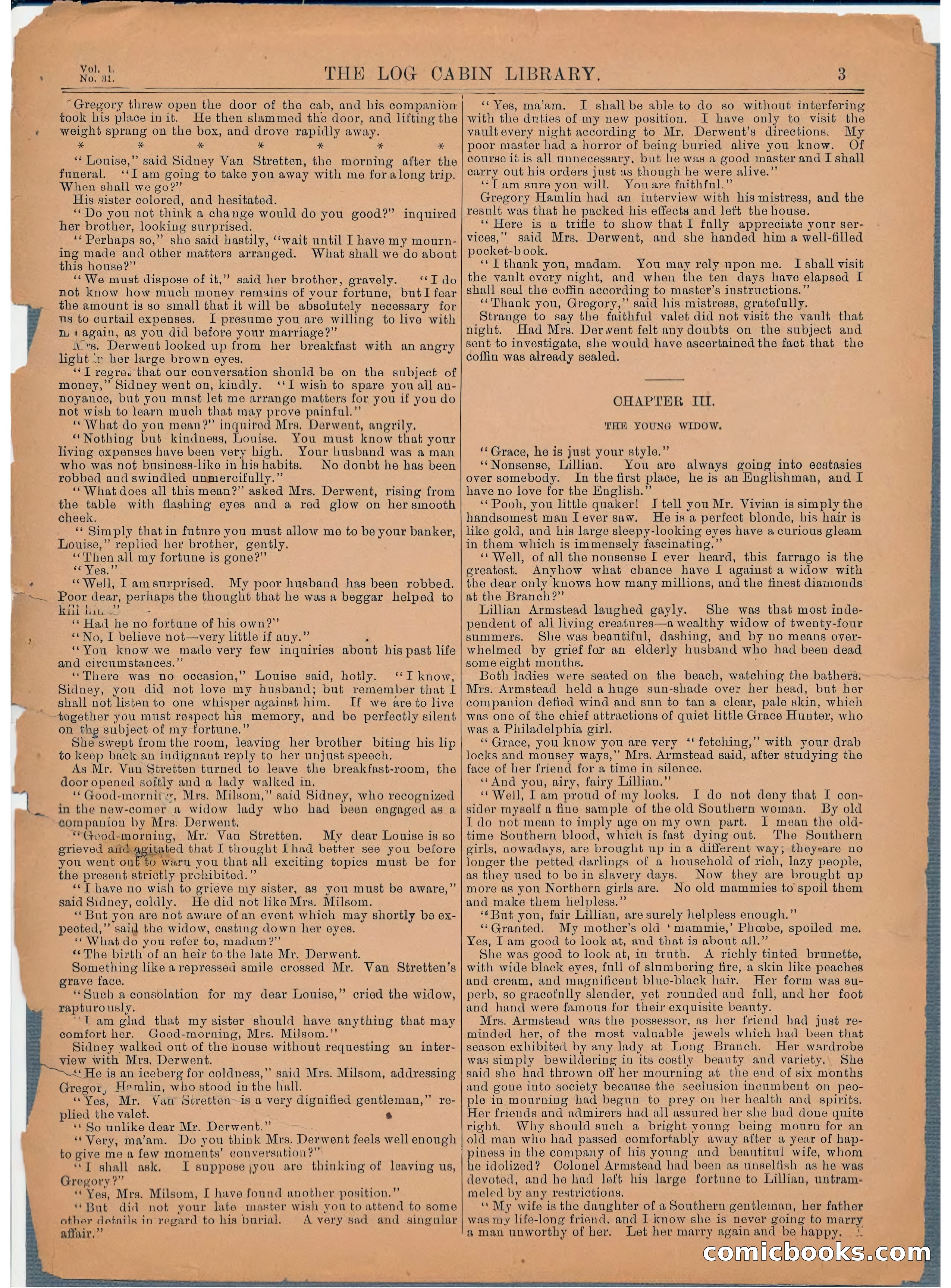
A restored page from Penny Dreadfuls, 1889. Page through the whole issue in the reader above.
📄 Transcribed text from this page (OCR, searchable)
Machine-transcribed from the original scan — historical spelling and the odd misread are preserved.
Vol. No, L ey THE LOG CABIN LIBRARY. 3 “Gregory threw open the door of the cab, and his companion took lis place init. He then slammed the door, and lifting the weight sprang on the box, and drove rapidly away. * * Me ig * * % “ Lonise,” said Sidney Van Stretten, the morning after the funeral. ‘‘Lam going to take you away with moe foralong trip. When shall we go?” His sister colored, and hesitated. “Do you not think a cha nge would do you good?” inquired her brother, looking surprised. ss Perhaps so,” she said hastily, ‘‘wait until I have my mourn- ing made and other matters arranged. What shall we do about this house?” ‘We must dispose of it,” said her brother, gravely. ‘I do not know how much money remains of your fortune, butI fear the amount is so small that it will be absolutely necessary for a to curtail expenses. I prestme you are willing to live with ragain, as you did before your marriage?” ae vs, Derwent looked up from her breakfast with an angry light ‘vr her large brown eyes, ‘“ T yegres that our conversation should be on the subject of money,” Sidney went on, kindly. ‘‘I wish to spare you all an- noyance, but you must let me arrange matters for you if you do not wish to learn much Pe may prove painful.” ‘What do you mean?” re Mrs, Derwent, angrily. “Nothing but kindness, Louise. You must know that your living expenses have been very high, Your husband was a man who was not business-like in his habits. No doubt he has been robbed aud swindled unmercifally.” “What does all this mean?” asked Mrs, Derwent, rising from the table with flashing eyes and a red glow on her smooth cheek, “ Simply thatin future you must allow me to be your banker, Louise,” replied her brother, gently. “Then all my fortune is gone?” * Yes.” ‘Well, Tamsurprised. My poor husband has been robbed. Poor dear, Beane the thought that he was a beggar helped to kil | Lith. “Had he no fortune of his own?” “‘No, I believe not—very little if any.’ “You know we macle very few inquiries about his past life and circumstances.’ “There was no occasion,” Louise said, hotly. ‘<I know, Sidney, you did not love my husband; but remember that T shall not listen to one whisper against him. If we are to live together you must respect his memory, and be perfectly silent on the subject of my fortune.” She swept from the room, leaving her brother biting his lip to keep bacl+an indignant reply to her unjust speech, As Mr. Vun Stretten turned to leave the breakfast-room, the door opened soltly and a Jady walled in. “ Good-mornit x, Mrs. Milsom," said Sidnay, who recognized in the new-comer a widow lady who had been engaged as o companion by Mrs. Derwent, *Good-morning, Mr. Van Stretten. My dear Louise is so grieved areal ated that I thought Lhad better see you before you went out to warn you that all exciting topies must be for the present strictly prohibited. ” **T have no wish to grieve my sister, a5 you must be aware,” said Sidney, coldly. He did not like Mrs. Milsom. “But you are not awire of an event which may shortly be ex- pected,” said the widow, casting down her eyes. “ What do you refer to, madam ?”’ *«The birth of an heir to the Jate Mr. Derwent. Something like n repressed smile crossed Myr. grave face. ‘Such a consolation for my dear Lonise, rapturously. “Tam glad that my sister should have anything that may comfort her, Good-morning, Mrs. Milsom.”' Sidney walled ont of the bhonse without requesting an inter- view with Mvs, Derwent. ‘* He is an iceberg for coldness,” said Mrs. Milsom, addressing Gregor, Hemlin, ea stood in ie hall. “Yes, Mr, Van Stretten~is a very dignified gentleman,” plied the valet. ry "So unlike dear Mr. Derwent.” “Very, ma’am. Do you think Mrs. Der went feels well enough to give ma n faw moments’ conversation?” “T shall ask. I suppose tyou are thinking of leaving us, Grogory ?” “Yes, Mrs, Milsom, I have found another position.” “But did not your late master wish yon to attend fo some other datnils in regard to his burial. A very sad and singular affair,” Van Stretten’s ” cried the widow, re- “‘Yos, ma'am. I shall be able to do so without interfering with the duties of my new position. I have only to visit the vaultevery night according to Mr, Derwent’s directions. My poor master had a horror of being buried alive you know. Of conrse itis all unnecessary, but he was a good master and I shall carry out his orders just us though he were alive.” “Tam sure you will. Youare faithful.” Gregory Hamlin had an interview with his mistress, and the result was that he packed his effects and left the house. ‘Here is a trifle to show that I fully appreciate your ser- vices,” said Mrs. Derwent, and she handed him a well-filled pocket-b ook. ‘‘T thank you, madam. You may rely upon me. J shall visit the yault every night, and when the ten days have elapsed I shall seal the coffin according to master’s instructions.” “Thank you, Gregory,’ said his mistress, gratefully. Strange to say the faithful valet did not visit the vault that night. Had Mrs. Derwent felt any doubts on the subject and sent to investigate, she would have ascertained the fact that the coffin was already sealed. OHAPTER ITI. THE YOUNG WIDOW, ‘*Qrace, he is just your stylo.” ‘Nonsense, Lillian. You are always going into ecstasies over somebody. In the first place, he is an Englishman, and I have no love for the English.” “Pooh, you little quaker! J tell you Mr. Vivian is simply the handsomest man Tever saw. He is a perfect blonde, his hair is like gold, and his large sleepy-looking eyes have a curious gleam in them which is immensely fascinating.” ‘Well, of all the nonsense I ever heard, this farrago is the greatest. Anyhow what chance have I against a widow with the dear only knows how many millions, and the finest diamonds at the Branch?” Lillian Armstead laughed gayly. She was that most inde- pendent of all living creatures—a wealthy widow of twenty-four summers. She was beautiful, dashing, and by no means over- whelmed by grief for an elderly husband who had been dead some eight months. Both ladies were seated on the beach, watching the bathers. Mrs. Armstead held a huge sun-shade over her head, but her companion defied wind and sun to tan a clear, pale skin, which was one of the chief attractions of quiet little Grace Hunter, who was a Philadelphia girl. “ Guace, you know you are yery ‘ fetching,”’ with your drab locks and mousey ways,’ Mrs, Armstead said, after studying the face of her friend for a time in silence, “And you, airy, fairy Lillian,” ‘Well, Iam proud of my looks, I do not deny that I con- sider myself o fine sample of the old Southern woman. By old Ido not mean to imply age on my own part. I mean the old- time Southern blood, which is fast dying out The Southern girls, nowadays, are brought up in a different way; theyrare no longer the petted darlings of a household of rich, lazy people, as they used to be in slavery days. Now they are brought up more as you Northern girls are. No old mammies to spoil them and make them helpless.” ‘But you, fair Lillian, aresurely helpless enough.” “Granted. My mother’s old ‘mammie,’ Phasbe, spoiled me. Yes, Iam good to look at, and that is about all.” She was good to look at, in truth. <A richly tinted brunette, with wide black eyes, full of slumbering fire, a skin like peaches and cream, and magnificent blue-black hair. Her form was su- perb, so gracefully slender, yet rounded and full, and her foot and hand were famous for their exquisite beauty. Mrs. Armstead was the possessor, us her friend had just re- minded her, of the most valuable jewels which had been that season exhibited by any lady at Long Branch. Her wardrobe was simply bewildering in its costly beauty and variety, She said she had thrown off her mourning at the end of six months and gone into society because the seclugion incumbent on peo- ple in mourning bad begun to prey on her health and spirits, Her friends and admirers had all assured her she had done quite right, Why should such a bright young being mourn for an old man who had passed comfortably away after a year of hap- piness in the company of his young and beautitul wife, whom is idolized? Colonel Armstend lind been as unselfish os he was devoted, and he had left his large fortune to Lillinn, untram- meled by any. restrictioas. “ My wife is the daughter of n Southern gentleman, her father was ty life-long friend. and I know she is never going to marry % man unworthy of her. Let her marry again and be happy, 1. Ecomicbooks.co