
Penny Dreadfuls, 1889 · page 15 of 32
The Human Vampire; Or, The Elixir of Life — page 15: what you’re looking at
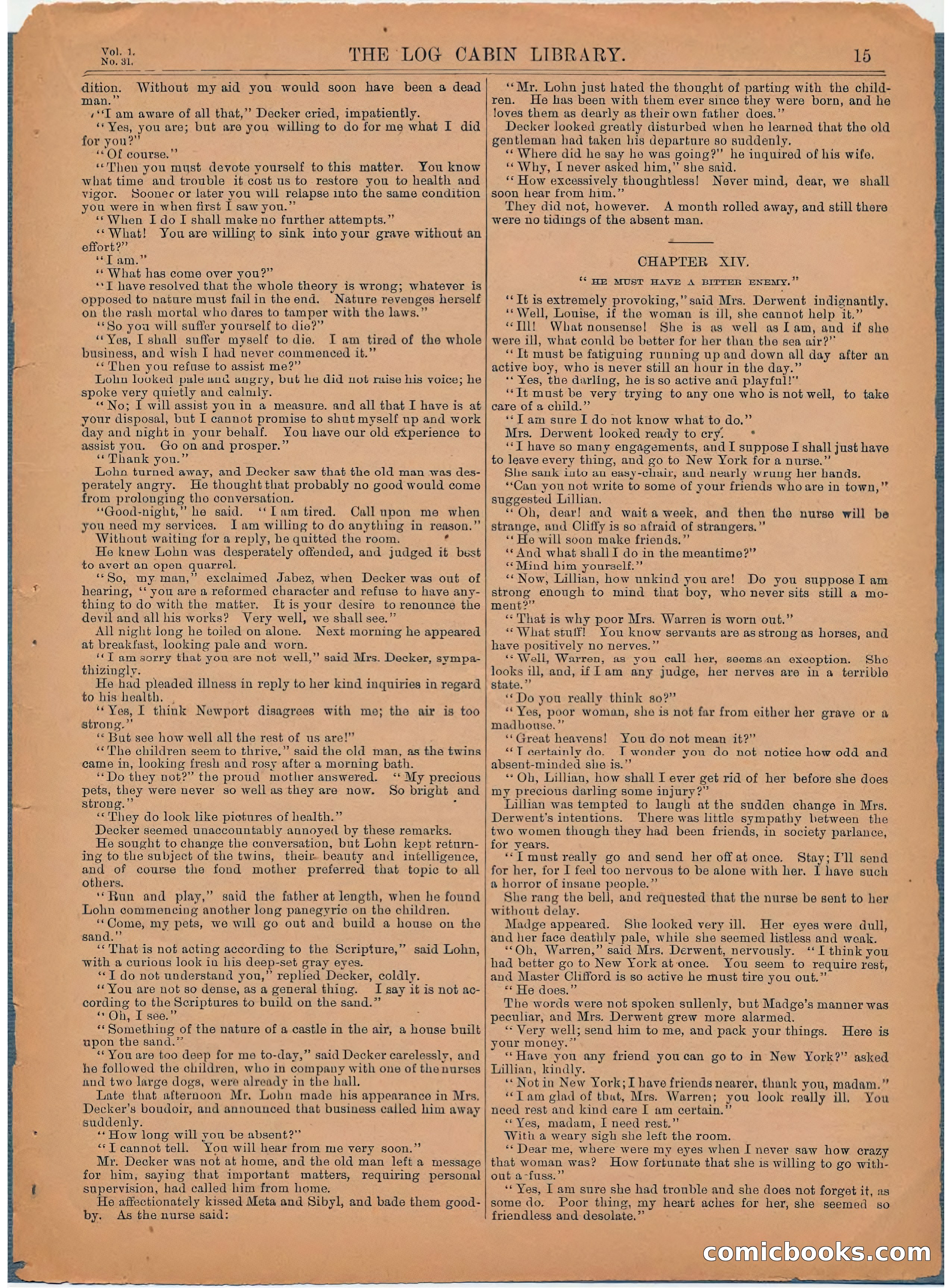
A restored page from Penny Dreadfuls, 1889. Page through the whole issue in the reader above.
📄 Transcribed text from this page (OCR, searchable)
Machine-transcribed from the original scan — historical spelling and the odd misread are preserved.
Vol. 4. THE LOG CABIN LIBRARY. 15 dition. Without my aid you would soon have been a dead ““Mr, Lohn just hated the thought of parting with the child- man.” -T am aware of all that,” Decker cried, impatiently. “Yas, you are; but are you willing to do for me what I did for you?’ ‘©Of course,” “Then you must devote yourself to this matter. You know what time and trouble it cost us to restore you to health and vigor. Soonec or later you will relapse into the same condition you were in when first I saw you.” ‘When Ido I shall make no further attempts.”’ «“What! You are willing to sink into your grave without an effort?” “Tom.” ** What has come over you?” ‘‘T have resolved that the whole theory is wrong; whatever is opposed to nature must failin the end. Nature revenges herself on the rash mortal who dares to tamper with the laws.” “So you will suffer yourself to die?” “Yos, I shall suffer myself to die, Iam tired of the whole business, and wish I had never commenced it.” “Then you refuse to assist me?” Dobn looked pale und ungry, bub he did uot mise his voice; he spoke very quietly and calmly. “No; I will assist you in a measure. and all that I have is at your disposal, but I cannot promise to shut myself up and work day and night in your behalf. You haye our old experience to assist you. Go on and prosper.” “Thank you.” Lohn turned away, and Decker saw that the old man was des- perately angry. He thoughtthat probably no good would come from prolonging tho conversation. “Good-night,” he said. ‘‘Inm tired. Call npon me when you need my services. Iam willing to do anything in reason.” Without waiting for m reply, he quitted the room. ¢ He knew Lohn was desperately offended, aud judged it best to avert on open quarrel. “So, my man,” exclaimed Jabez, when Decker was out of hearing, ‘‘ you are a reformed character and refuse to have any- thing to do with the matter, Itis your desire to renounce the devil and all his works? Very well, we shall see.” All night long he toiled on alone. Next morning he appeared at breakfast, looking pale and worn. ‘«T am sorry that you are not well,” said Mrs. Decker, sympa- thizinely. He had pleaded illness in reply to her kind inquiries in regard to his health, , “Yes, I think Newport disagrees with mo; the air is too strong.” «But see how well all the rest of us are!” “Phe children seem to thrive,” said the old man, as the twins came in, looking fresh and rosy after a morning bath. “Do they not?” the proud mother answered. <‘* My precious pets, they were never so wellas they are now. So bright and strong.” : “They do look like pictures of health.” Decker seemed unaccountably annoyed by these remarks. He sought to change the conversation, but Lohn kept return- ing to the subject of the twins, their beauty and intelligence, and of course the fond mother preferred that topic to all others. ‘Run and play,” said the father at length, when he found Lohn commencing another long panegyrie on the children. ‘Come, my pets, we will go out and build a house on the sand.” “That is not acting according to the Scripture,” said Lohn, with a curions look in his deep-set gray eyes. ‘*T do not understand you,” replied Decker, coldly. ‘“You are not so dense, as a general thing. I say it is not ac- cording to the Scriptures to build on the sand.” “ Qh, I see.” : «Something of the nature of a castle in the air, a house built upon the sand.” “You are too deep for me to-day,” said Decker carelessly, and he followed the children, who in company with one of the nurses und two large dogs, were already in the hall, Inte that afteraoon Mr. Lohn made his appenrance in Mrs. Decker's boudoir, and announced that business called him away suddenly. “ How long will you be absent?” “T cannot tell. You will hear from me very soon.” Mr. Decker was not at home, and the old man left a message for him, saying that important matters, requiring personal supervision, had called him from home. He affectionately kissed Meta and Sibyl, and bade them good- by. As the nurse said: s ren. He has been with them ever since they were born, and he loves them as dearly as their own father does.’ Decker looked greatly disturbed when he learned that the old gentleman had taken his departure so suddenly. “Where did he say ho was going?” he inquired of his wife, «Why, I never asked him," she snid. ** How excessively thoughtless! Never mind, dear, we shall soon hear from him,” They did not, however. A month rolled away, and still there were no tidings of the absent man. CHAPTER XIV. “ Ge MUST HAVE A BITTHR ENEMY.” ‘Tf is extremely provoking,’ said Mrs. Derwent indignantly. ‘*Well, Louise, if the woman is ill, she cannot help it,” “Till What nonsense! She is as well as Iam, and if she wore ill, what conld be better for her than tho sea air?” ‘It must be fatiguing running up and down all day after an active boy, who is never still an hour in the day.” ** Yes, the darling, he isso active and playful!" ‘“‘It must be very trying to any one who is not well, to take care of a child.” ‘Tam sure I do not know what to do,” Mrs. Derwent looked ready to ery. . “T have so many engagements, and I suppose I shall just haye fo leave every thing, and go to New York for a nurse.” She sank into an easy-chair, aud nearly wrung her hands. ‘Can you not write to some of your friends whoare in town,” suggested Lillian. “Oh, dear! and wait a week, and then the nurse will be strange, and Cliffy is so afraid of strangers.” ‘« He will soon make friends,”’ ‘©And what shallI do in the meantime?” ‘Mind him yourself:” “*Now, Lillian, how unkind you are! Do you suppose I am strong enough to mind that boy, who never sits still a mo- ment?” «That is why poor Mrs. Warren is worn out.’ “What stulfl You know servants are as strong as horses, and have positively no nerves.” ‘Well, Warren, as you call her, seemsan excoption. Sho looks il, and, if lam any judge, her nerves are in a terrible state.” **Do you really think 80?” “Yes, poor woman, sho is not far from either her graye or a madbouse.”” **Great heavens! You do not mean it?” “€T eartainly do. T wonder you do not notice how odd and absent-minded shie is.”’ “Ob, Lillian, how shall I ever get rid of her before she does my precious darling some injury?” Lillian was tempted to laugh aot the sudden change in Mrs. Derwent's intentions. There was little sympathy between the two women though they had been friends, in society parlance, for years. ‘‘T must really go and send her offat once. Stay; Vl send for her, for I feel too nervous to be alone with her. 1 haye such o horror of insane people.” She rang the bell, and requested that the nurse be sent to her without delay. Madge appeared. She looked very ill. Her eyes were dull, and her face deathly pale, while she seemed listless and wenk. “Oh, Warren,” said Mrs, Derwent, nervously. ‘‘I think you had better go to New York at-once. You seem to require rest, and Master Clifford is so active he must tire you out.” «* He does.” The words were not spoken sullenly, but Madge’s manner was peculiar, and Mrs. Derwent grew more alarmed. “Very well; send him to me, and pack your things. your money.” ‘*Have yon any friend youcan goto in New York?” asked Lillian, kindly. ‘“Not in New York;I have friends nearer, thank you, madam.” “Tam glad of that, Mrs. Warren; you lool really ill, You need rest and kind care I am certain.” “Yes, madam, I need res6.”’ With a weary sigh she left the room. “Dear me, where were my eyes when I never saw how crazy that woman was? How fortunate that she is willing to go with- out a-fuss.”’ ‘Yes, [am sure she had trouble and she does not forget it, as some do. Poor thing, my heart aches for her, she seemed so Here ig friendless and desolaie.”’ comicbooks.com