
Penny Dreadfuls, 1899 · page 149 of 359
Her Faithful Knight — page 149: what you’re looking at
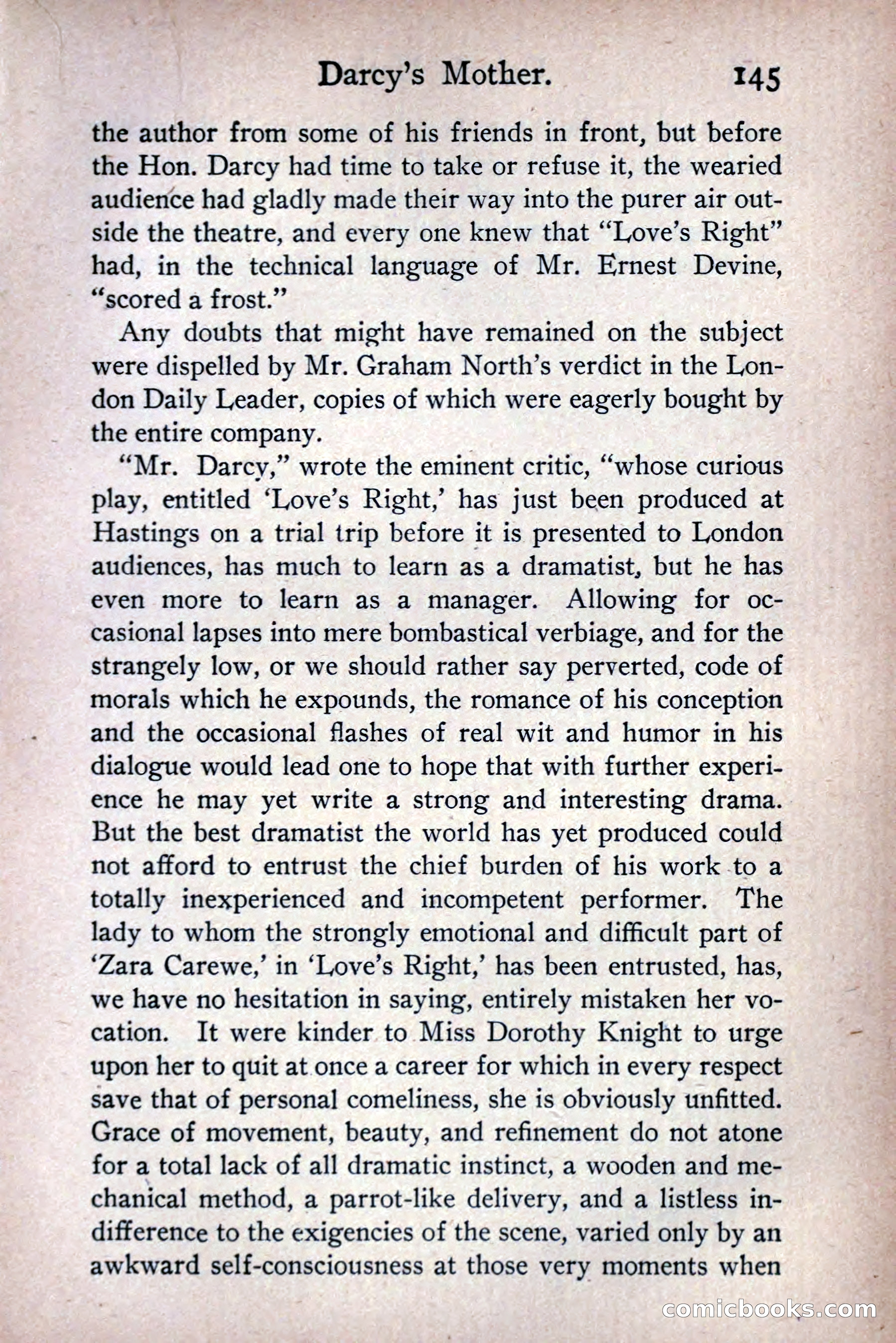
A restored page from Penny Dreadfuls, 1899. Page through the whole issue in the reader above.
📄 Transcribed text from this page (OCR, searchable)
Machine-transcribed from the original scan — historical spelling and the odd misread are preserved.
Darcy’s Mother. 145 the author from some of his friends in front, but before the Hon. Darcy had time to take or refuse it, the wearied audience had gladly made their way into the purer air out- side the theatre, and every one knew that “Love’s Right” had, in the technical language of Mr. Ernest Devine, “scored a frost.” Any doubts that might have remained on the subject were dispelled by Mr. Graham North’s verdict in the Lon- don Daily Leader, copies of which were eagerly bought by the entire company. “Mr. Darcy,” wrote the eminent critic, “whose curious play, entitled ‘Love’s Right,’ has just been produced at Hastings on a trial trip before it is presented to London audiences, has much to learn as a dramatist, but he has even more to learn as a manager. Allowing for oc- casional lapses into mere bombastical verbiage, and for the strangely low, or we should rather say perverted, code of morals which he expounds, the romance of his conception and the occasional flashes of real wit and humor in his dialogue would lead one to hope that with further experi- ence he may yet write a strong and interesting drama. But the best dramatist the world has yet produced could not afford to entrust the chief burden of his work-to a totally inexperienced and incompetent performer. The lady to whom the strongly emotional and difficult part of ‘Zara Carewe,’ in “‘Love’s Right,’ has been entrusted, has, we have no hesitation in saying, entirely mistaken her vo- cation. It were kinder to Miss Dorothy Knight to urge upon her to quit at once a career for which in every respect save that of personal comeliness, she is obviously unfitted. Grace of movement, beauty, and refinement do not atone for a total lack of all dramatic instinct, a wooden and me- chanical method, a parrot-like delivery, and a listless in- difference to the exigencies of the scene, varied only by an awkward self-consciousness at those very moments when EOmiGcdoo (S)