
Penny Dreadfuls, 1889 · page 235 of 298
A Heart's Bitterness — page 235: what you’re looking at
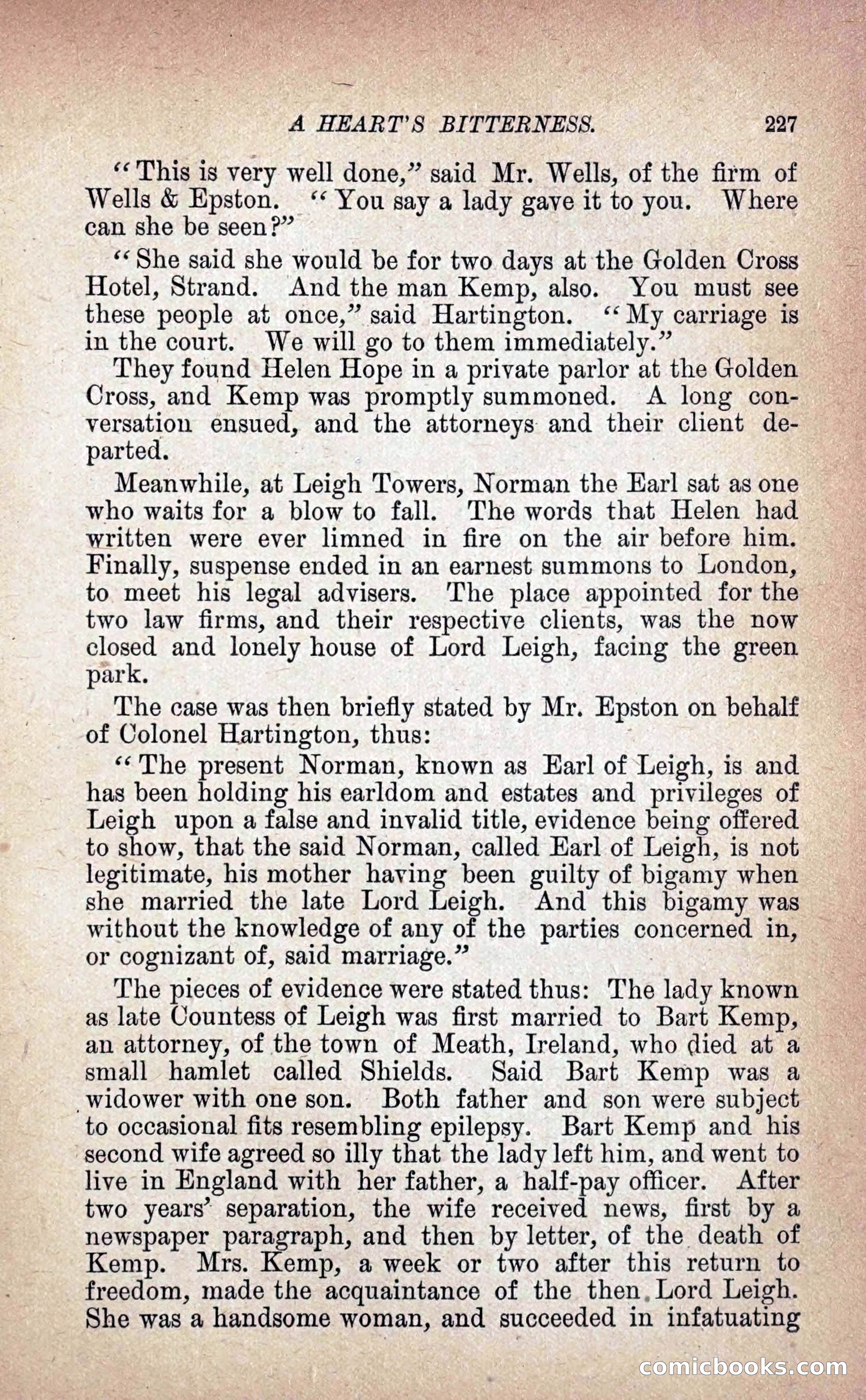
A restored page from Penny Dreadfuls, 1889. Page through the whole issue in the reader above.
📄 Transcribed text from this page (OCR, searchable)
Machine-transcribed from the original scan — historical spelling and the odd misread are preserved.
> © ae oa, “a. gala) mee ee ee Dorie Oe Uae ere a a OW he Oe or ee ee PS op ae ge Oe et ha Aa I eT Oe) ee aT or | Se Ba AD oP oer, fas @ * #8 TAP Ss : f fa, eve paw he eee ed a Bt Pt Str Se cia gen eats IY LIES Br Aly, 4 uades “CTT ae Deere ie ; a, Rpt a® “+ ae AY L mn 4 ' or Petes «+ ; A HEART'S BITTERNESS. 297 ‘This is very well done,” said Mr. Wells, of the firm of Wells & Epston. ‘* You say a lady gave it to you. Where can she be seen?” ‘<She said she would be for two days at the Golden Cross Hotel, Strand. And the man Kemp, also. You must see these people at once,” said Hartington. ‘‘ My carriage is — in the court. We will go to them immediately.” They found Helen Hope in a private parlor at the Golden Cross, and Kemp was promptly summoned. A long con- versation ensued, and the attorneys and their client de- parted. , Meanwhile, at Leigh Towers, Norman the Earl sat as one who waits for a blow to fall. The words that Helen had written were ever limned in fire on the air before him. Finally, suspense ended in an earnest summons to London, to meet his legal advisers. ‘The place appointed for the two law firms, and their respective clients, was the now closed and lonely house of Lord Leigh, facing the green park. The case was then briefly stated by Mr. Epston on behalf of Colonel Hartington, thus: | ‘‘The present Norman, known as Earl of Leigh, is and has been holding his earldom and estates and privileges of Leigh upon a false and invalid title, evidence being offered to show, that the said Norman, called Earl of Leigh, is not legitimate, his mother having been guilty of bigamy when she married the late Lord Leigh. And this bigamy was © without the knowledge of any of the parties concerned in, or cognizant of, said marriage.” | The pieces of evidence were stated thus: The lady known as late Countess of Leigh was first married to Bart Kemp, an attorney, of the town of Meath, Ireland, who died at a small hamlet called Shields. Said Bart Kemp was a widower with one son. Both father and son were subject to occasional fits resembling epilepsy. Bart Kemp and his second wife agreed so illy that the lady left him, and went to © live in England with her father, a half-pay officer. After two years’ separation, the wife received news, first by a newspaper paragraph, and then by letter, of the death of Kemp. Mrs. Kemp, a week or two after this return to freedom, made the acquaintance of the then, Lord Leigh. She was a handsome woman, and succeeded in infatuating Eomicbooks.co