
Penny Dreadfuls, 1895 · page 12 of 313
A Gentleman from Gascony: A Romance of the Huguenots — page 12: what you’re looking at
A restored page from Penny Dreadfuls, 1895. Page through the whole issue in the reader above.
📄 Transcribed text from this page (OCR, searchable)
Machine-transcribed from the original scan — historical spelling and the odd misread are preserved.
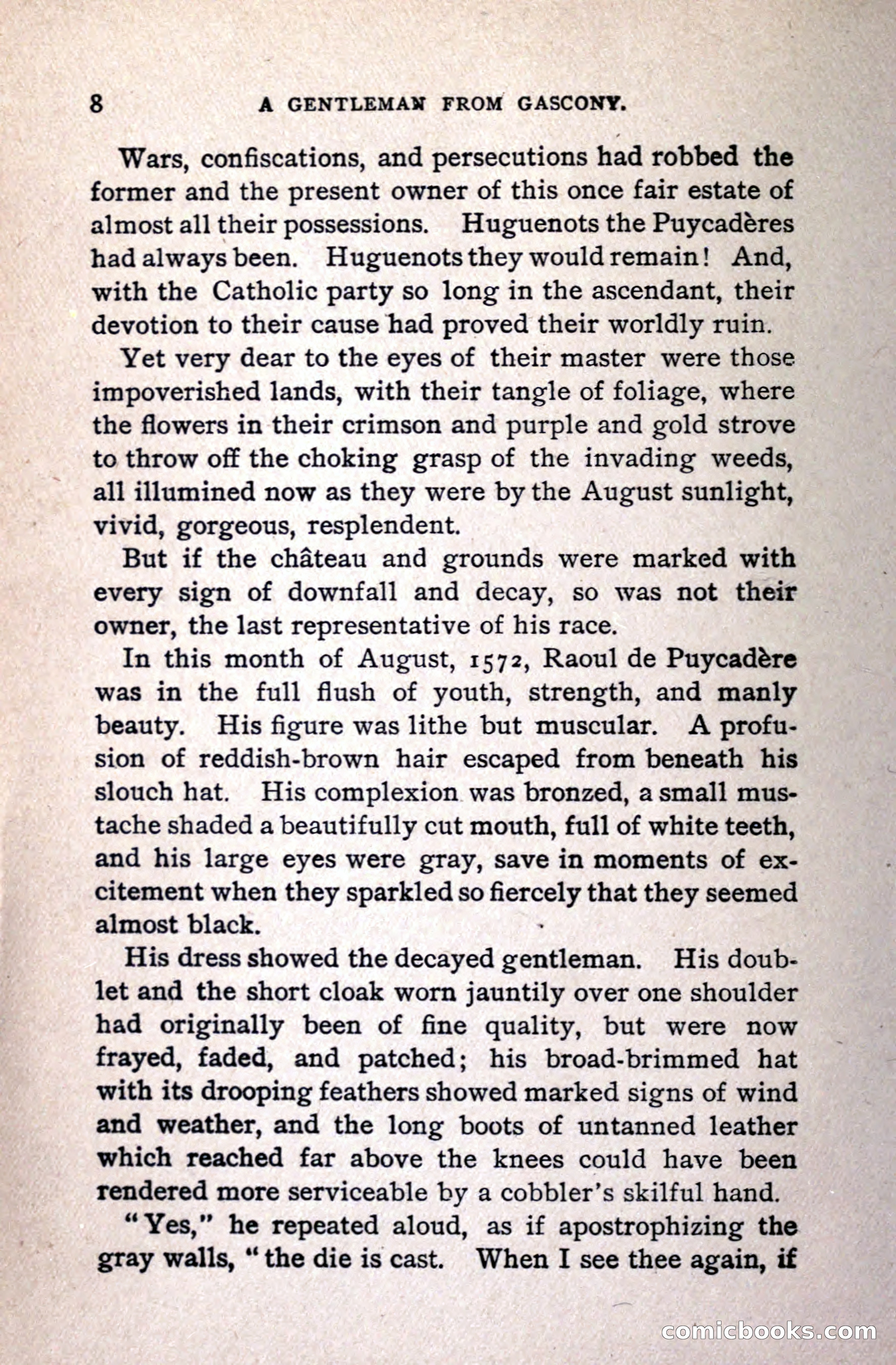
8 A GENTLEMAN FROM GASCONY. Wars, confiscations, and persecutions had robbed the former and the present owner of this once fair estate of almost all their possessions. Huguenots the Puycadéres had always been. Huguenotsthey wouldremain! And, with the Catholic party so long in the ascendant, their devotion to their cause had proved their worldly ruin. Yet very dear to the eyes of their master were those impoverished lands, with their tangle of foliage, where the flowers in their crimson and purple and gold strove to throw off the choking grasp of the invading weeds, all illumined now as they were by the August sunlight, vivid, gorgeous, resplendent. But if the chateau and grounds were marked with every sign of downfall and decay, so was not their owner, the last representative of his race. In this month of August, 1572, Raoul de Puycadére was in the full flush of youth, strength, and manly beauty. His figure was lithe but muscular. A profu- sion of reddish-brown hair escaped from beneath his slouch hat. His complexion was bronzed, a small mus- tache shaded a beautifully cut mouth, full of white teeth, and his large eyes were gray, save in moments of ex- citement when they sparkled so Beha that they seemed almost black. His dress showed the decayed ciedaanant His doub- let and the short cloak worn jauntily over one shoulder had originally been of fine quality, but were now frayed, faded, and patched; his broad-brimmed hat with its drooping feathers showed marked signs of wind and weather, and the long boots of untanned leather which reached far above the knees could have been rendered more serviceable by a cobbler’s skilful hand. “Yes,” he repeated aloud, as if apostrophizing the gray walls, “the die is cast. When I see thee again, if GEomicbooks ((©)