
Penny Dreadfuls, 1892 · page 6 of 24
Frank Reade Library No. 12: Frank Reade and His Steam Man of the Plains — page 6: what you’re looking at
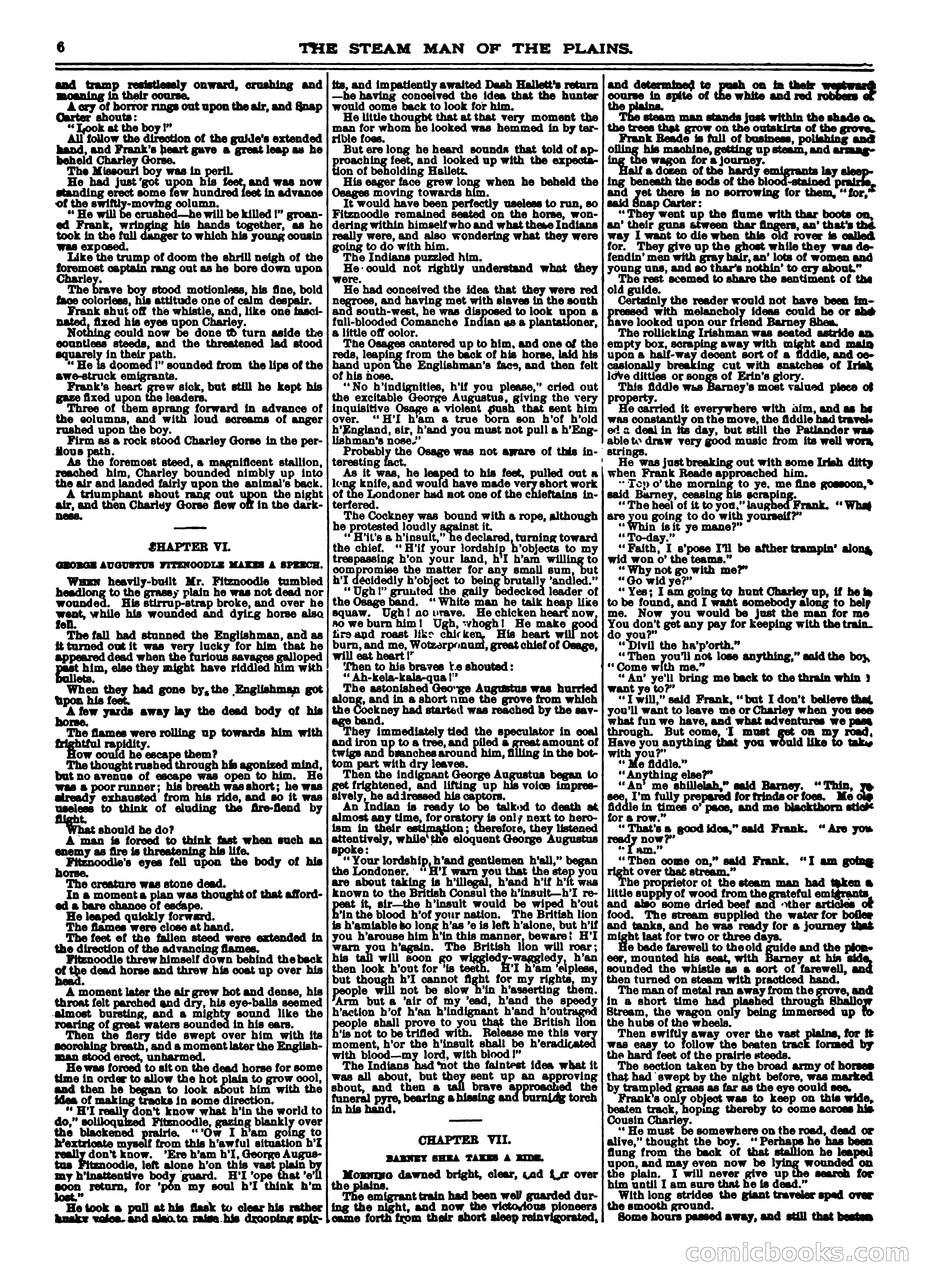
A restored page from Penny Dreadfuls, 1892. Page through the whole issue in the reader above.
📄 Transcribed text from this page (OCR, searchable)
Machine-transcribed from the original scan — historical spelling and the odd misread are preserved.
6 THE STEAM MAN OF THE PLAINS. and tramp resistlessly onward, crushing and a ory of horror nngs out upon the air, and Rasp Oarter shouts: ** Look at the boy !” All follow the direction of the guide’s extended hand, and Frank’s heart guve a great leap a» he beheld Charley Gorse. The Missouri boy was in peril. He had just ’got upon his and was now standing erect some few hundred feet in advance of the swiftly-moving column. “ He will be crushed—he will be killed !” groan- ed Frank, wrip his hands together, as he took in the full r to which his young cousin was exposed. Like the trump of doom the shrill neigh of the foremost captain rang out as he bore dowa upon Charley. The Siave boy stood motionless, his fine, bold face colorless, his attitude one of calm despair. Frank shut off the whistle, and, like one fasci- nated, fixed his eyes upon Charley. Nothing could now be done t® turn aside the eountless steeds, and the threatened lad stood rey a their path. ** He is doomed !” sounded from the lips of the awe-struck em ta. Frank’s heart w sick, but still he kept his gaze fixed upon the leaders. Three of them sprang forward in advance of the columns, and with loud screams of anger rushed upon the boy. ore Broce stood Charley Gorse in the per- ous path. As the foremost steed, a magnificent stallion, reached him, Charley bounded nimbly up into the air and landed fairly upon the animal's back. A triumphant shout rang out n the night air, and then Charidy Gorse flew off in the dark- ness. SHAPTER VI. GEORGE AUGUSTUS FITZNOODLE MAKES A SPEECH. Wen heavily-built Mr. Fitznoodie tumbled headlong to the grassy plain he was not dead nor wounded. His stirrup-strap broke, and over he oo while his wounded and dyirg horse alsa 6 oe The fall had stunned the Englishman, and as it turned out it was very lucky for him that he peared dead when the furious savages galloped ps am, else they might have riddled him with When they had gone by, the Englishman got upon his feet. oo. few yards away lay the dead body of his rse. The flames were rolling up towards him with tful rapidity. ow could he escape them? The thought rushed through his agonized mind, but no avenue of escape was open to him. He was 8 poor runner; his breath was short; he was already exhausted from his ride, and so it was useless to think of eluding the fire-flend by t. hat should he do? A man is forced to think fast when such an enemy as fire is threatening his life. . Fitznoodle’s eyes fell upon the body of his orse, The creature was stone dead. In a momenta plan was thought of that afford- ed a bare chance of escape. He leaped quickly forward. The flames were close at hand. The feet ef the fallen steed were extended in the direction of the advancing flames. Fitznoodle threw himself down behind the back of the dead horse and threw his coat up over his A moment later the air grew hot and dense, his throat felt parched and dry, his eye-balls seemed almost bursting, and a mighty sound like the roaring of great waters sounded in his ears. Then the fiery tide swept over him with its scorching breath, and a moment later the English- man stood erect, unharmed. He was forced to sit on the dead horse for some time in order to allow the hot : plain to grow cool, and then he began to look ut him with the idea of making tracks in some direction. ** H’l really don’t know what h’in the world to do,” soliloquized Fitenoodle, gazing blankly over the blackened prairie. “’Ow I h’am going to h’extricate m from this h’awful situation h’Z really don’t know. ’Ere h’am h’I, George Augus- tas oodle, left alone h’on this vast plain by my h’inattentive body guard. H'I ’ope that ’e’ soon return, for *pon my soul He took a pull at his flask tw clear his rather husky voice. and alao.ta raisa. his drooping spir- h’I think h’m | th its, and impatiently awaited Dash Hallett’s return —he having conoeived the idea that the hunter would come back to look for him. He little phousht that at that very moment the man for whom he looked was hemmed in by ter- rible foes. But ere long he heard sounds that told of ap- proaching feet, and looked up with the expecta- igiis ‘eee face now lo hen he beheld th eager face w long when he C) Osages moving towards hima, It would have been perfectly useless to run, 80 Fitznoodle remained seated on the horse, won- dering within himself who and what these Indians really were, and also wondering what they were going to do with him. The Indians puzzled him. He- could not rightly understand what they were. He had conceived the idea that they were red D , and having met with slaves in the south and south-west, he was dis to look - upon a fall-blooded Comanche Indian gs a plan ner, @ little off color. The Osages cantered up to him, and one of the reds, leaping from the back of his horse, laid his hand upon the Englishman's face, and then felt of his nose. ‘‘No h’indignities, h’if you please,” cried out the excitable George Augustus, giving the very inquisitive Osage a violent gush that sent him over. ‘“ H’I h’am a true born son h’of h’old h’England, sir, h’and you must not pull a h’Eng- lishman’s nose.” Probably the Osage was not aware of this in- teresting fact. As it was, he lea to his feet, pulled out a long knife, and would have made very short work of the Londoner had not one of the chieftains in- terfered. The Cockney was bound with a rope, although he protested loudly st it. ‘** H’it’s a h’insuilt,” he declared, turning toward the chief. ‘ H’if your lordship objects to my trespassing h’on your land, h’I bh’am willing to com promise the matter for any small sum, but h’I décidedly h’object to being brutally ’andled.” ‘‘Ugh!” gruuted the gaily ecked leader of the band. ‘ White man he talk heap like equaw. Ugh! no vrave. He chicken heart now so we burn him! Ugh, ‘vhogh! He make oie and Epler chic ke great chief T Osene, urn,and me, Wotzerponum, chief 0 4 will eat heart !” ‘Then to his braves f.e shouted : ‘* Ah-kela-kala-qua {” The astonished Geo-ge Augustus was hurried srong, ane in a short nme the grove from which the meg had starte«| was reached by the sav- band. “eT hey immediately tied the speculator in coal and iron up to a tree, and piled a amount of twigs and branches around him, fi in the bot- tom part with dry leaves. Then the indignant George Au us began to voica impres- get frightened, and lifting u erely ee ad iressed his on ns An Indian is ready to almost any time, for oratory is only next to hero- ism in their estimation ; refore, they listened attentively, while'the eloquent George Augustus spoke: ‘** Your lordship, h’and gentlemen h’all,” the Londoner. ' “ H’I warn you that the step you are about taking is h’illegal, h’and h’if h’it was known to the British Consul the h’insuit—h’I re- it, sir—the h’insult would be wiped h’out *in the blood h’of your nation. The British lion is h’amiable So long h’as ’e is left h’alone, but h’if you h’arouse him h’in this manner, beware! H’I vom a yea h’again. The British lion will roar; will soon go edy-waggledy, h’an then look h'out for ’is le HT h’am ‘cipless, but though h’I cannot fight for my rights, my people will not be slow h’in h’asserting them. Arm but a ’air of my ’ead, h’and the speed h’action h’of h’an h’indignant h’and Woutragad ple shall prove to you that the British lion Fis not to be trifled with. Release me this v moment, h’or the h’insult shalt be h’eradicated with blood—my lord, with biood !” The Indians ‘not the faintest idea what it was all about, but they sent up an approving talked to death at shout, and then a brave ap roached the fanere) pyre, Dearing = biasing as burnidg torch CHAPTER VII. BARNEY GHEA TAKES A RIDE. Monwiya dawned bright, clear, cad fr over e , emigrant train had been wel! guarded dur- ® ing the night, and now the victoyious pioneers came forth from their short sleep rein and d te etermined on in their sparee in. spite of white and red , polishing and oO his machine, getting up steams, and arrang- ing wagon for a journey. alf a dozen of the hardy lay ae eee there is onowie for them, “fo and ye no sorrow or ** for, said Soap Carter: ‘“‘They went up the flume with thar boots on, an’ their guns stween thar , an’ that’s thé way I want to die when this old rover is called for. They give up the ghost while they was de- fendin’ men with gray hair, an’ lots of women and young uns, and so thar’e nothin’ to cry about.” The rest scemed to share the sentiment of the old guide. Certainly the reader would not have been im- ressed with melancholy ideas could he or shé ave looked upon our friend Barney Shea. The rollicking Irishman was seated astride an empty box, scraping away with might and main upon a half-way decent sort of a fiddle, and oo- casionally b cut with snatches of Irisk loVe ditties or songs of Erin's glory. This fiddle was Barney's most valued piece of property: . © carried it everywhere with aim, and as he was constantly on the move, the fiddle had travele ed 2 deal in its day, but still the Patlander was able t draw very good music from its well worn ' strings. He was just breaking out with some Irish ditty when Frank Reade approached him. Top o’ the morning to ye, me fine gossoon,® said Barney, ceasing his scraping. ‘‘The heel of it to you,” jaughed Frank, ‘‘ Whag are bie going to do with yourseif?” “ n isit ye mane?” 6e Oo day.” ‘‘ Faith, I s’pose I'll be afther trampin’ alo wid won o’ the teams.” “e n ‘‘ Why not go with me?” “Yoos Laan g ing to hunt Chariey if he fa “Yes; Iam go \] up, to be found, and I want somebody atoug to help me. Now you would be just the man for me you don't get any pay for keeping with the train. 0 you?” «Divil the ha’p’orth.” “Then you'll not lose anything,” said the bo}, ‘Come with me.” ‘“‘ An’ ye'll bring me back to the thrain whin } want ye to?” ‘*T will,” said Frank, “but I don’t believe that you’ll want to leave me or Charley when you see what fun we have, and what adventures we pase through. But come, J must On my road, ~~ you anything that you would like to taky ou?” ‘“* Me fiddle.” “ Anything else?” ‘‘An’ me shillelah,” said Barney. “Thin, see, I’m fully prepered for frinds or foes. Me de fiddle in times o’ pace, and me blackthorn stick r a row.” “* That’s a good idoa,” said Frank. “Are you ready now?” be am.” ‘“‘Tbhen come on,” said Frank. “I am going ht over that stream.” little _ wood fie th tal en ferante, © supply of w rom the emigre and siso some dried beef and ther articies of food. The stream supplied the water for and tanks, and he was ready for a journey that might last for two or three da e bade farewell to theold guide and the plone eer, mounted his seat, with ey at hin sid sounded the whistle as a sort of farewell, an then turned on steam with practiced hand. The man of metal ran away from the 6, and Stream un ween 6 pela immersed ‘ m, the wagon o m u the hubs of the wheels. y 8 P Then swiftly away over the vast for it was easy to follow the beaten track formed by the hard feet of the prairie ateeds. The section taken by the broad army of horses that had swept by the night before, was marked by Sampled grace as far as the eye could see, Frank's only object was to keep on this wide, beaten track, hoping thereby to come acroas his Cousin wong ‘*Hoe must be somewhere on the road, dead or alive,” thought the boy. ‘‘ Perhaps he has been flung from the back of that stallion he leaped upon, and may even now be lying wounded on the plain. I will never give up search for him uatil I am sure that he is dead.” With long strides the giant traveler sped over the smooth ground. Some hours passed away, and still that besten COmiIcoooe C S (SO)