
Penny Dreadfuls, 1900 · page 91 of 254
The Evil Genius: A Domestic Story — page 91: what you’re looking at
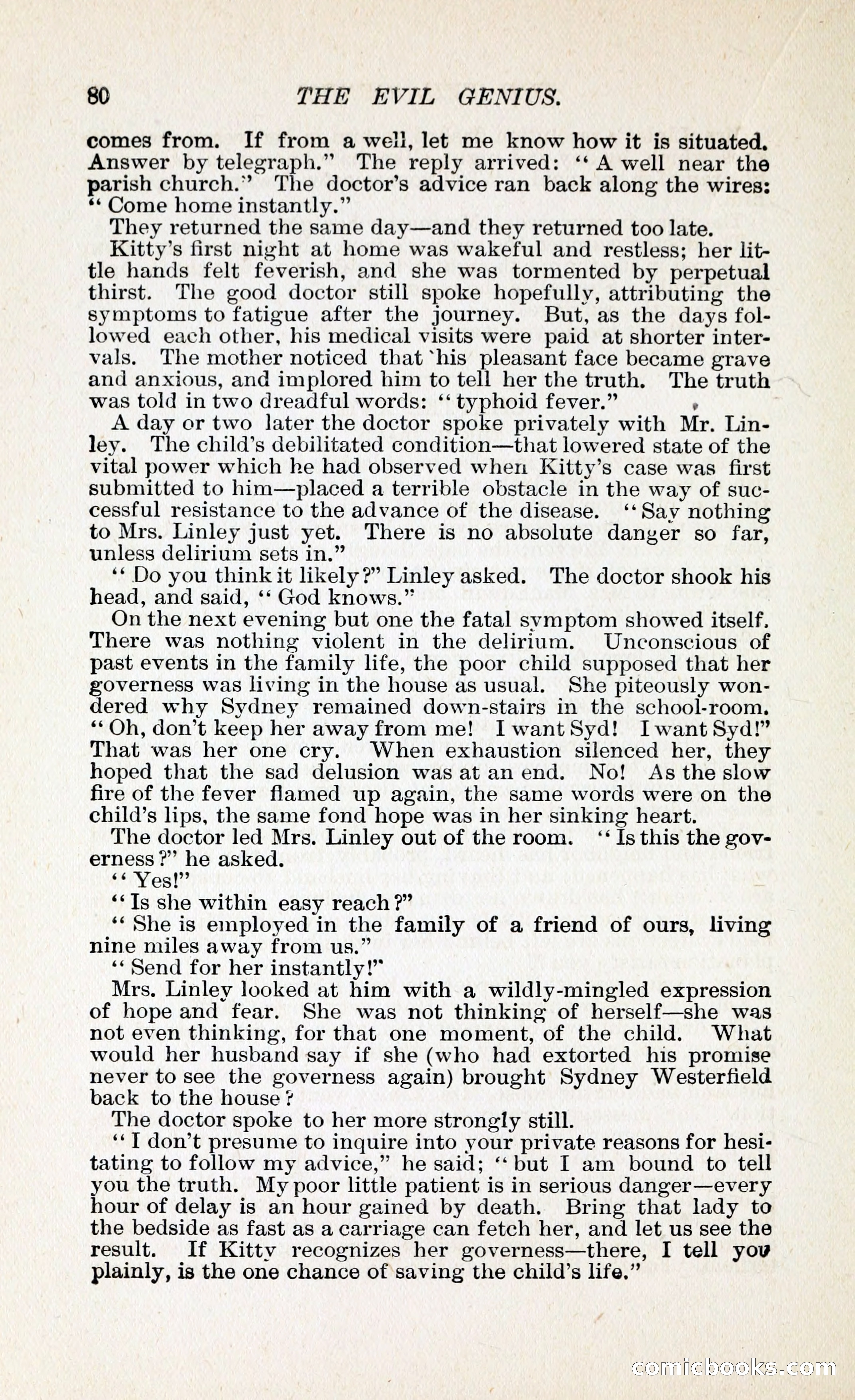
A restored page from Penny Dreadfuls, 1900. Page through the whole issue in the reader above.
📄 Transcribed text from this page (OCR, searchable)
Machine-transcribed from the original scan — historical spelling and the odd misread are preserved.
80 THE EVIL GENIUS. comes from. If from a well, let me know how it is situated. Answer by telegraph.” The reply arrived: ‘‘ A well near the parish church.” The doctor’s advice ran back along the wires: **Come home instantly.” They returned the same day—and they returned too late. Kitty’s first night at home was wakeful and restless; her lit- tle hands felt feverish, and she was tormented by perpetual thirst. The good doctor still spoke hopefully, attributing the symptoms to fatigue after the journey. But, as the days fol- lowed each other, his medical visits were paid at shorter inter- vals. The mother noticed that his pleasant face became grave and anxious, and implored him to tell her the truth. The truth was told in two dreadful words: ‘‘ typhoid fever.” ’ A day or two later the doctor spoke privately with Mr. Lin- ley. The child’s debilitated condition—that lowered state of the vital power which he had observed when Kitty’s case was first submitted to him—placed a terrible obstacle in the way of suc- cessful resistance to the advance of the disease. ‘‘Say nothing to Mrs. Linley just yet. There is no absolute danger so far, unless delirium sets in.” ‘* Do you think it likely?” Linley asked. The doctor shook his head, and said, ‘‘ God knows.” On the next evening but one the fatal symptom showed itself. There was nothing violent in the delirium. Unconscious of past events in the family life, the poor child supposed that her governess was living in the house as usual. She piteously won- dered why Sydney remained down-stairs in the school-room. ‘Qh, don’t keep her away from me! I wantSyd! Iwant Syd!” That was her one cry. When exhaustion silenced her, they hoped that the sad delusion was at anend. No! As the slow fire of the fever flamed up again, the same words were on the child’s lips, the same fond hope was in her sinking heart. The doctor led Mrs. Linley out of the room. ‘‘ Is this the gov- erness ?” he asked. ‘* Yes!” ‘‘Is she within easy reach ?” ‘‘ She is employed in the family of a friend of ours, living nine miles away from us.” ‘* Send for her instantly!” Mrs. Linley looked at him with a wildly-mingled expression of hope and fear. She was not thinking of herself—she was not even thinking, for that one moment, of the child. What would her husband say if she (who had extorted his promise never to see the governess again) brought Sydney Westerfield back to the house ? The doctor spoke to her more strongly still. ‘‘T don’t presume to inquire into your private reasons for hesi- tating to follow my advice,” he said; ‘‘ but I am bound to tell you the truth. My poor little patient is in serious danger—every hour of delay is an hour gained by death. Bring that lady to the bedside as fast as a carriage can fetch her, and let us see the result. If Kittv recognizes her governess—there, I tell you plainly, is the one chance of saving the child’s life.” EGomichbooks (c@) m