
Penny Dreadfuls, 1900 · page 48 of 254
The Evil Genius: A Domestic Story — page 48: what you’re looking at
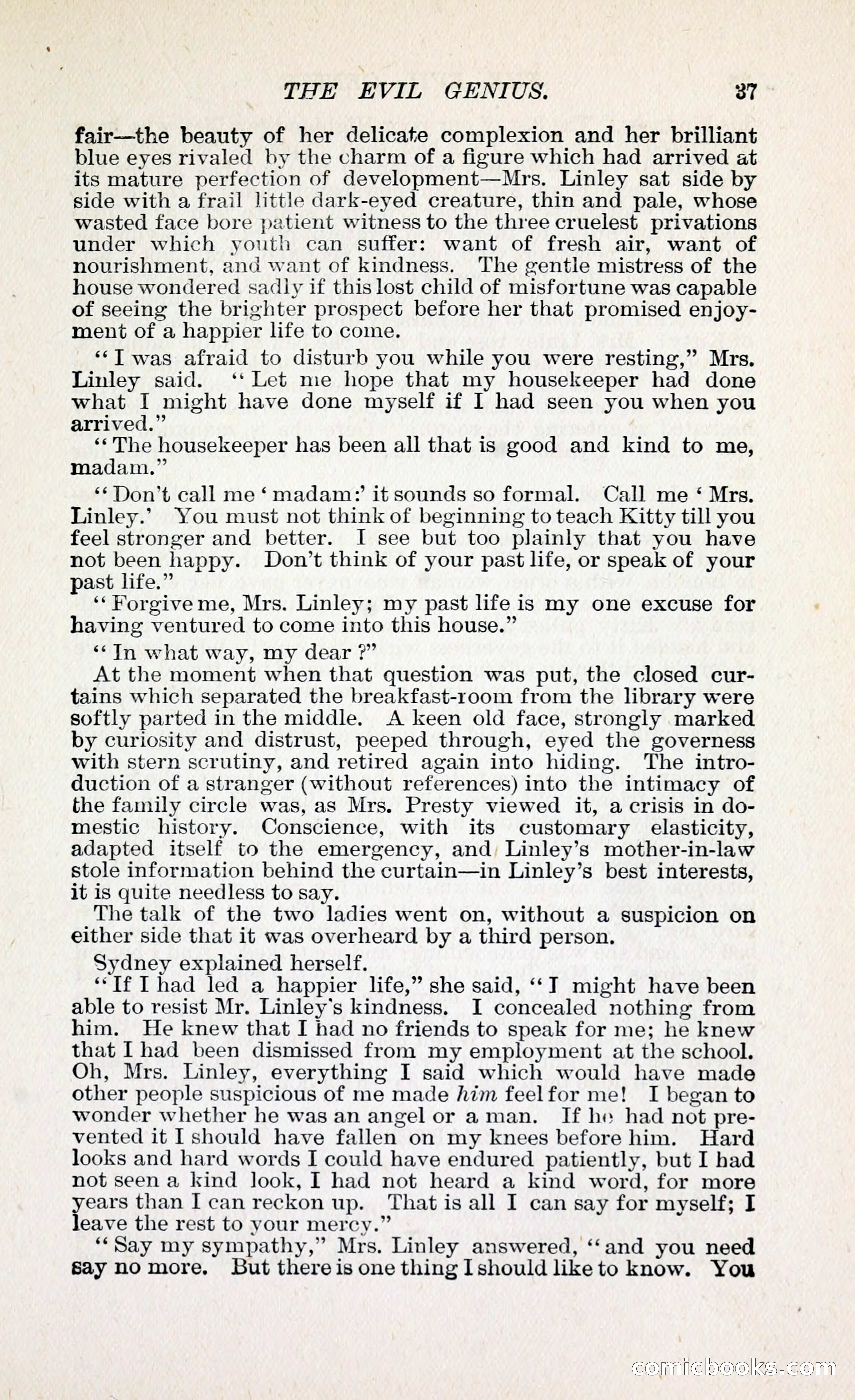
A restored page from Penny Dreadfuls, 1900. Page through the whole issue in the reader above.
📄 Transcribed text from this page (OCR, searchable)
Machine-transcribed from the original scan — historical spelling and the odd misread are preserved.
THE EVIL GENIUS. 37 fair—the beauty of her delicate complexion and her brilliant blue eyes rivaled by the charm of a figure which had arrived at its mature perfection of development—Mrs. Linley sat side by side with a frail little dark-eyed creature, thin and pale, whose wasted face bore patient witness to the three cruelest privations under which youth can suffer: want of fresh air, want of nourishment, and want of kindness. The gentle mistress of the house wondered sadly if this lost child of misfortune was capable of seeing the brighter prospect before her that promised enjoy- ment of a happier life to come. ‘‘T was afraid to disturb you while you were resting,” Mrs. Linley said. ‘‘ Let me hope that my housekeeper had done what I might have done myself if I had seen you when you arrived.” ‘‘The housekeeper has been all that is good and kind to me, madam.” ‘Don’t call me ‘madam? itsounds so formal. Call me ‘ Mrs. Linley.” You must not think of beginning to teach Kitty till you feel stronger and better. I see but too plainly that you have not been happy. Don’t think of your past life, or speak of your past life.” ‘Forgive me, Mrs. Linley; my past life is my one excuse for having ventured to come into this house.” “In what way, my dear ?” At the moment when that question was put, the closed cur- tains which separated the breakfast-room from the library were softly parted in the middle. A keen old face, strongly marked by curiosity and distrust, peeped through, eyed the governess with stern scrutiny, and retired again into hiding. The intro- duction of a stranger (without references) into the intimacy of the family circle was, as Mrs. Presty viewed it, a crisis in do- mestic history. Conscience, with its customary elasticity, adapted itself to the emergency, and Linley’s mother-in-law stole information behind the curtain—in Linley’s best interests, it is quite needless to say. The talk of the two ladies went on, without a suspicion on either side that it was overheard by a third person. Sydney explained herself. ‘‘If I had led a happier life,” she said, ‘‘I might have been able to resist Mr. Linley’s kindness. I concealed nothing from him. He knew that I had no friends to speak for me; he knew that I had been dismissed from my employment at the school. Oh, Mrs. Linley, everything I said which would have made other people suspicious of me made him feelfor me! I began to wonder whether he was an angel or aman. If he had not pre- vented it Ishould have fallen on my knees before him. Hard looks and hard words I could have endured patiently, but I had not seen a kind Jook, 1 had not heard a kind word, for more years than I can reckon up. That is all I can say for myself; I leave the rest to your mercy.” ‘‘Say my sympathy,” Mrs. Linley answered, ‘‘and you need Say no more. But thereis one thing Ishouldliketo know. You COMMICLO© S (CO) im