
Penny Dreadfuls, 1900 · page 43 of 254
The Evil Genius: A Domestic Story — page 43: what you’re looking at
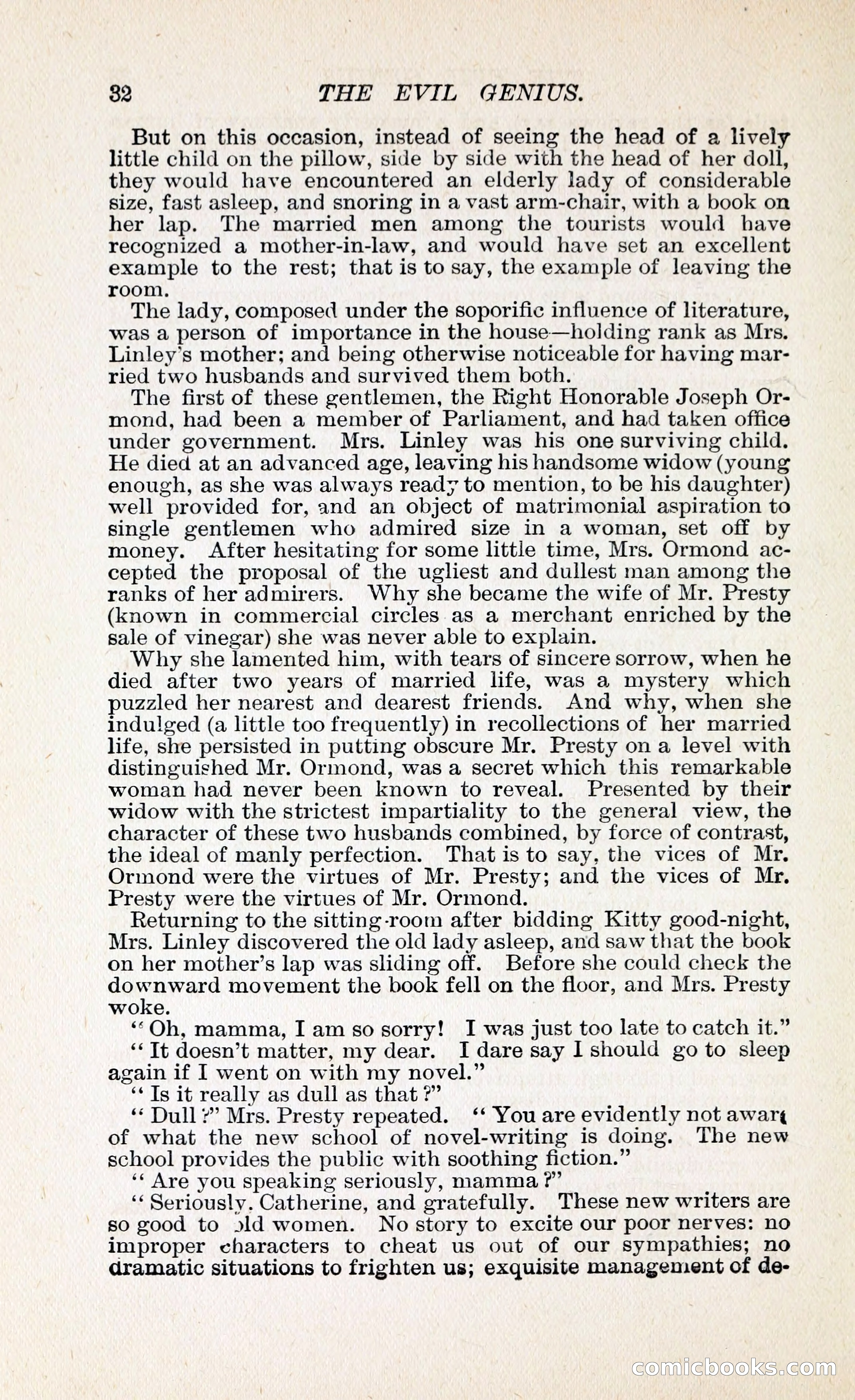
A restored page from Penny Dreadfuls, 1900. Page through the whole issue in the reader above.
📄 Transcribed text from this page (OCR, searchable)
Machine-transcribed from the original scan — historical spelling and the odd misread are preserved.
32 THE EVIL GENIUS. But on this occasion, instead of seeing the head of a lively little child on the pillow, side by side with the head of her doll, they would have encountered an elderly lady of considerable size, fast asleep, and snoring in a vast arm-chair, with a book on her lap. The married men among the tourists would have recognized a mother-in-law, and would have set an excellent example to the rest; that is to say, the example of leaving the room. The lady, composed under the soporific influence of literature, was a person of importance in the house—holding rank as Mrs. Linley’s mother; and being otherwise noticeable for having mar- ried two husbands and survived them both. The first of these gentlemen, the Right Honorable Joseph Or- mond, had been a member of Parliament, and had taken office under government. Mrs. Linley was his one surviving child. He died at an advanced age, leaving his handsome widow (young enough, as she was always ready to mention, to be his daughter) well provided for, and an object of matrimonial aspiration to single gentlemen who admired size in a woman, set off by money. After hesitating for some little time, Mrs. Ormond ac- cepted the proposal of the ugliest and dullest man among the ranks of her admirers. Why she became the wife of Mr. Presty (known in commercial circles. as a merchant enriched by the sale of vinegar) she was never able to explain. Why she lamented him, with tears of sincere sorrow, when he died after two years of married life, was a mystery which puzzled her nearest and dearest friends. And why, when she indulged (a little too frequently) in recollections of her married life, she persisted in putting obscure Mr. Presty on a level with distinguished Mr. Ormond, was a secret which this remarkable woman had never been known to reveal. Presented by their widow with the strictest impartiality to the general view, the character of these two husbands combined, by force of contrast, the ideal of manly perfection. That is to say, the vices of Mr. Ormond were the virtues of Mr. Presty; and the vices of Mr. Presty were the virtues of Mr. Ormond. Returning to the sitting-room after bidding Kitty good-night, Mrs. Linley discovered the old lady asleep, and saw that the book on her mother’s lap was sliding off. Before she could check the downward movement the book fell on the floor, and Mrs. Presty woke. ‘‘Oh, mamma, I am so sorry! I was just too late to catch it.” ‘‘Tt doesn’t matter, my dear. I dare say I should goto sleep again if I went on with my novel.” ‘*Ts it really as dull as that ?” ‘* Dull?’ Mrs. Presty repeated. ‘‘ You are evidently not awar, of what the new school of novel-writing is doing. The new school provides the public with soothing fiction.” ‘‘ Are you speaking seriously, mamma ?”’ ‘‘ Seriously. Catherine, and gratefully. These new writers are so good to »ld women. No story to excite our poor nerves: no improper characters to cheat us out of our sympathies; no dramatic situations to frighten us; exquisite management of de- Gomiichbooks:co im