
Penny Dreadfuls, 1900 · page 34 of 254
The Evil Genius: A Domestic Story — page 34: what you’re looking at
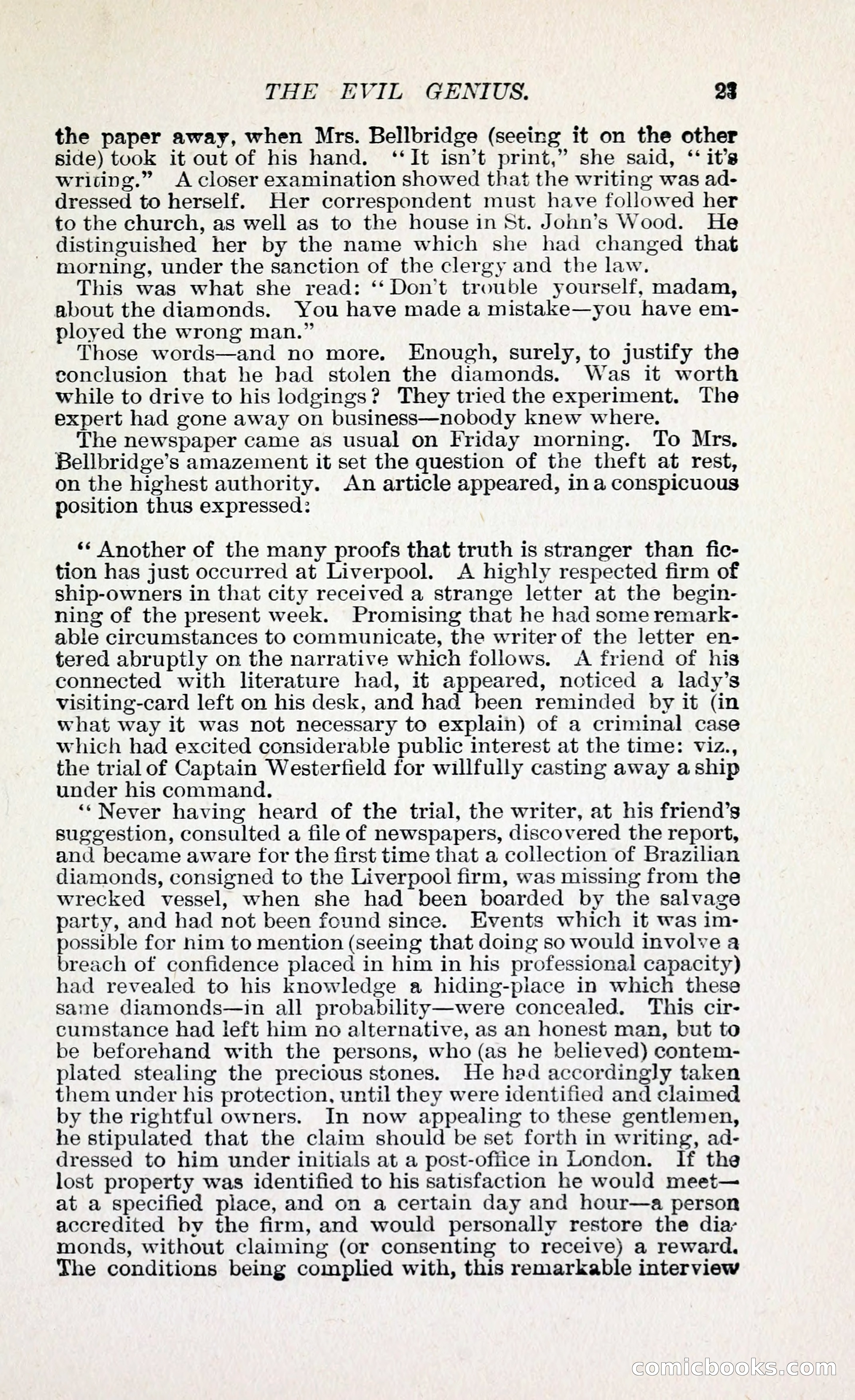
A restored page from Penny Dreadfuls, 1900. Page through the whole issue in the reader above.
📄 Transcribed text from this page (OCR, searchable)
Machine-transcribed from the original scan — historical spelling and the odd misread are preserved.
THE EVIL GENIUS. 23 the paper away, when Mrs. Bellbridge (seeing it on the other side) took it out of his hand. ‘‘It isn’t print,” she said, ‘‘ it’s writing.” A closer examination showed that the writing was ad- dressed to herself. Her correspondent must have followed her to the church, as well as to the house in St. John’s Wood. He distinguished her by the name which she had changed that - morning, under the sanction of the clergy and the law. This was what she read: ‘‘ Don’t trouble yourself, madam, about the diamonds. You have made a mistake—you have em- ployed the wrong man.” Those words—and no more. Enough, surely, to justify the conclusion that he bad stolen the diamonds. Was it worth while to drive to his lodgings? They tried the experiment. The expert had gone away on business—nobody knew where. The newspaper came as usual on Friday morning. To Mrs. Bellbridge’s amazement it set the question of the theft at rest, on the highest authority. An article appeared, in a conspicuous position thus expressed: ‘* Another of the many proofs that truth is stranger than fic- tion has just occurred at Liverpool. A highly respected firm of ship-owners in that city received a strange letter at the begin- ning of the present week. Promising that he had some remark- able circumstances to communicate, the writer of the letter en- tered abruptly on the narrative which follows. <A friend of his connected with literature had, it appeared, noticed a lady’s visiting-card left on his desk, and had been reminded by it (in what way it was not necessary to explain) of a criminal case which had excited considerable public interest at the time: viz., the trial of Captain Westerfield for willfully casting away aship under his command. ‘‘Never having heard of the trial, the writer, at his friend’s suggestion, consulted a file of newspapers, discovered the report, and became aware for the first time that a collection of Brazilian diamonds, consigned to the Liverpool firm, was missing from the wrecked vessel, when she had been boarded by the salvage party, and had not been found since. Events which it was im- possible for him to mention (seeing that doing so would involve a breach of confidence placed in him in his professional capacity) had revealed to his knowledge a hiding-piace in which these same diamonds—in all probability—-were concealed. This cir- cumstance had left him no alternative, as an honest man, but to be beforehand with the persons, who (as he believed) contem- plated stealing the precious stones. He had accordingly taken them under his protection, until they were identified and claimed by the rightful owners. In now appealing to these gentlemen, he stipulated that the claim should be set forth in writing, ad- dressed to him under initials at a post-office in London. If the lost property was identified to his satisfaction he would meet— at a specified place, and on a certain day and hour—a person accredited by the firm, and would personally restore the dia- monds, without claiming (or consenting to receive) a reward. The conditions being complied with, this remarkable interview COMIC OO© S (CO) im