
Penny Dreadfuls, 1900 · page 190 of 254
The Evil Genius: A Domestic Story — page 190: what you’re looking at
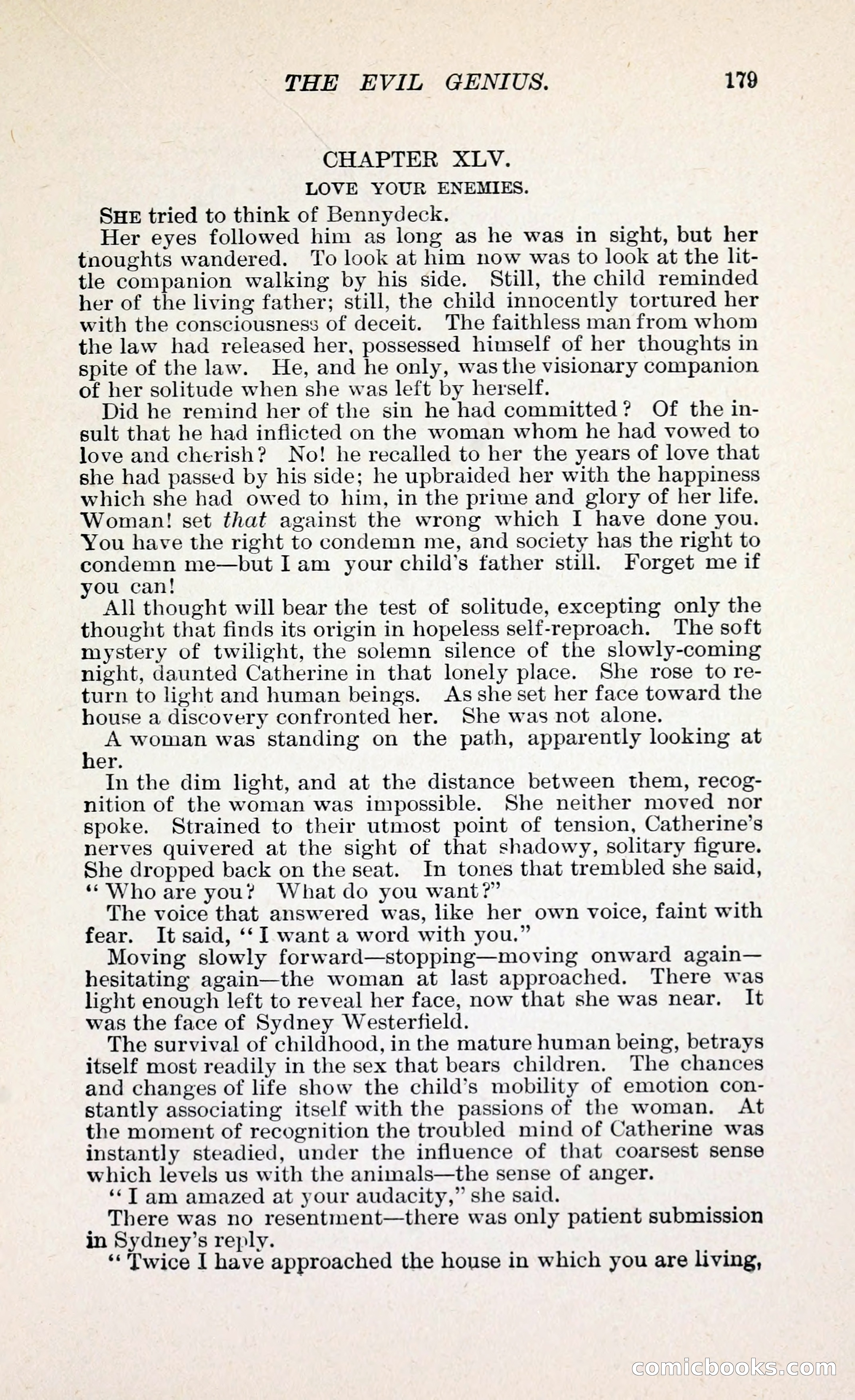
A restored page from Penny Dreadfuls, 1900. Page through the whole issue in the reader above.
📄 Transcribed text from this page (OCR, searchable)
Machine-transcribed from the original scan — historical spelling and the odd misread are preserved.
THE EVIL GENIUS. | 179 CHAPTER XLV. LOVE YOUR ENEMIES. SHE tried to think of Bennydeck. Her eyes followed him as long as he was in sight, but her tnoughts wandered. To look at him now was to look at the lit- tle companion walking by his side. Still, the child reminded her of the living father; still, the child innocently tortured her with the consciousness of deceit. The faithless man from whom the law had released her, possessed himself of her thoughts in spite of the law. He, and he only, was the visionary companion of her solitude when she was left by herself. Did he remind her of the sin he had committed? Of the in- sult that he had inflicted on the woman whom he had vowed to love and cherish? No! he recalled to her the years of love that she had passed by his side; he upbraided her with the happiness which she had owed to him, in the prime and glory of her life. Woman! set that against the wrong which I have done you. You have the right to condemn me, and society has the right to condemn me—but Iam your child’s father still. Forget me if you can! All thought will bear the test of solitude, excepting only the thought that finds its origin in hopeless self-reproach. The soft mystery of twilight, the solemn silence of the slowly-coming night, daunted Catherine in that lonely place. She rose to re- turn to light and human beings. Assheset her face toward the house a discovery confronted her. She was not alone. 4 A woman was standing on the path, apparently looking at er. In the dim light, and at the distance between them, recog- nition of the woman was impossible. She neither moved nor spoke. Strained to their utmost point of tension, Catherine’s nerves quivered at the sight of that shadowy, solitary figure. She dropped back on the seat. In tones that trembled she said, ‘Who are you? What do you want?” The voice that answered was, like her own voice, faint with fear. Itsaid, ‘‘ I want a word with you.” Moving slowly forward—stopping—moving onward again— hesitating again—the woman at last approached. There was light enough left to reveal her face, now that she was near. It was the face of Sydney Westerfield. The survival of childhood, in the mature human being, betrays itself most readily in the sex that bears children. The chances and changes of life show the child’s mobility of emotion con- stantly associating itself with the passions of the woman. At the moment of recognition the troubled mind of Catherine was instantly steadied, under the influence of that coarsest sense which levels us with the animals—the sense of anger. ‘‘T am amazed at your audacity,” she said. There was no resentment—there was only patient submission in Sydney’s reply. ‘‘ Twice I have approached the house in which you are living, Gomicdooks (CO) m