
Penny Dreadfuls, 1900 · page 186 of 254
The Evil Genius: A Domestic Story — page 186: what you’re looking at
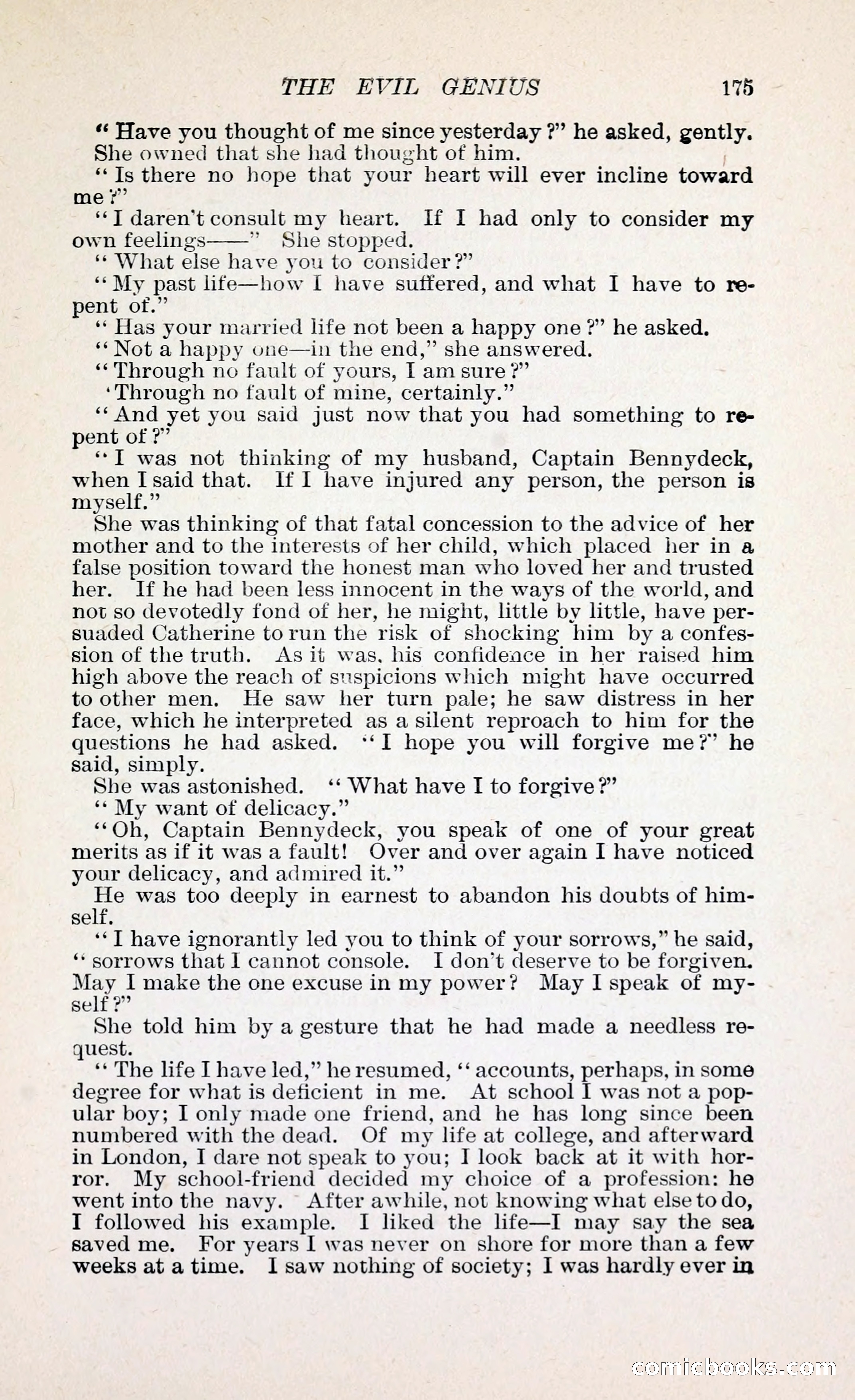
A restored page from Penny Dreadfuls, 1900. Page through the whole issue in the reader above.
📄 Transcribed text from this page (OCR, searchable)
Machine-transcribed from the original scan — historical spelling and the odd misread are preserved.
THE EVIL GENIUS 175 ‘ Have you thought of me since yesterday ?” he asked, gently. She owned that she had thought of him. Is there no hope that your heart will ever incline toward me 7?” ‘“T daren’t consult my heart. If I had only to consider my own feelings ” She stopped. ‘* What else have you to consider ?” ‘“My past life—how [ have suffered, and what I have to re- pent of.” ‘* Has your married life not been a happy one ?” he asked. “Not a happy one—in the end,” she answered. ‘Through no fault of yours, I am sure ?” ‘Through no fault of mine, certainly.” ‘And yet you said just now that you had something to re pent of ?” “I was not thinking of my husband, Captain Bennydeck, when I said that. If I have injured any person, the person is myself.” She was thinking of that fatal concession to the advice of her mother and to the interests of her child, which placed her in @ false position toward the honest man who loved her and trusted her. If he had been less innocent in the ways of the world, and not so devotedly fond of her, he might, little by little, have per- suaded Catherine torun the risk of shocking him by a confes- sion of the truth. As it was, his confideace in her raised him high above the reach of suspicions which might have occurred to other men. He saw her turn pale; he saw distress in her face, which he interpreted as a silent reproach to him for the questions he had asked. ‘‘I hope you will forgive me?” he said, simply. She was astonished. ‘‘ What have I to forgive?” ‘* My want of delicacy.” ‘‘Oh, Captain Bennydeck, you speak of one of your great merits as if it was a fault! Over and over again I have noticed your delicacy, and admired it.” a was too deeply in earnest to abandon his doubts of him- self ‘*T have ignorantly led you to think of your sorrows,” he said, ‘sorrows that I cannot console. I don’t deserve to be forgiven. May I make the one excuse in my power? May I speak of my- self ?” She told him by a gesture that he had made a needless re- uest. Ms The life I have led,” he resumed, ‘‘ accounts, perhaps, in some degree for what is deficient in me. At school I was not a pop- ular boy; I only made one friend, and he has long since been numbered with the dead. Of my life at college, and afterward in London, I dare not speak to you; I look back at it with hor- ror. My school-friend decided my choice of a profession: he went into the navy. After awhile, not knowing what else to do, I followed his example. I liked the life—I may say the sea saved me. For years I was never on shore for more than a few weeks at atime. I saw nothing of society; I was hardly ever in CONMNIELOO S (©) im