
Penny Dreadfuls, 1900 · page 169 of 254
The Evil Genius: A Domestic Story — page 169: what you’re looking at
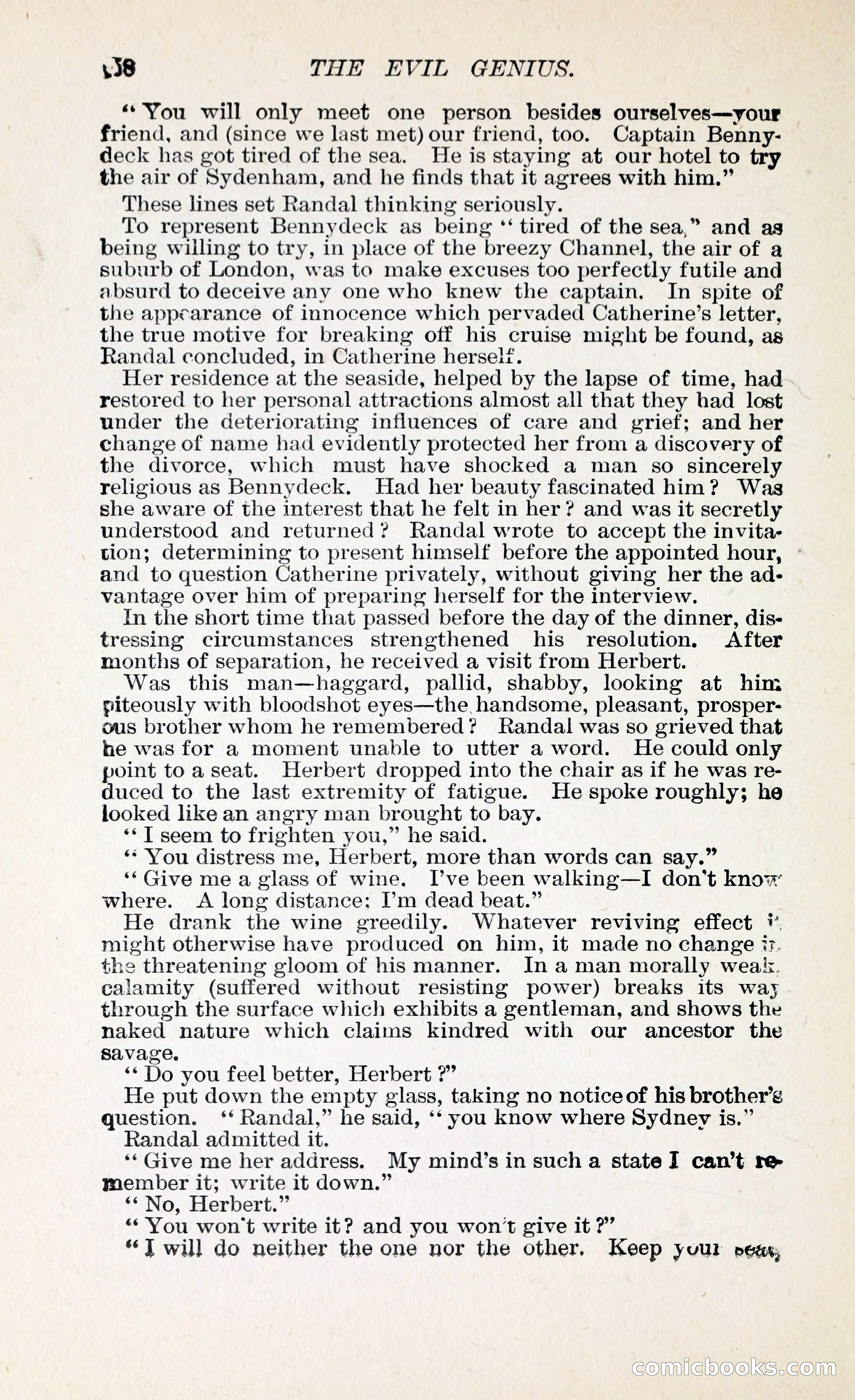
A restored page from Penny Dreadfuls, 1900. Page through the whole issue in the reader above.
📄 Transcribed text from this page (OCR, searchable)
Machine-transcribed from the original scan — historical spelling and the odd misread are preserved.
.38 THE EVIL GENIUS. “You will only meet one person besides ourselves—your friend, and (since we last met) our friend, too. Captain Benny- deck has got tired of the sea. He is staying at our hotel to the air of Sydenham, and he finds that it agrees with him.” These lines set Randal thinking seriously. To represent Bennydeck as being ‘‘ tired of the sea,” and as being willing to try, in place of the breezy Channel, the air of a suburb of London, was to make excuses too perfectly futile and absurd to deceive any one who knew the captain. In spite of the appearance of innocence which pervaded Catherine’s letter, the true motive for breaking off his cruise might be found, ag Randal concluded, in Catherine herself. Her residence at the seaside, helped by the lapse of time, had restored to her personal attractions almost all that they had lost under the deteriorating influences of care and grief; and her change of name had evidently protected her from a discovery of the divorce, which must have shocked a man so sincerely religious as Bennydeck. Had her beauty fascinated him? Was she aware of the interest that he felt in her? and was it secretly understood and returned? Randal wrote to accept the invita- tion; determining to present himself before the appointed hour, » and to question Catherine privately, without giving her the ad- vantage over him of preparing herself for the interview. In the short time that passed before the day of the dinner, dis- tressing circumstances strengthened his resolution. After months of separation, he received a visit from Herbert. Was this man—haggard, pallid, shabby, looking at him piteously with bloodshot eyes—the handsome, pleasant, prosper: ous brother whom he remembered? Randal was so grieved that he was for a moment unable to utter a word. He could only point to a seat. Herbert dropped into the chair as if he was re- duced to the last extremity of fatigue. He spoke roughly; he looked like an angry man brought to bay. ‘‘T seem to frighten you,” he said. ‘* You distress me, Herbert, more than words can say.” ‘‘Give me a glass of wine. I’ve been walking—I don’t know where. <A long distance; I’m dead beat.” He drank the wine greedily. Whatever reviving effect ” might otherwise have produced on him, it made no change iz. the threatening gloom of his manner. In a man morally weak. calamity (suffered without resisting power) breaks its way through the surface which exhibits a gentleman, and shows the naked nature which claims kindred with our ancestor the savage. ‘*Do you feel better, Herbert ?”’ He put down the empty glass, taking no noticeof his brother’s question. ‘* Randal,” he said, ‘‘ you know where Sydney is.” Randal admitted it. ‘‘Give me her address. My mind’s in sucha state] can’t re member it; write it down.” ‘‘ No, Herbert.” “*‘You won't write it? and you won't give it ?”” ‘J will do neither the one nor the other, Keep yuul peas, ECOMMICOOOKS (c@) m