
Penny Dreadfuls, 1900 · page 128 of 254
The Evil Genius: A Domestic Story — page 128: what you’re looking at
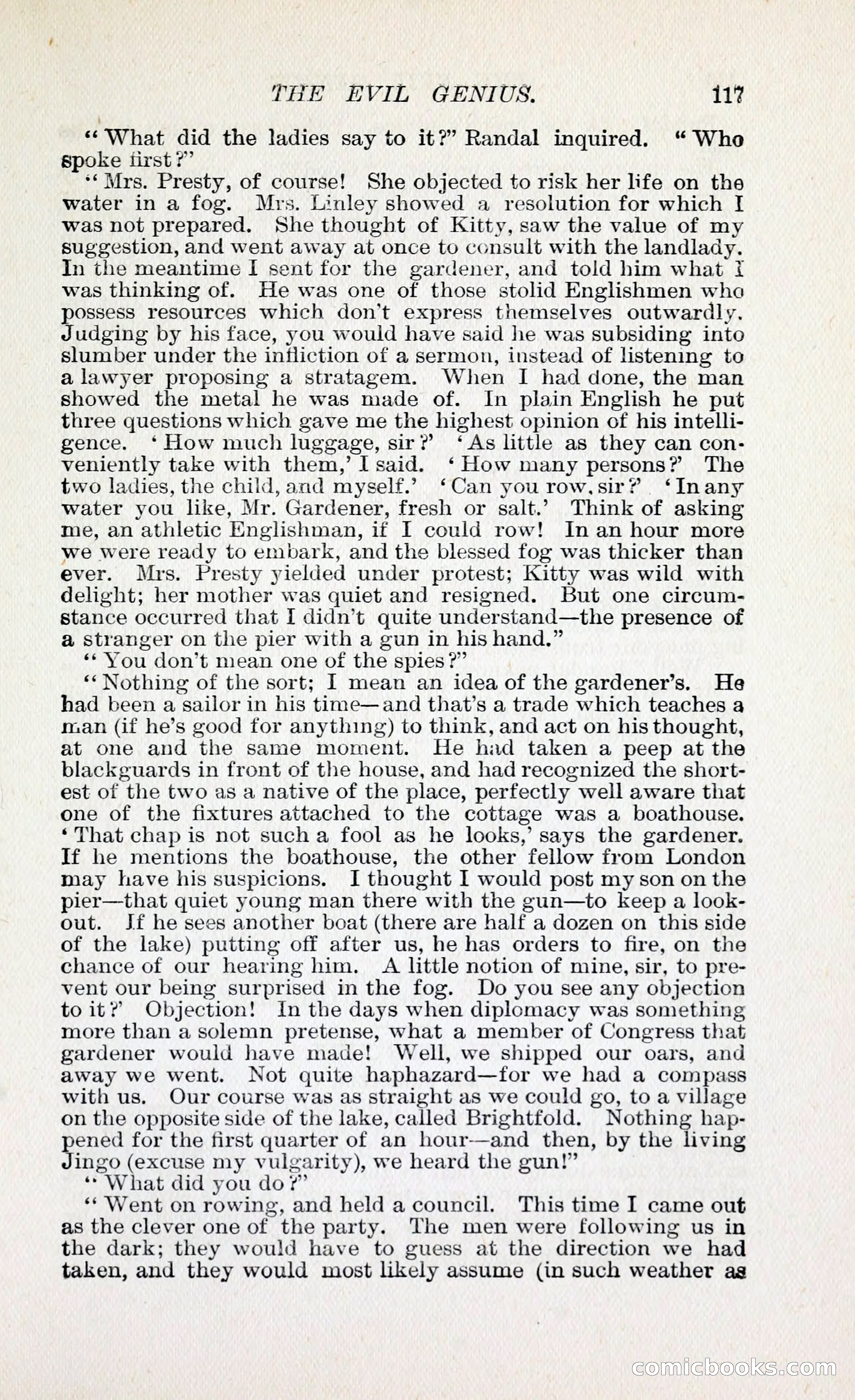
A restored page from Penny Dreadfuls, 1900. Page through the whole issue in the reader above.
📄 Transcribed text from this page (OCR, searchable)
Machine-transcribed from the original scan — historical spelling and the odd misread are preserved.
THE EVIL GENIUS. 11? “What did the ladies say to it?” Randal inquired. “ Who spoke first?” ** Mrs. Presty, of course! She objected to risk her life on the water in a fog. Mrs. Linley showed a resolution for which [I was not prepared. She thought of Kitty, saw the value of my suggestion, and went away at once to consult with the landlady. In the meantime I sent for the gardener, and told him what f was thinking of. He was one of those stolid Englishmen wha possess resources which don’t express themselves outwardly. Judging by his face, you would have said he was subsiding into slumber under the infliction of a sermon, instead of listening to a lawyer proposing a stratagem. When I had done, the man showed the metal he was made of. In plain English he put three questions which gave me the highest opinion of his intelli- gence. ‘How much luggage, sir? ‘As little as they can con- veniently take with them,’ I said. ‘ How many persons? The two ladies, the child, and myself.’ ‘Can yourow,sir? ‘Inany water you like, Mr. Gardener, fresh or salt.’ Think of asking me, an athletic Englishman, if I could row! Inan hour more we were ready to embark, and the blessed fog was thicker than ever. Mrs. Presty yielded under protest; Kitty was wild with delight; her mother was quiet and resigned. But one circum- stance occurred that I didn’t quite understand—the presence of a stranger on the pier with a gun in his hand.” ‘“* You don’t mean one of the spies?” ‘Nothing of the sort; I mean an idea of the gardener’s. He had been a sailor in his time—and that’s a trade which teaches a man (if he’s good for anything) to think, and act on his thought, at one and the same moment. He had taken a peep at the blackguards in front of the house, and had recognized the short- est of the two as a native of the place, perfectly well aware that one of the fixtures attached to the cottage was a boathouse. ‘That chap is not such a fool as he looks,’ says the gardener. If he mentions the boathouse, the other fellow from London may have his suspicions. I thought I would post my son on the pier—that quiet young man there with the gun—to keep a look- out. Jf he sees another boat (there are half a dozen on this side of the lake) putting off after us, he has orders to fire, on the chance of our hearing him. A little notion of mine, sir, to pre- vent our being surprised in the fog. Do you see any objection to it?? Objection! In the days when diplomacy was something more than a solemn pretense, what a member of Congress that gardener would have made! Well, we shipped our oars, and away we went. Not quite haphazard—for we had a compass with us. Our course was as straight as we could go, to a village on the opposite side of the lake, called Brightfold. Nothing hap- pened for the first quarter of an hour-—and then, by the living Jingo (excuse my vulgarity), we heard the gun!” ‘** What did you do?” ‘* Went on rowing, and held acouncil. This time I came out as the clever one of the party. The men were following us in the dark; they would have to guess at the direction we had taken, and they would most likely assume (in such weather as CORNICLO© S (©) im