
Penny Dreadfuls, 1856 · page 82 of 399
Ellen Percy; or, The Memoirs of an Actress — page 82: what you’re looking at
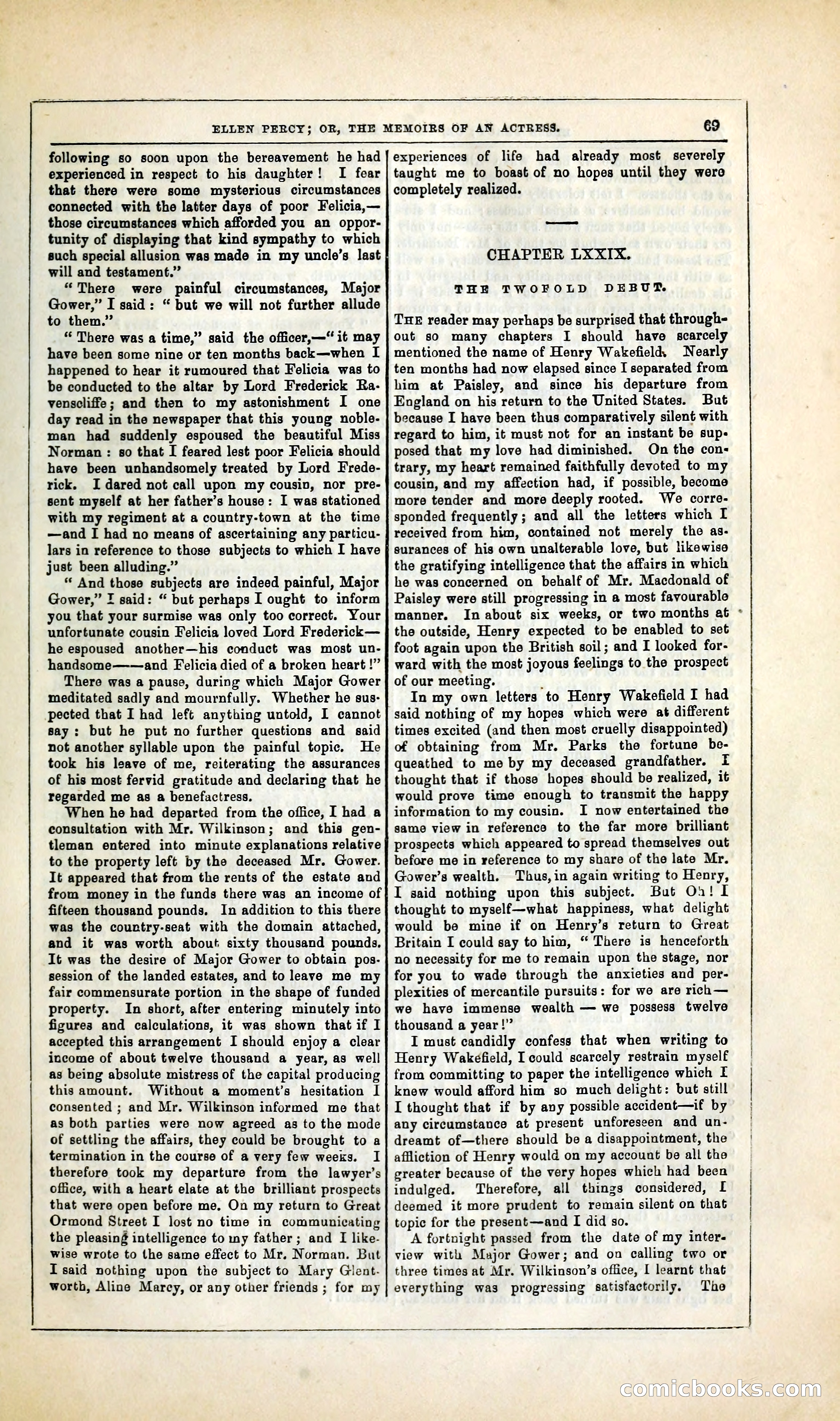
A restored page from Penny Dreadfuls, 1856. Page through the whole issue in the reader above.
📄 Transcribed text from this page (OCR, searchable)
Machine-transcribed from the original scan — historical spelling and the odd misread are preserved.
ELLEN PERCY; OR, THE MEMOIRS OF AN ACTRESS. 69 ee following so soon upon the bereavement he had experienced in respect to his daughter! I fear that there were some mysterious circumstances connected with the latter days of poor Felicia,— those circumstances which afforded you an oppor- tunity of displaying that kind sympathy to which such special allusion was made in my uncle’s last will and testament.” “There were painful circumstances, Major Gower,” I said: “ but we will not further allude to them.” “ There was a time,” said the officer,—“ it may have been some nine or ten months back—when I happened to hear it rumoured that Felicia was to be conducted to the altar by Lord Frederick Ra- venscliffe; and then to my astonishment I one day read in the newspaper that this young noble- man had suddenly espoused the beautiful Miss Norman: so that I feared lest poor Felicia should have been unhandsomely treated by Lord Frede- rick. I dared not call upon my cousin, nor pre- sent myself at her father’s house: I was stationed with my regiment at a country-town at the time —and I had no means of ascertaining any particu- lars in reference to those subjects to which I have just been alluding.” * And those subjects are indeed painful, Major Gower,” = said: “ but perhaps I ought to inform you that your surmise was only too correct. Your unfortunate cousin Felicia loved Lord Frederick — he espoused another—his conduct was most un- handsome——and Felicia died of a broken heart !” There was a pause, during which Major Gower meditated sadly and mournfully. Whether he sus- pected that I had left anything untold, I cannot say: but he put no further questions and said not another syllable upon the painful topic. He took his leave of me, reiterating the assurances of his most fervid gratitude and declaring that he regarded me as a benefactress. When he had departed from the office, I had a consultation with Mr. Wilkinson; and this gen- tleman entered into minute explanations relative to the property left by the deceased Mr. Gower. It appeared that from the rents of the estate and from money in the funds there was an income of fifteen thousand pounds. In addition to this there was the courtry-seat with the domain attached, and it was worth about sixty thousand pounds. It was the desire of Major Gower to obtain pos- session of the landed estates, and to leave me my fair commensurate portion in the shape of funded property. In short, after entering minutely into figures and calculations, it was shown that if I accepted this arrangement I should enjoy a clear income of about twelve thousand a year, as well as being absolute mistress of the capital producing this amount. Without a moment’s hesitation I consented ; and Mr. Wilkinson informed me that as both parties were now agreed as to the mode of settling the affairs, they could be brought to a termination in the course of a very few weexs. I therefore took my departure from the lawyer’s office, with a heart elate at the brilliant prospects that were open before me. On my return to Great Ormond Street I lost no time in communicating the pleasing intelligence to my father; and I like- wise wrote to the same effect to Mr. Norman. But I said nothing upon the subject to Mary Glent- worth, Aline Marcy, or any other friends ; for my experiences of life had already most severely taught me to boast of no hopes until they were completely realized. CHAPTER LXXIX. THE TWOFOLD DEBUT. THE reader may perhaps be surprised that through- out sO many chapters I should have scarcely mentioned the name of Henry Wakefield. Nearly ten months had now elapsed since I separated from him at Paisley, and since his departure from England on his return to the United States. But because I have been thus comparatively silent with regard to him, it must not for an instant be sup- posed that my love had diminished. On the con- trary, my heart remained faithfully devoted to my cousin, and my affection had, if possible, become more tender and more deeply rooted. We corre- sponded frequently; and all the letters which I received from him, contained not merely the as- surances of his own unalterable love, but likewise the gratifying intelligence that the affairs in which he was concerned on behalf of Mr. Macdonald of Paisley were still progressing in a most favourable manner. In about six weeks, or two months at the outside, Henry expected to be enabled to set foot again upon the British soil; and I looked for- ward with the most joyous feelings to the prospect of our meeting. In my own letters to Henry Wakefield I had said nothing of my hopes which were at different times excited (and then most cruelly disappointed) of obtaining from Mr. Parks the fortune be- queathed to me by my deceased grandfather. I thought that if those hopes should be realized, it would prove time enough to transmit the happy information to my cousin. I now entertained the same view in reference to the far more brilliant prospects which appeared to spread themselves out before me in reference to my share of the late Mr. Gower’s wealth. Thus,in again writing to Henry, I said nothing upon this subject. But Oa! I thought to myself—what happiness, what delight would be mine if on Henry’s return to Great Britain I could say to him, “ There is henceforth no necessity for me to remain upon the stage, nor for you to wade through the anxieties and per- plexities of mercantile pursuits: for we are rich— we have immense wealth — we possess twelve thousand a year!” I must candidly confess that when writing to Henry Wakefield, I could scarcely restrain myself from committing to paper the intelligence which I knew would afford him so much delight: but still I thought that if by avy possible accident—if by any circumstance at present unforeseen and un- dreamt of—there should be a disappointment, the affliction of Henry would on my account be all the greater because of the very hopes which had been indulged. Therefore, all things considered, L deemed it more prudent to remain silent on that topic for the present—and I did so. A fortnight passed from the date of my inter. view with Major Gower; and on calling two or three times at Mr. Wilkinson’s oflice, I learnt that everything was progressing satisfactorily. The —_— = — (E(0) = JOO cS (E(O)