
Penny Dreadfuls, 1856 · page 80 of 399
Ellen Percy; or, The Memoirs of an Actress — page 80: what you’re looking at
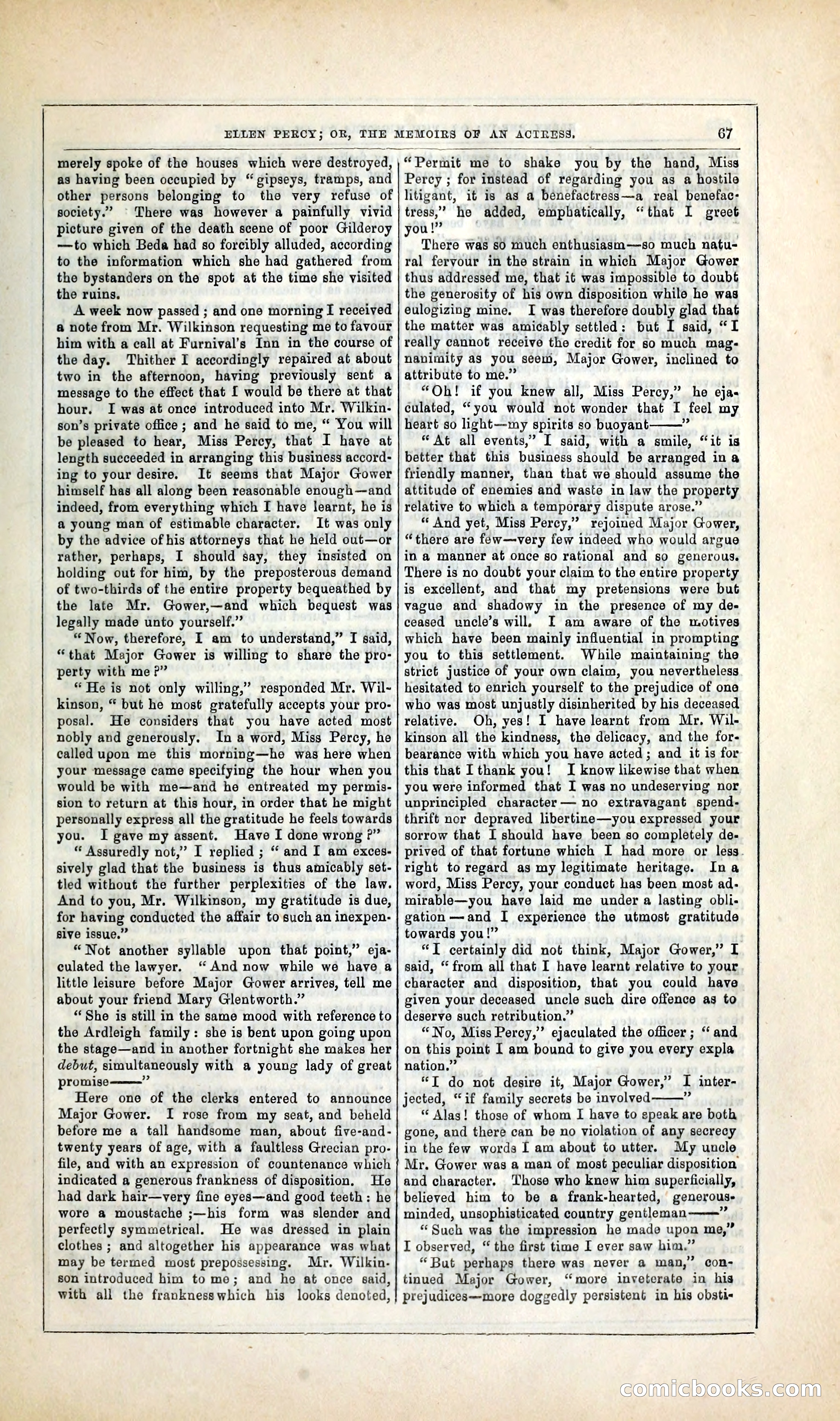
A restored page from Penny Dreadfuls, 1856. Page through the whole issue in the reader above.
📄 Transcribed text from this page (OCR, searchable)
Machine-transcribed from the original scan — historical spelling and the odd misread are preserved.
ELLEN PERCY; OR, THE MEMOIRS OF AN ACTRESS, merely spoke of the houses which were destroyed, as having been occupied by “ gipseys, tramps, and other persons belonging to the very refuse of society.’ © There was however a painfully vivid picture given of the death scene of poor Gilderoy -——to which Beda had so forcibly alluded, according to the information which she had gathered from the bystanders on the spot at the time she visited the ruins. A week now passed ; and one morning I received a note from Mr. Wilkinson requesting me to favour him with a call at Furnival’s Inn in the course of the day. Thither I accordingly repaired at about two in the afternoon, having previously sent a message to the effect that [ would be there at that hour. I was at once introduced into Mr. Wilkin- son’s private office; and he said to me, “ You will be pleased to hear, Miss Percy, that I have at length succeeded in arranging this business accord- ing to your desire. It seems that Major Gower himself has all along been reasonable enough—and indeed, from everything which I have learnt, he is a young man of estimable character. It was only by the advice of his attorneys that he held out—or rather, perhaps, I should say, they insisted on holding out for him, by the preposterous demand of two-thirds of the entire property bequeathed by the late Mr. Gower,—and which bequest was legally made unto yourself.” * Now, therefore, I am to understand,” I said, “that Major Gower is willing to share the pro- perty with me ?” “He is not only willing,” responded Mr. Wil- kinson, “ but he most gratefully accepts your pro- posal. He considers that you have acted most nobly and generously. In a word, Miss Percy, he called upon me this morning—he was here when your message came specifying the hour when you would be with me—and he entreated my permis- sion to return at this hour, in order that he might personally express all the gratitude he feels towards you. I gave my assent. Have I done wrong ?P” “ Assuredly not,” I replied ; “ and I am exces- sively glad that the business is thus amicably set- tled without the further perplexities of the law. And to you, Mr. Wilkinson, my gratitude is due, for having conducted the affair to such an inexpen- sive issue.” “Not another syllable upon that point,” eja- culated the lawyer. “And now while we have a little leisure before Major Gower arrives, tell me about your friend Mary Glentworth.” “She is still in the same mood with reference to the Ardleigh family: she is bent upon going upon the stage—and in another fortnight she makes her debut, simultaneously with a young lady of great promise ts Here one of the clerks entered to announce Major Gower. I rose from my seat, and beheld before me a tall handsome man, about five-and- twenty years of age, with a faultless Grecian pro- file, and with an expression of countenance which indicated a generous frankness of disposition. He had dark hair—very fine eyes—and good teeth: he wore & moustache ;—his form was slender and perfectly symmetrical. He was dressed in plain clothes ; and altogether his appearance was what may be termed most prepossessing. Mr. Wilkin- son introduced him to me; and he at once said, with all the franknesswhich his looks denoted, —_— OO 67 “Permit me to shake you by the hand, Miss Percy ; for instead of regarding you as a hostile litigant, it is as a benefactress—a real benefac- tress,’ he added, emphatically, “that I greet you!” : There was so much enthusiasm—so much natu- ral feryour in the strain in which Major Gower thus addressed me, that if was impossible to doubt the generosity of his own disposition while he was eulogizing mine. I was therefore doubly glad that the matter was amicably settled: but I said, “I really cannot receive the credit for so much mags navimity as you seem, Major Gower, inclined to attribute to me.” “Oh! if you knew all, Miss Percy,” he eja- culated, “you would not wonder that I feel my heart so light—-my spirits so buoyant He * At all events,” I said, with a smile, “it is better that this business should be arranged in a friendly manner, than that we should assume the attitude of enemies and waste in law the property relative to which a temporary dispute arose.” * And yet, Miss Percy,” rejoined Major Gower, “there are few—very few indeed who would argue in a manner at once so rational and so generous. There is no doubt your claim to the entire property is excellent, and that my pretensions were but vague and shadowy in the presence of my de- ceased uncle’s will, I am aware of the motives which have been mainly influential in prompting you to this settlement. While maintaining the stricé justice of your own claim, you nevertheless hesitated to enrich yourself to the prejudice of one who was most unjustly disinherited by his deceased relative. Oh, yes! I have learnt from Mr, Wil- kinson all the kindness, the delicacy, and the for- bearance with which you have acted; and it is for this that Ithank you! I know likewise that when you were informed that I was no undeserving nor unprincipled character — no extravagant spend- thrift nor depraved libertine—you expressed your sorrow that I should have been so completely de- prived of that fortune which I had more or less. right to regard as my legitimate heritage. Ina word, Miss Percy, your conduct has been most ad. mirable—you have laid me under a lasting obli- gation —-and I experience the utmost gratitude towards you!” “T certainly did not think, Major Gower,” I said, “ from all that I have learnt relative to your character and disposition, that you could have given your deceased uncle such dire offence as to deserve such retribution.” “No, Miss Percy,’ ejaculated the officer; ‘‘ and on this point I am bound to give you every expla nation.” “T do not desire it, Major Gower,” I inter- jected, “if family secrets be involved ‘¢ «© Alas! those of whom I have to epeak are both gone, and there can be no violation of any secrecy in the few words I am about to utter. My uncle Mr. Gower was a man of most peculiar disposition and character. Those who knew him superficially, believed him to be a frank-hearted, generous minded, unsophisticated country gentleman ‘ “Such was the impression he made upon me,” I observed, “ the first time I ever saw him.” “But perhaps there was never @ man,” con- tinued Major Gower, “more inveterate in his prejudices—more doggedly persistent in his obsti- OOK (E@)