
Penny Dreadfuls, 1856 · page 376 of 399
Ellen Percy; or, The Memoirs of an Actress — page 376: what you’re looking at
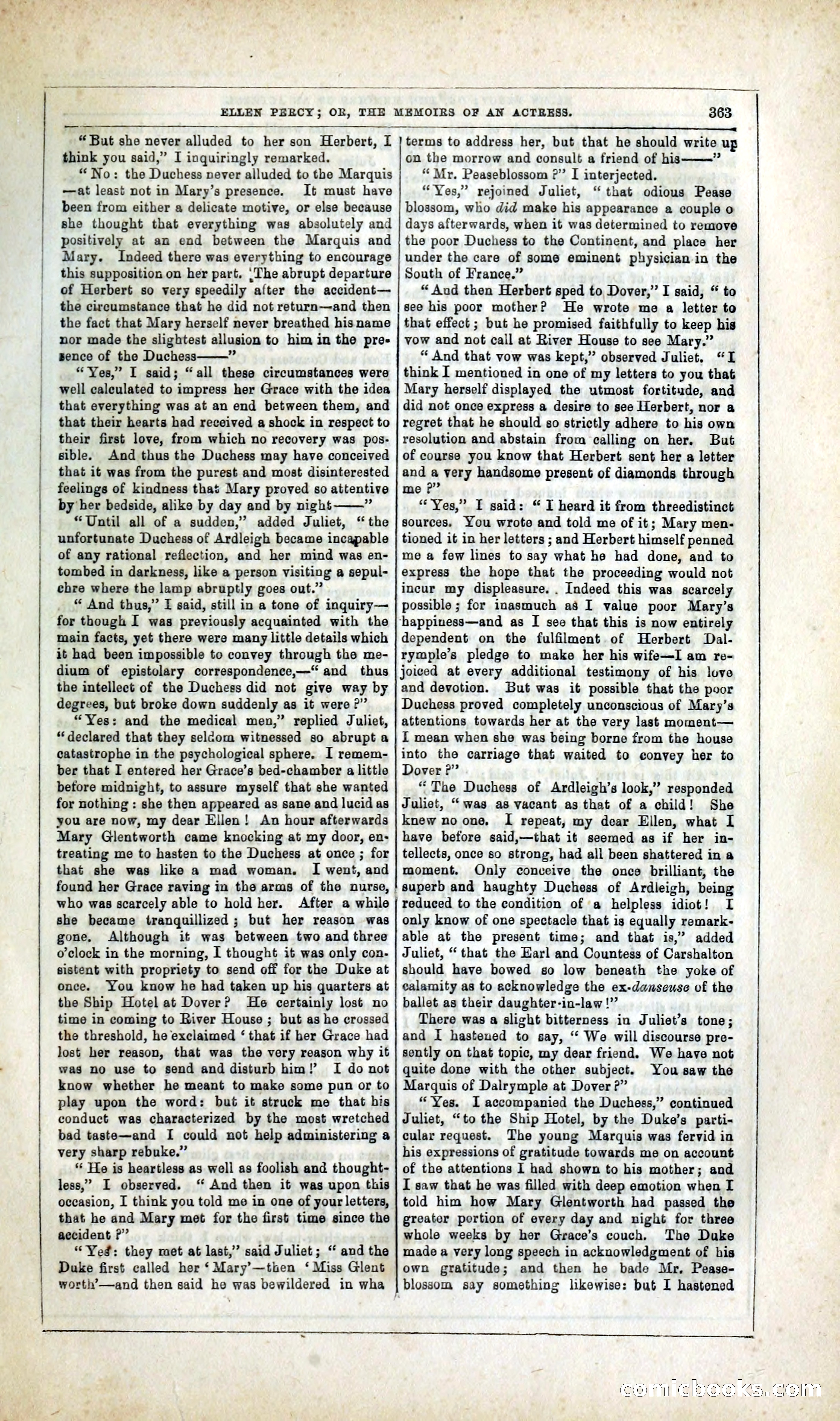
A restored page from Penny Dreadfuls, 1856. Page through the whole issue in the reader above.
📄 Transcribed text from this page (OCR, searchable)
Machine-transcribed from the original scan — historical spelling and the odd misread are preserved.
eee eee ee ee ELLEN PERCY; OR, THE MEMOIRS OF AN ACTRESS. —_—— think you said,” I inquiringly remarked. “No: the Duchess never alluded to the Marquis —at least not in Mary’s presence. It must have been from either a delicate motive, or else because she thought that everything was absolutely and positively at an end between the Marquis and Mary. Indeed there was everything to encourage this supposition on her part. ‘The abrupt departure of Herbert so very speedily after the accident— the circumstance that he did not return—and then the fact that Mary herself never breathed hisname nor made the slightest allusion to him in the pre- sence of the Duchess “Yes,” I said; “all these circumstances were well calculated to impress her Grace with the idea that everything was at an end between them, and that their hearts had received a shock in respect to their first love, from which no recovery was pos- sible. And thus the Duchess may have conceived that it was from the purest and most disinterested feelings of kindness that Mary proved so attentive by her bedside, alike by day and by night “Until all of a sudden,” added Juliet, “ the unfortunate Duchess of Ardleigh became incapable of any rational reflection, and her mind was en- tombed in darkness, like a person visiting a sepul- ehre where the lamp abruptly goes out.” _ “ And thus,” I said, still in a tone of inquiry— for though I was previously acquainted with the main facts, yet there were many little details which it had been impossible to convey through the me- dium of epistolary correspondence,—“ and thus the intellect of the Duchess did not give way by degrees, but broke down suddenly as it were ?” “Yes: and the medical men,” replied Juliet, “declared that they selcom witnessed so abrupt a catastrophe in the psychological sphere. I remem- ber that I entered her Grace’s bed-chamber a little before midnight, to assure myself that she wanted for nothing : she then appeared as sane and lucid as you are now, my dear Ellen! An hour afterwards Mary Glentworth came knocking at my door, en- treating me to hasten to the Duchess at once ; for that she was like a mad woman. I went, and found her Grace raving in the arms of the nurse, who was scarcely able to hold her. she became tranguillized; but her reason was gone, Although it was between two and three o’clock in the morning, I thought it was only con- sistent with propriety to send off for the Duke at once. You know he had taken up his quarters at the Ship Hotel at Dover? He certainly lost no time in coming to River House ; but as he crossed the threshold, he exclaimed ‘ that if her Grace had lost her reason, that was the very reason why it was no use to send and disturb him!’ I do not know whether he meant to make some pun or to play upon the word: but it struck me that his conduct was characterized by the most wretched bad taste—and I could not help administering a very sharp rebuke.” ** He is heartless as well as foolish and thought- less,’ I observed. “ And then it was upon this occasion, I think you told me in one of your letters, that he and Mary met for the first time since the accident ?” “Ved: they met at last,” said Juliet; “ and the Duke first called her ‘ Mary’—then ‘ Miss Glent worth’—and then said a was bewildered in wha To a FTL a RR a a After a ehila ~———— iti 363 eee eee ere ee ee ae ater Oe Ei eae ee eee ee age OL) PLY Pee ee “ But she never alluded to her son Herbert, I | terms to address her, but that he should write ug on the morrow and consult a friend of hisa——~” “ Mr. Peaseblossom ?” I interjected. “Yes,” rejoined Juliet, “that odious Pease blossom, who did make his appearance a couple o days afterwards, when it was determined to remove the poor Duchess to the Continent, and place her under the care of some eminent physician in the South of France.” “ And then Herbert sped to Dover,’ I said, “ to see his poor mother? He wrote me a letter to that effect ; but he promised faithfully to keep his vow and not call at River House to see Mary.” “ And that vow was kept,” observed Juliet. “I think I mentioned in one of my letters to you that Mary herself displayed the utmost fortitude, and did not once express a desire to see Herbert, nor a regret that he should so strictly adhere to his own resolution and abstain from calling on her. But of course you know that Herbert sent her a letter and a very handsome present of diamonds through me ?” “Yes,” I said: “ I heard it from threedistinct sources. You wrote and told me of it; Mary men- tioned it in her letters ; and Herbert himself penned me @ few lines to say what he had done, and to express the hope that the proceeding would not incur my displeasure. . Indeed this was scarcely possible ; for inasmuch as I value poor Mary’s happiness—and as I see that this is now entirely dependent on the fulfilment of Herbert Dal- rymple’s pledge to make her his wife—I am re- joiced at every additional testimony of his luve and devotion. But was it possible that the poor Duchess proved completely unconscious of Mary’s attentions towards her at the very last moment— I mean when she was being borne from the house into the carriage that waited to convey her to Dover ?” “The Duchess of Ardleigh’s look,” responded Juliet, “was as vacant as that of a child! She knew no one, I repeat, my dear Ellen, what I have before said,—that it seemed as if her in- tellects, once so strong, had all been shattered in a moment. Only conceive the once brilliant, the superb and haughty Duchess of Ardleigh, being reduced to the condition of a helpless idiot! I only know of one spectacle that is equally remark- able at the present time; and that is,’ added Juliet, “that the Harl and Countess of Carshalton should have bowed so low beneath the yoke of calamity as to acknowledge the ex-dauseuse of the ballet as their daughter-in-law!” There was a slight bitterness in Juliet’s tone; and I hastened to say, “ We will discourse pre- sently on that topic, my dear friend. We have not quite done with the other subject. You saw the Marquis of Dalrymple at Dover?” “Yes. I accompanied the Duchess,” continued Juliet, “to the Ship Hotel, by the Duke’ s parti- cular request. The young Marquis was fervid in his expressions of gratitude towards me on account of the attentions I had shown to his mother; and I saw that he was filled with deep emotion when, f told him how Mary Glentworth had passed the greater portion of every day and night for three whole weeks by her Grace’s couch. The Duke made a very long speech in acknowledgment of his own gratitude; and then he bade Mr, Pease- blossom say something likewise: but I hastened COMMU OOO)|KK (CO)