
Penny Dreadfuls, 1856 · page 372 of 399
Ellen Percy; or, The Memoirs of an Actress — page 372: what you’re looking at
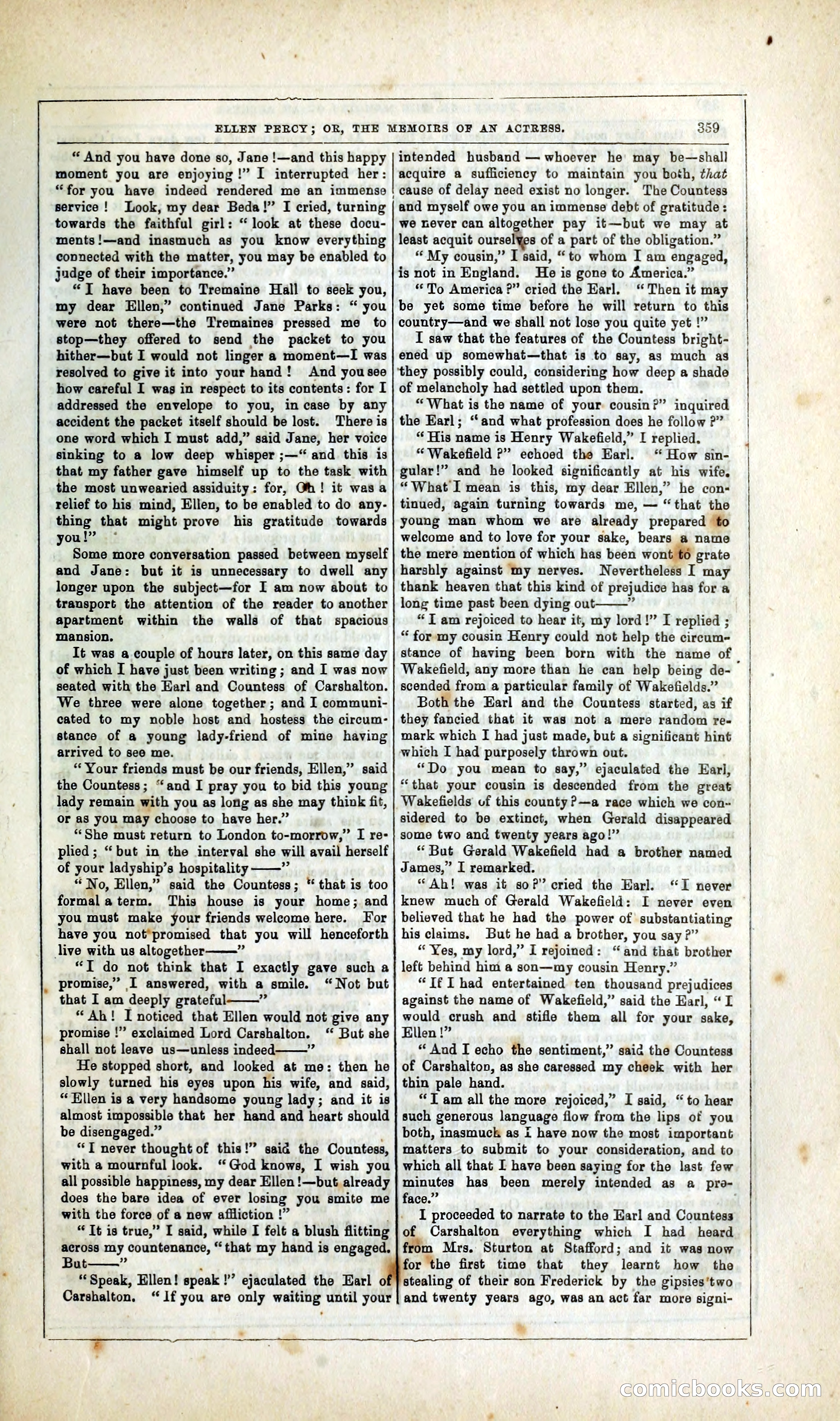
A restored page from Penny Dreadfuls, 1856. Page through the whole issue in the reader above.
📄 Transcribed text from this page (OCR, searchable)
Machine-transcribed from the original scan — historical spelling and the odd misread are preserved.
=, *. ana ELLEN PERCY; OR, THE MEMOIRS OF AN ACTRESS, 359 ** And you have done so, Jane !—and this happy moment you are enjoying!” I interrupted her: “for you have indeed rendered me an immense service! Look, my dear Beda!” I cried, turning towards the faithful girl: “ look at these docu- ments!—and inasmuch as you know everything connected with the matter, you may be enabled to judge of their importance.” “J have been to Tremaine Hall to seek you, my dear Ellen,” continued Jane Parks: “ you were not there—the Tremaines pressed me to stop—they offered to send the packet to you hither—but I would not linger a moment—I was resolved to give it into your hand! And yousee how careful I was in respect to its contents: for I addressed the envelope to you, incase by any accident the packet itself should be lost. There is one word which I must add,” said Jane, her voice sinking to a low deep whisper ;—“ and this is that my father gave himself up to the task with the most unwearied assiduity: for, Gh! it wasa relief to his mind, Ellen, to be enabled to do any- thing that might prove his gratitude towards you!” ~* Some more conversation passed between myself and Jane: but it is unnecessary to dwell any longer upon the subject—for I am now about to transport the attention of the reader to another apartment within the walls of that spacious mansion. It was a couple of hours later, on this same day of which I have just been writing; and I was now seated with the Harl and Countess of Carshalton. We three were alone together; and I communi- cated to my noble host and hostess the circum- stance of a young lady-friend of mine having arrived to see me. ‘Your friends must be our friends, Ellen,” said the Countess; “and I pray you to bid this young lady remain with you as long as she may think fit, or as you may choose to have her.” **She must return to London to-morrow,” I re- plied; “but in the interval she will avail herself of your ladyship’s hospitality ——”’ “ No, Ellen,” said the Countess; “ that is too formalaterm. This house is your home; and you must make your friends welcome here. For have you not’promised that you will henceforth live with us altogether 4 “T do not think that I exactly gave such a promise,’ I answered, with a smile. “Not but that I am deeply gratefu és “Ah! I noticed that Ellen would not give any promise !” exclaimed Lord Carshalton. ‘ But she shall not leave us—unless indeed # He stopped short, and looked at me: then he slowly turned his eyes upon his wife, and said, “Ellen is a very handsome young lady; and it is almost impossible that her hand and heart should be disengaged.” ; “T never thought of this!” said the Countess, with a mournful look. “God knows, I wish you all possible happiness, my dear Ellen !—but already does the bare idea of ever losing you smite me with the force of a new affliction !” } “ It is true,” I said, while I felt a blush flitting across my countenance, “that my hand is engaged. But——” ; ‘Speak, Ellen! speak !’’ ejaculated the Earl o Carshalton, “Ifyou are only waiting until your intended husband — whoever he may be—shall acquire a sufliciency to maintain you both, that cause of delay need exist no longer. The Countess and myself owe you an immense debt of gratitude: we never can altogether pay it—but we may at least acquit oursel¥es of a part of the obligation.” “ My cousin,” I said, “to whom I am engaged, is not in England. He is gone to America.” “To America ?” cried the Earl. “Then it may be yet some time before he will return to this country—and we shall not lose you quite yet !” I saw that the features of the Countess bright- ened up somewhat—that is to say, as much as ‘they possibly could, considering how deep a shade of melancholy had settled upon them. “What is the name of your cousin?” inquired the Earl; “and what profession does he follow ?” “His name is Henry Wakefield,” I replied. “Wakefield P” echoed the Harl. ‘“ How sin- gular!” and he looked significantly at his wife. “What I mean is this, my dear Ellen,” he con- tinued, again turning towards me, — “that the young man whom we are already prepared to welcome and to love for your sake, bears a name the mere mention of which has been wont 60 grate harshly against my nerves. Nevertheless I may thank heaven that this kind of prejudice has for a long time past been dying out 4 “TI am rejoiced to hear it, my lord!” I replied ; “ for my cousin Henry could not help the circum- Wakefield, any more than he can help being de- scended from a particular family of Wakefields.” Both the Earl and the Countess started, as if they fancied that it was not a mere random re- mark which I had just made, but a significant hint which I had purposely thrown out. “Do you mean to say,” ejaculated the Earl, “that your cousin is descended from the great Wakefields of this county?—a race which we con- sidered to be extinct, when Gerald disappeared some two and twenty years ago!” “But Gerald Wakefield had a brother named James,” I remarked. “Ab! was it so?” cried the Karl. “I never knew much of Gerald Wakefield: I never even believed that he had the power of substantiating his claims. But he had a brother, you say ?” “Yes, my lord,” I rejoined: “and that brother left behind him a son—my cousin Henry.” “Tf I had entertained ten thousand prejudices against the name of Wakefield,” said the Harl, “I would crush and stifle them all for your sake, Ellen !” “ And I echo the sentiment,” said the Countess of Carshalton, as she caressed my cheek with her thin pale hand. “1 am all the more rejoiced,” I said, “to hear such generous language flow from the lips of you both, inasmuck as i have now the most important matters to submit to your consideration, and to which all that I have been saying for the last few face.” I proceeded to narrate to the Karl and Countess of Carshalton everything which I had heard m Mrs. Sturton at Stafford; and it was now for ‘the first time that they learnt how the stealing of their son Frederick by the gipsies'two and twenty years ago, was an act far more signi- , » CC ras EORANICLOOC stance of having been born with the name of | minutes has been merely intended as a pra- — : 2 el) -_ . — = a (SO)