
Penny Dreadfuls, 1856 · page 285 of 399
Ellen Percy; or, The Memoirs of an Actress — page 285: what you’re looking at
A restored page from Penny Dreadfuls, 1856. Page through the whole issue in the reader above.
📄 Transcribed text from this page (OCR, searchable)
Machine-transcribed from the original scan — historical spelling and the odd misread are preserved.
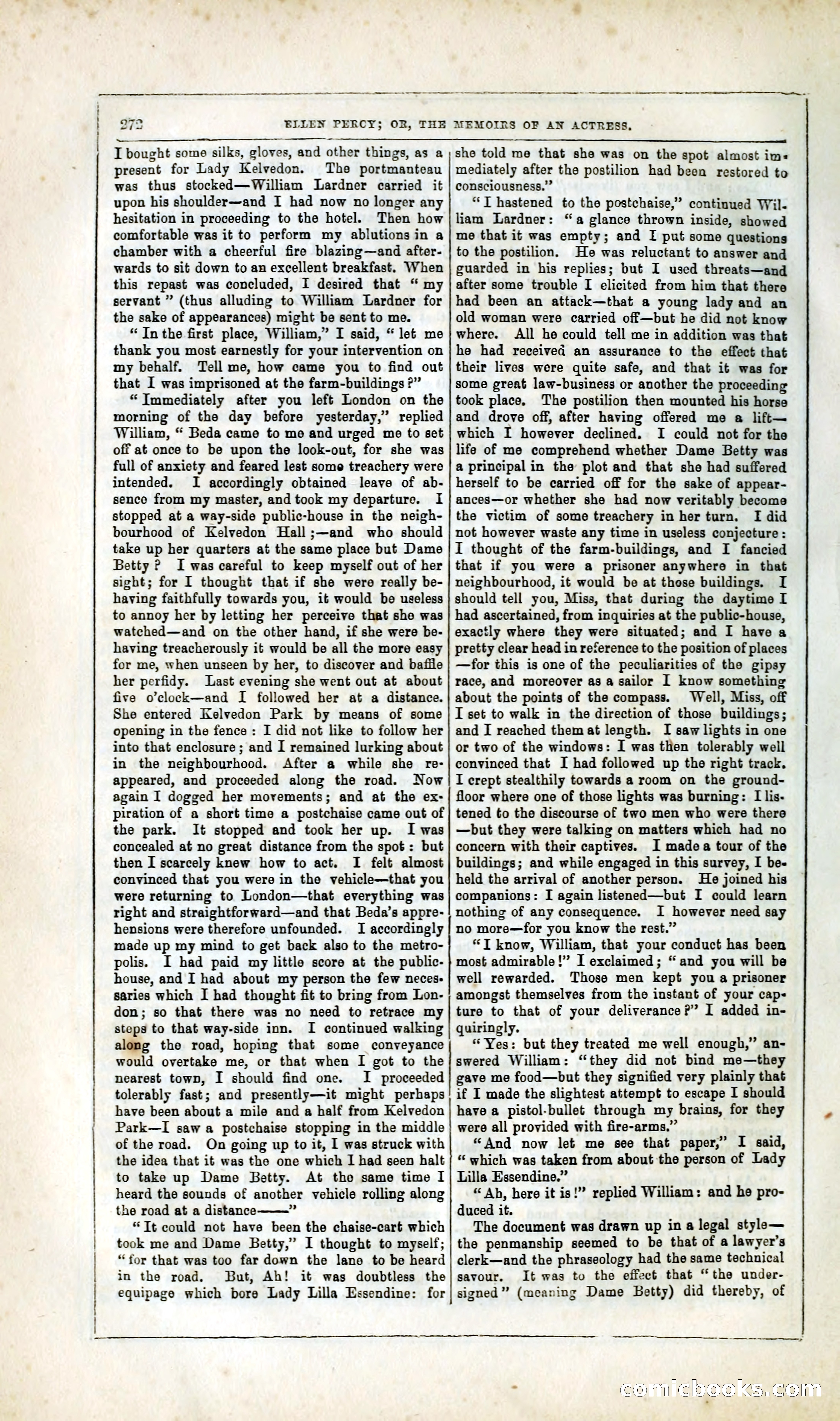
oe eee CS 275 I bought some silks, gloves, and s, and other things, as a; she told me that she was on the spot almost im- things, as a present for Lady Kelvedon. The portmanteau was thus stocked—William Lardner carried it upon his shoulder—and I had now no longer any hesitation in proceeding to the hotel. Then how comfortable was it to perform my ablutionsin a chamber with a cheerful fire blazing—and after- wards to sit down to an excellent breakfast. When this repast was concluded, I desired that “ my servant ” (thus alluding to William Lardner for the sake of appearances) might be sent to me. “Inthe first place, William,’ I said, “ let me thank you most earnestly for your intervention on my behalf. Tell me, how came you to find out that I was imprisoned at the farm-buildings ?” “Immediately after you left London on the morning of the day before yesterday,’ replied William, “ Beda came to me and urged me to set off at once to be upon the look-out, for she was full of anxiety and feared lest some treachery were intended. I accordingly obtained leave of ab- sence from my master, and took my departure. I stopped at a way-side public-house in the neigh- bourhood of Kelvedon Hall ;—and who should take up her quarters at the same place but Dame Betty ? I was careful to keep myself out of her sight; for I thought that if she were really be- having faithfully towards you, it would be useless to annoy her by letting her perceive that she was watched—and on the other hand, if she were be- having treacherously it would be all the more easy for me, when unseen by her, to discover and bafile her perfidy. Last evening she went out at about five o’clock—and I followed her at a distance. She entered Kelvedon Park by means of some opening in the fence: I did not like to follow her into that enclosure ; and I remained lurking about in the neighbourhood. After a while she re- appeared, and proceeded along the road. Now again I dogged her movements; and at the ex- piration of a short time a postchaise came out of the park. It stopped and took her up. I was concealed at no great distance from the spot: but then I scarcely knew how to act. I felt almost convinced that you were in the vehicle—that you were returning to London—that everything was right and straightforward—and that Beda’s appre- hensions were therefore unfounded. I accordingly made up my mind to get back also to the metro- polis. I had paid my little score at the public- house, and I had about my person the few neces- saries which I had thought fit to bring from Lon- don; so that there was no need to retrace my steps to that way-side inn. I continued walking along the road, hoping that some conveyance would overtake me, or that when I got to the nearest town, I should find one. I proceeded tolerably fast; and presently—it might perhaps have been about a mile and a half from Kelvedon Park—I saw a postchaise stopping in the middle of the road. On going up to it, I was struck with the idea that it was the one which I had seen halt to take up Dame Betty. At the same time I heard the sounds of another vehicle rolling along the road at a distance s “Tt could not have been the chaise-cart which took me and Dame Betty,” I thought to myself; “for that was too far down the lane to be heard in the road. But, Ah! it was doubtless the equipage which bore Lady Lilla Essendine: for rr ee = ee Re ne | ELLEN PERCY; OR, THE MEMOIRS OF AN ACTRESS, she told me that she was on the spot almost ims mediately after the postilion had been restored to consciousness.’ ““T hastened to the postchaise,” continued Wil- liam Lardner: “a glance thrown inside, showed me that it was empty; and I put some questions to the postilion. He was reluctant to answer and guarded in his replies; but I used threats—and after some trouble I elicited from him that there had been an attack—that a young lady and an old woman were carried off—but he did not know where. All he could tell me in addition was that he had received an assurance to the effect that their lives were quite safe, and that it was for some great law-business or another the proceeding took place. The postilion then mounted his horse and drove off, after having offered me a lift— which I however declined. I could not for the life of me comprehend whether Dame Betty was a principal in the plot and that she had suffered herself to be carried off for the sake of appear- ances—or whether she had now veritably become the victim of some treachery in her turn. [I did not however waste any time in useless conjecture : I thought of the farm-buildings, and I fancied that if you were a prisoner anywhere in that neighbourhood, it would be at those buildings. I should tell you, Miss, that during the daytime I had ascertained, from inquiries at the public-house, exactly where they were situated; and I have a pretty clear head in reference to the position of places —for this is one of the peculiarities of the gipsy race, and moreover as a sailor [ know something about the points of the compass. Well, Miss, off I set to walk in the direction of those buildings; and I reached themat length. I saw lights in one or two of the windows: I was tlien tolerably weil convinced that I had followed up the right track. I crept stealthily towards a room on the ground- floor where one of those lights was burning: [lis- tened to the discourse of two men who were there —but they were talking on matters which had no concern with their captives. I madea tour of the buildings; and while engaged in this survey, I be- held the arrival of another person. He joined his companions: I again listened—but I could learn nothing of any consequence. I however need say no more—for you know the rest.” *T know, William, that your conduct has been most admirable!” I exclaimed; “and you will be well rewarded. Those men kept you a prisoner amongst themselves from the instant of your cap- ture to that of your deliverance ?” I added in- quiringly. “Yes: but they treated me well enough,” an- swered William: “they did not bind me—they gave me food—but they signified very plainly that if I made the slightest attempt to escape I should have a pistol-bullet through my brains, for they were all provided with fire-arms.” “And now let me see that paper,” I said, “ which was taken from about the person of Lady Lilla Essendine.” “ Ah, here it is!” replied William: and he pro- duced it. The document was drawn up in a legal style— the penmanship seemed to be that of a lawyer’s clerk—and the phraseology had the same technical savour. It was to the effect that “the under- signed” (meaning Dame Betty) did thereby, of —-, —— --- ClOOOKSaEO