
Penny Dreadfuls, 1856 · page 229 of 399
Ellen Percy; or, The Memoirs of an Actress — page 229: what you’re looking at
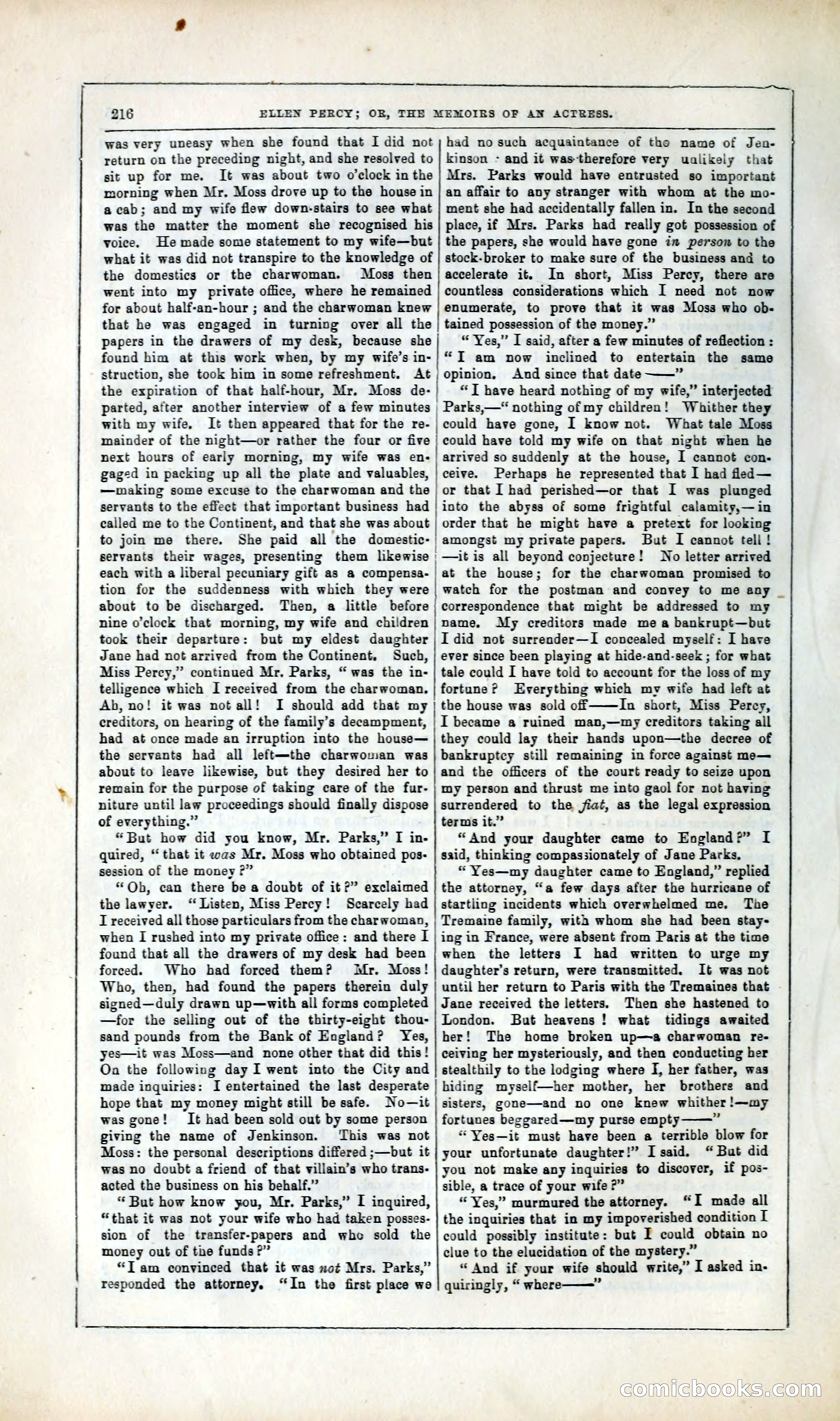
A restored page from Penny Dreadfuls, 1856. Page through the whole issue in the reader above.
📄 Transcribed text from this page (OCR, searchable)
Machine-transcribed from the original scan — historical spelling and the odd misread are preserved.
216 —_— ELLEN PERCY; OBR, THE MEMOIRS OF AN ACTRESS. was very uneasy when she found that I did not return on the preceding night, and she resolved to sit up for me. It was about two o’clock in the morning when Mr. Moss drove up to the house in acab; and my wife flew down-stairs to see what was the matter the moment she recognised his voice. He made some statement to my wife—but what it was did not transpire to the knowledge of the domestics or the charwoman. Moss then went into my private office, where he remained for about half-an-hour ; and the charwoman knew that he was engaged in turning over all the papers in the drawers of my desk, because she found him at this work when, by my wife’s in- struction, she took him in some refreshment. At | the expiration of that half-hour, Mr. Moss de- | parted, after another interview of a few minutes | with my wife, It then appeared that for the re- mainder of the night—or rather the four or five next hours of early morning, my wife was en- gaged in packing up all the plate and valuables, —making some excuse to the charwoman and the servants to the effect that important business had called me to the Continent, and that she was about to join me there. She paid all the domestic: | servants their wages, presenting them likewise | each with a liberal pecuniary gift as a compensa- tion for the suddenness with which they were about to be discharged. Then, a little before nine o’clock that morning, my wife and children took their departure: but my eldest daughter Jane had not arrived from the Continent. Such, Miss Percy,” continued Mr. Parks, “ was the in- telligence which I received from the charwoman. Ab, no! it was notall! I should add that my creditors, on hearing of the family’s decampment, had at once made an irruption into the house— the servants had all left—the charwoman was about to leave likewise, but they desired her to remain for the purpose of taking care of the fur- niture until law proceedings should finally dispose of everything.” “But how did you know, Mr. Parks,” I in- quired, ‘‘ that it «as Mr. Moss who obtained pos- session of the money ?” “Ob, can there be a doubt of it ?” exclaimed the lawyer. “Listen, Miss Perey! Scarcely had I received all those particulars from the charwoman, when I rushed into my private office : and there I found that all the drawers of my desk had been forced. Who had forced them? Mr. Moss! Who, then, had found the papers therein duly signed—duly drawn up—with all forms completed —for the selling out of the thirty-eight thou- sand pounds from the Bank of England? Yes, yes—it was Moss—and none other that did this! On the following day I went into the City and made inquiries: I entertained the last desperate hope that my money might still be safe. No—it was gone! It had been sold out by some person giving the name of Jenkinson. ‘This was not Moss: the personal descriptions differed ;—but it was no doubt a friend of that villain’s who trans- acted the business on his behalf.” * But how know you, Mr. Parks,” I inquired, “that it was not your wife who had taken posses- sion of the transfer-papers and whe sold the money out of the funds ?” “JT am convinced that it was not Mrs. Parks,” responded the attorney. “In the first place we had no such acquaintance of the name of Jen- kinson - and it was-therefore very ualikely that Mrs. Parks would have entrusted so important an affair to any stranger with whom at the mo- ment she had accidentally fallen in. In the second place, if Mrs. Parks had really got possession of the papers, she would have gone in person to the stock-broker to make sure of the business and to accelerate it. In short, Miss Percy, there are countless considerations which I need not now enumerate, to prove that it was Moss who ob- tained possession of the money.” “ Yes,” I said, after a few minutes of reflection : “T am now inclined to entertain the same opinion, And since that date ¥ “T have heard nothing of my wife,” interjected Parks,—* nothing of my children! Whither they could have gone, I know not. What tale Moss could have told my wife on that night when he arrived so suddenly at the house, I cannot con- ceive. Perhaps he represented that I had fled— or that I had perished—or that I was plunged into the abyss of some frightful calamity,—in order that he might have a pretext for looking amongst my private papers. But I cannot tell! —itis all beyond conjecture! No letter arrived at the house; for the charwoman promised to watch for the postman and convey to me any _ correspondence that might be addressed to my name. My creditors made me a bankrupt—but I did not surrender—I concealed myself: I have ever since been playing at hide-and-seek ; for what tale could I have told to account for the loss of my fortune? Everything which my wife had left at the house was sold off——In short, Miss Percy, I became a ruined man,—my creditors taking all they could lay their hands upon—the decree of bankruptcy still remaining in force against me— and the officers of the court ready to seize upon my person and thrust me into gaol for not having surrendered to the jiat, as the legal expression terms it.” “And your daughter came to England?” I said, thinking compas3ionately of Jane Parks, “ Yes—my daughter came to England,” replied the attorney, “a few days after the hurricane of startling incidents which overwhelmed me. The Tremaine family, with whom she had been stay- ing in France, were absent from Paris at the time when the letters I had written to urge my daughter’s return, were transmitted. It was not until her return to Paris with the Tremaines that Jane received the letters. Then she hastened to London. But heavens! what tidings awaited her! The home broken up—a charwoman re- ceiving her mysteriously, and then conducting her stealthily to the lodging where I, her father, was hiding myself—her mother, her brothers and sisters, gone—and no one knew whither!—my fortunes beggared—my purse empty i “Yes—it must have been a terrible blow for your unfortunate daughter!” I said. “ But did you not make any inquiries to discover, if pos- sible, a trace of your wife ?” “ Yes,” murmured the attorney. “I made all the inquiries that in my impoverished condition I could possibly institute: but I could obtain no clue to the elucidation of the mystery.” “And if your wife should write,” I asked in- quiringly, “ where : (CO) ECORNICLOOO©