
Penny Dreadfuls, 1856 · page 211 of 399
Ellen Percy; or, The Memoirs of an Actress — page 211: what you’re looking at
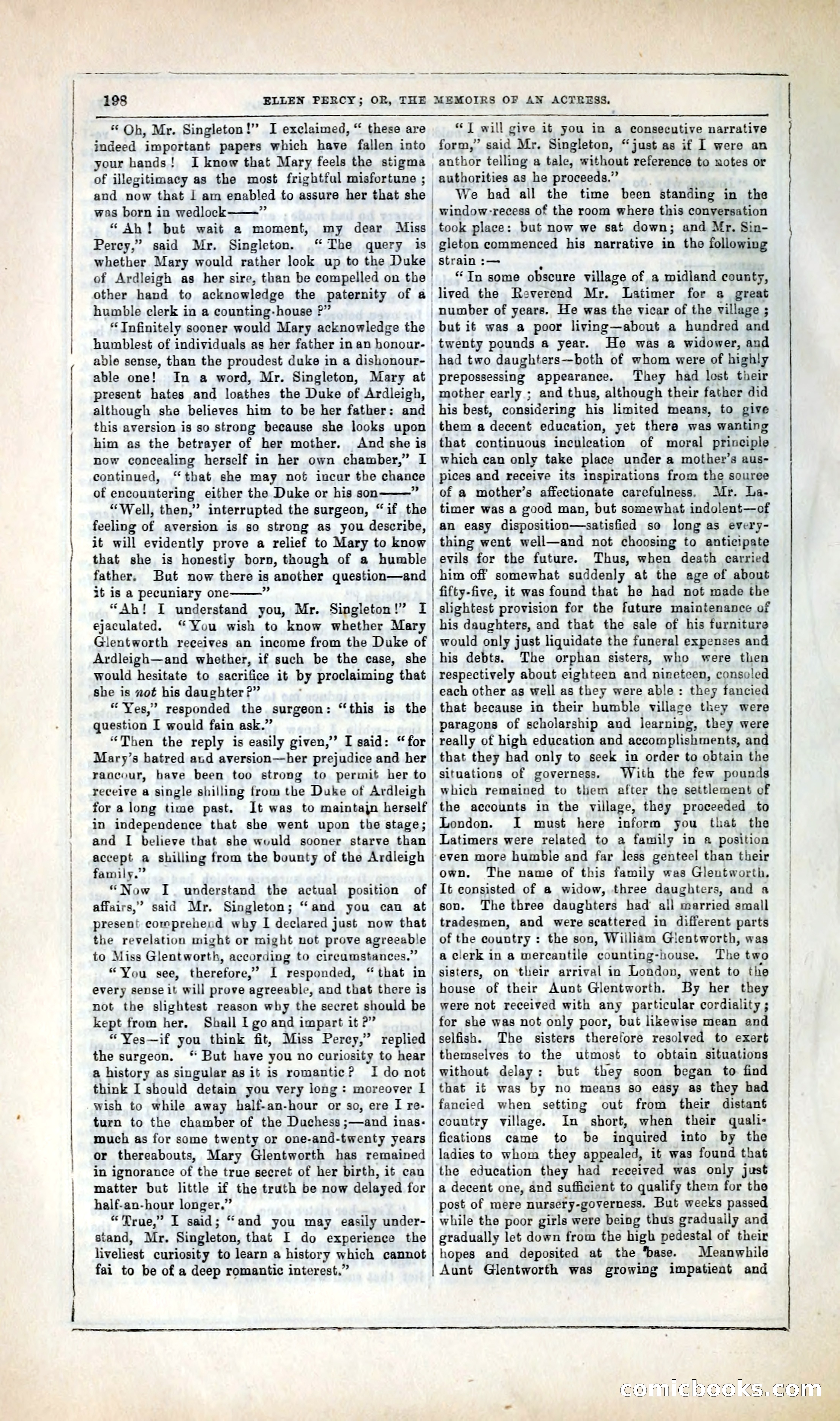
A restored page from Penny Dreadfuls, 1856. Page through the whole issue in the reader above.
📄 Transcribed text from this page (OCR, searchable)
Machine-transcribed from the original scan — historical spelling and the odd misread are preserved.
—— ee oe *. re ee ne ———— EEE a 7 mee ee ee eee ee a wr rm Se ee 198 ELLEN PERCY; OR, THE MEMOIRS OF AN ACTRESS, * Oh, Mr. Singleton!” I exclaimed,“ these are “I will give it you in a consecutive narrative indeed important papers which have fallen into form,” said Mr. Singleton, “just as if 1 were an your hands! I know that Mary feels the stigma anthor telling a tale, without reference to notes or of illegitimacy as the most frightful misfortune ; authorities as he proceeds.” and now that 1 am enabled to assure her that she | We had all the time been standing in the was born in wedlock ts | window-recess of the room where this conversation “Ah! but wait a moment, my dear Miss took place: but now we sat down; and Mr. Sin- Perey,” said Mr. Singleton. “The query is| gleton commenced his narrative in the following whether Mary would rather look up to the Duke strain :— 4 of Ardleigh as her sire, than be compelled on the’ ‘In some obscure village of a midland county, other hand to acknowledge the paternity of a lived the Reverend Mr. Latimer for a great humble clerk in a counting-house P” number of years. He was the vicar of the village ; “Infinitely sooner would Mary acknowledge the but it was a poor living—about a hundred and humblest of individuals as her father inan honour- | twenty pounds a year. He was a widower, and able sense, than the proudest duke in a dishonour- had two daughters—both of whom were of highly able one! In a word, Mr. Singleton, Mary at prepossessing appearance. They had lost their present hates and loathes the Duke of Ardleigh, | mother early ; and thus, although their father did although she believes him to be her father: and his best, considering his limited means, to give this aversion is so strong because she looks upon ‘them a decent education, yet there was wanting him as the betrayer of her mother. And she is that continuous inculcation of moral principle now concealing herself in her own chamber,” I} which can only take place under a mother’s aus- continued, “that she may not incur the chance | pices and receive its inspirations from the souree of encountering either the Duke or his son Mr. La- ” | of a mother’s affectionate carefulness. “Well, then,” interrupted the surgeon, “if the | timer was a good man, but somewhat indolent—of feeling of aversion is so strong as you describe, an easy disposition—satisfied so long as every- it will evidently prove a relief to Mary to know | thing went well—and not choosing to anticipate that she is honestiy born, though of a humble evils for the future. Thus, when death carried father. But now there is another question—and | him off somewhat suddenly at the age of about it is a pecuniary one 4 fifty-five, it was found that he had not made the “Ah! I understand you, Mr. Singleton!” I | slightest provision for the future maintenance of ejaculated. “You wish to know whether Mary | his daughters, and that the sale of his furniture Glentworth receives an income from the Duke of | would only just liquidate the funeral expenses and Ardleigh—and whether, if such be the ease, she | his debts. The orphan sisters, who were then would hesitate to sacrifice it by proclaiming that | respectively about eighteen and nineteen, consoled she is not his daughter?” each other as well as they were able: they fancied “Yes,” responded the surgeon: “this is the | that because in their humble village they were question I would fain ask.” paragons of scholarship and learning, they were “Then the reply is easily given,” I said: “for | really of high education and accomplishments, and Mary’s hatred aud aversion—her prejudice and her | that they had only to seek in order to obtain the rancour, have been too strong to permit her to| situations of governess. With the few pounds receive a single shilling from the Duke of Ardleigh | which remained to tliem after the settlement of for along time past. It was to maintajn herself | the accounts in the village, they proceeded to in independence that she went upon the stage;| London. I must here inform you that the and I believe that she would sooner starve than | Latimers were related to a family in a position accept a shilling from the bounty of the Ardleigh | even more humble and far less genteel than their family.” own. The name of this family was Glentworth. “Now I understand the actual position of | It consisted of a widow, three daughters, and a affairs,” said Mr. Singleton; “and you can at;son. The three daughters had all married small present comprehend why I declared just now that tradesmen, and were scattered in different parts the revelation might or might not prove agreeable | of the country: the son, William Glentworth, was to Miss Glentworth, according to circumstances.” | a clerk in a mercantile counting-iiouse. The two “You see, therefore,’ I responded, “that in! sisters, on their arrival in London, went to the every sense it will prove agreeable, and that there is | house of their Aunt Glentworth. By her they not the slightest reason why the secret should be | were not received with any particular cordiality ; kept from her. Shall I go and impart it ?” for she was not only poor, but likewise mean and “Yes—if you think fit, Miss Perey,” replied | selfish, The sisters therefore resolved to exert the surgeon. ‘“ But have you no curiosity to hear | themselves to the utmost to obtain situations a history as singular as it is romantic? Ido not| without delay: but they soon began to find think I should detain you very long: moreover I| that it was by no means so easy as they had wish to while away half-an-hour or so, ere I re- | fancied when setting out from their distant turn to the chamber of the Duchess;—and inas- | country village. In short, when their quali- much as for some twenty or one-and-twenty years or thereabouts, Mary Glentworth has remained in ignorance of the true secret of her birth, it can matter but little if the truth be now delayed for half-an-hour longer.” “True,” I said; “and you may easily under- stand, Mr. Singleton, that I do experience the liveliest curiosity to learn a history which cannot fai to be of a deep romantic interest.” fications came to be inquired into by the ladies to whom they appealed, it was found that the education they had received was only just a decent one, and sufficient to qualify them for the post of mere nursery-governess. But weeks passed while the poor girls were being thus graduaily and gradually let down from the high pedestal of their hopes and deposited at the ‘base. Meanwhile Aunt Glentworth was growing impatient and ee CORNICLOCC) (E@)