
Penny Dreadfuls, 1856 · page 200 of 399
Ellen Percy; or, The Memoirs of an Actress — page 200: what you’re looking at
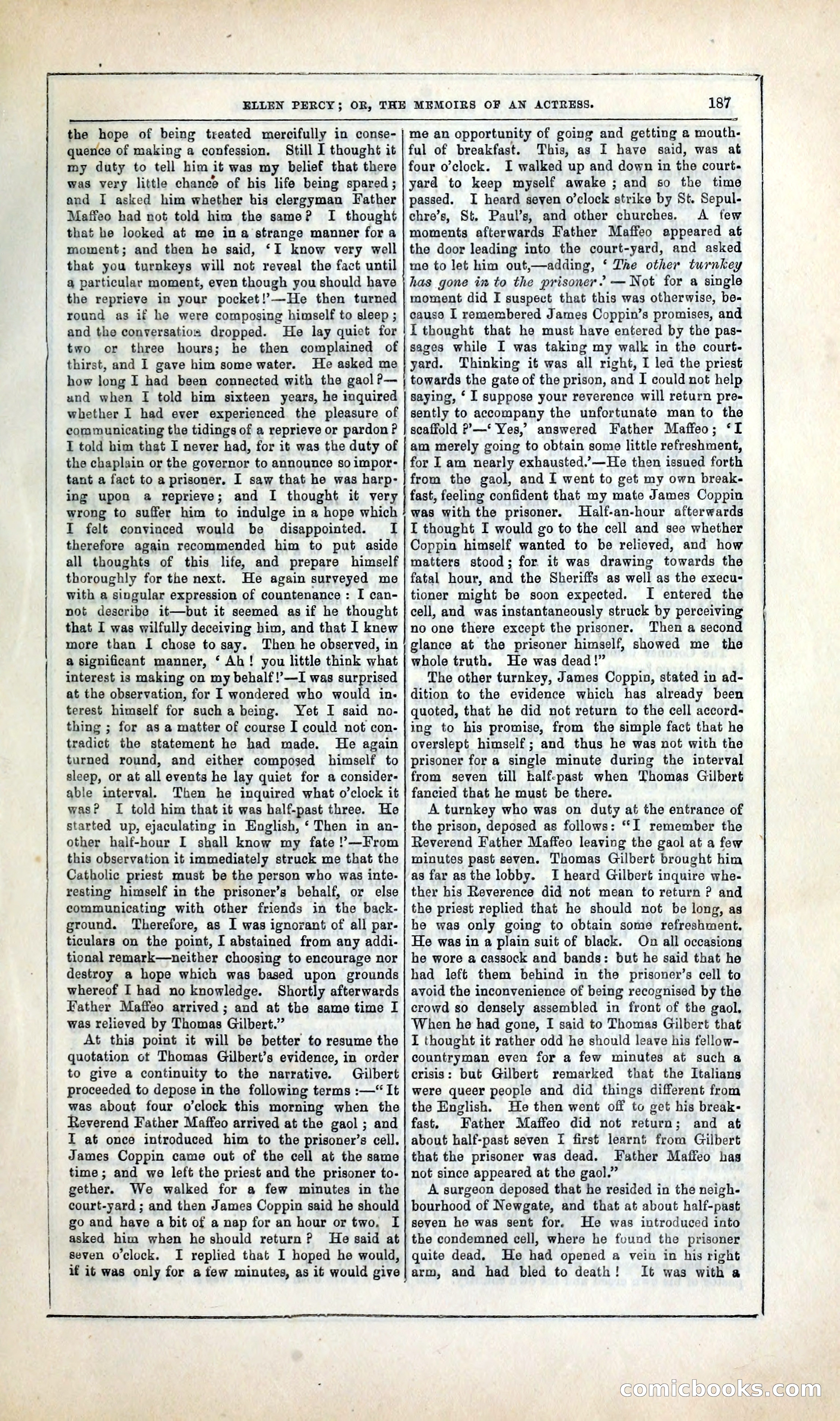
A restored page from Penny Dreadfuls, 1856. Page through the whole issue in the reader above.
📄 Transcribed text from this page (OCR, searchable)
Machine-transcribed from the original scan — historical spelling and the odd misread are preserved.
ELLEN PERCY; OR, THE MEMOIRS OF AN ACTRESS. the hope of being treated mercifully in conse- | quence of making a confession. Still I thought it my duty to tell him it was my belief that there was very little chance of his life being spared ; and I asked him whether his clergyman Father Maffeo had not told him the same? I thought that he looked at me ina strange manner for a moment; and then he said, ‘I know very well that you turnkeys will not reveal the fact until a particular moment, even though you should have the reprieve in your pocket!’—He then turned round as if he were composing himself to sleep ; and the conversation dropped. He lay quiet for two or three hours; he then complained of thirst, and 1 gave him some water. He asked me } yard. me an opportunity of going and getting a mouth- ful of breakfast. This, as I have said, was at four o’clock. I walked up and down in the court- yard to keep myself awake ; and so the time passed. I heard seven o’clock strike by St. Sepul- chre’s, St. Paul’s, and other churches. <A few moments afterwards Father Maffeo appeared at the door leading into the court-yard, and asked me to let him out,—adding, ‘ The other turnkey has gone ix to the prisoner.” — Not for a single moment did I suspect that this was otherwise, be- cause I remembered James Coppin’s promises, and I thought that he must have entered by the pas- sages while I was taking my walk in the court- Thinking it was all right, I led the priest how long I had been connected with the gaol?— | towards the gate of the prison, and I could not help und when If told him sixteen years, he inquired whether I had ever experienced the pleasure of communicating the tidings of a reprieve or pardon P I told him that I never had, for it was the duty of the chaplain or the governor to announce so impor- tant a fact to a prisoner. I saw that he was harp- ing upon a reprieve; and I thought it very wrong to suffer him to indulge in a hope which I felt convinced would be disappointed. I therefore again recommended him to put aside all thoughts of this life, and prepare himself thoroughly for the next. He again surveyed me with a singular expression of countenance: I can- not describe it—but it seemed as if he thought that I was wilfully deceiving him, and that I knew more than I chose to say. Then he observed, in a significant manner, ‘ Ah! you little think what interest is making on my behalf !’—I was surprised at the observation, for I wondered who would in- terest himself for sucha being. Yet I said no- thing ; for as a matter of course I could not con- tradict the statement he had made. He again turned round, and either composed himself to sleep, or at all events he lay quiet for a consider- able interval. Then he inquired what o’clock it was? I told him that it was half-past three. He started up, ejaculating in English, ‘ Then in an- other half-hour I shall know my fate !’—From this observation it immediately struck me that the Catholic priest must be the person who was inte- resting himself in the prisoner’s behalf, or else communicating with other friends in the back- ground. Therefore, as I was ignorant of all par- ticulars on the point, I abstained from any addi- tional remark—neither choosing to encourage nor destroy a hope which was based upon grounds whereof I had no knowledge. Shortly afterwards Father Maffeo arrived; and at the same time I was relieved by Thomas Gilbert.” At this point it will be better to resume the quotation of Thomas Gilbert’s evidence, in order to give a continuity to the narrative. Gilbert proceeded to depose in the following terms :—“ It was about four o’clock this morning when the Reverend Father Maffeo arrived at the gaol ; and I at once introduced him to the prisoner’s cell. James Coppin came out of the cell at the same time; and we left the priest and the prisoner to- gether. We walked for a few minutes in the court-yard ; and then James Coppin said he should go and have a bit of a nap for an hour or two, I asked him when he should return? He said at seven o'clock. I replied that I hoped he would, if it was only for a few minutes, as it would give saying, ‘ I suppose your reverence will return pre- sently to accompany the unfortunate man to the scaffold P?—* Yes,’ answered Father Maffeo; ‘I am merely going to obtain some little refreshment, for I am nearly exhausted.’—He then issued forth from the gaol, and [ went to get my own break- fast, feeling confident that my mate James Coppin was with the prisoner. Half-an-hour afterwards I thought I would go to the cell and see whether Coppin himself wanted to be relioved, and how matters stood; for it was drawing towards the fatal hour, and the Sheriffs as well as the execu- tioner might be soon expected. I entered the cell, and was instantaneously struck by perceiving no one there except the prisoner. Then a second glance at the prisoner himself, showed me the whole truth. He was dead!” The other turnkey, James Coppin, stated in ad- dition to the evidence which has already been quoted, that he did not return to the cell accord- ing to his promise, from the simple fact that he overslept himself; and thus he was not with the prisoner for a single minute during the interval from seven till half-past when Thomas Gilbert fancied that he must be there. A turnkey who was on duty at the entrance of the prison, deposed as follows: ““I remember the Reverend Father Maffeo leaving the gaol at a few minutes past seven. Thomas Gilbert brought him as far asthe lobby. I heard Gilbert inquire whe- ther his Reverence did not mean to return ? and the priest replied that he should not be long, as he was only going to obtain some refreshment. He was in a plain suit of black. On all occasions he wore a cassock and bands: but he said that he had left them behind in the prisoner’s cell to avoid the inconvenience of being recognised by the crowd so densely assembled in front of the gaol, When he had gone, I said to Thomas Gilbert that I thought it rather odd he should leave his fellow- countryman even for a few minutes at such a crisis: but Gilbert remarked that the Italians were queer people and did things different from the English. He then went off to get his break- fast. Father Maffeo did not return; and at about half-past seven [ first learnt from Gilbert that the prisoner was dead. Father Maffeo has not since appeared at the gaol.” A surgeon deposed that he resided in the neigh- bourhood of Newgate, and that at about half-past seven he was sent for. He was introduced into the condemned cell, where he found the prisoner quite dead. He had opened a vein in his right arm, and had bled to death! It was with a com c .IOoOK (E©)