
Penny Dreadfuls, 1856 · page 20 of 399
Ellen Percy; or, The Memoirs of an Actress — page 20: what you’re looking at
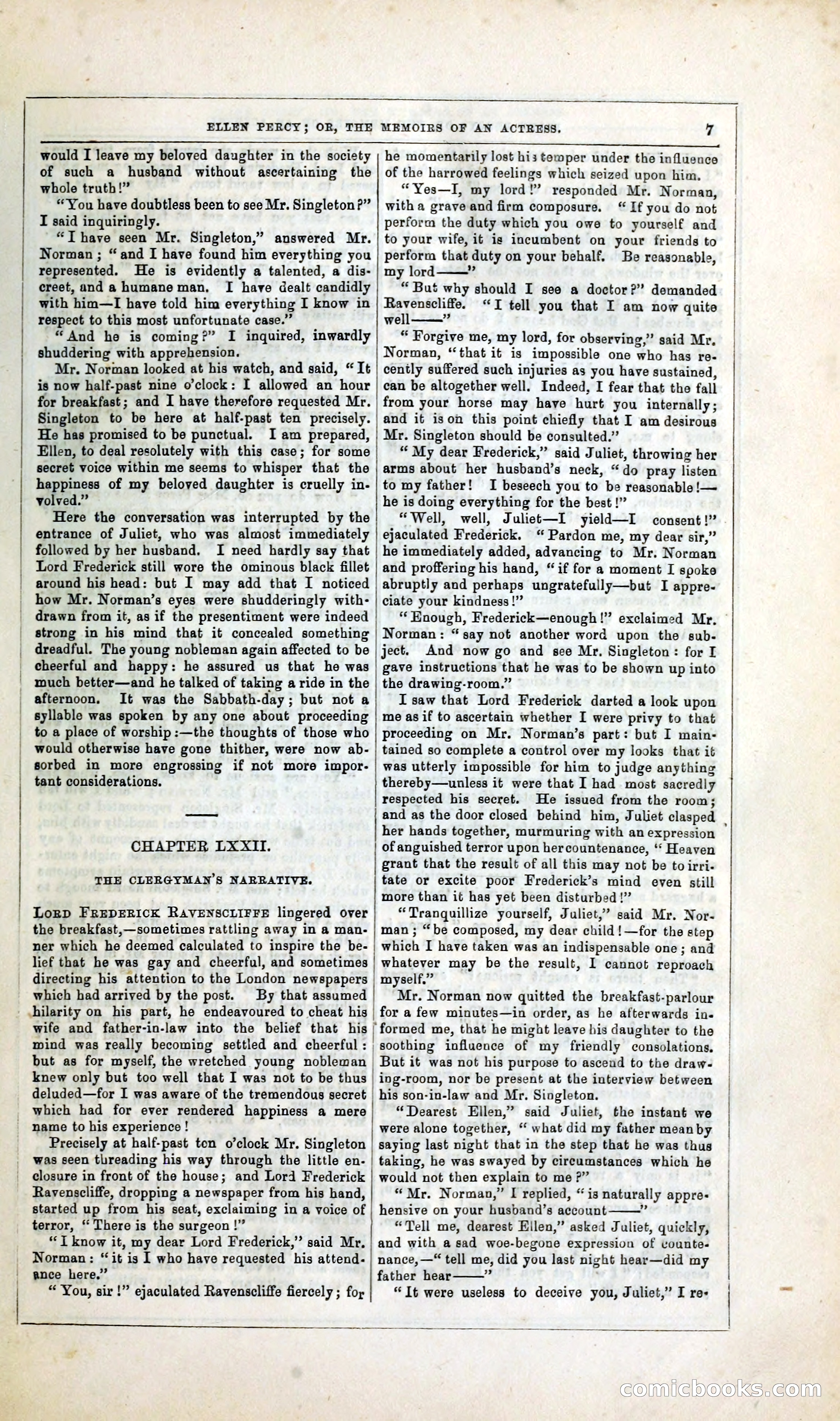
A restored page from Penny Dreadfuls, 1856. Page through the whole issue in the reader above.
📄 Transcribed text from this page (OCR, searchable)
Machine-transcribed from the original scan — historical spelling and the odd misread are preserved.
hilarity on his part, he endeavoured to cheat his wife and father-in-law into the belief that his / : : i ELLEN PERCY; OR, THE MEMOIRS OF AN ACTRESS. 7 would I leave my beloved daughter in the society of such a husband without ascertaining the whole truth!” “You have doubtless been to see Mr. Singleton P” I said inquiringly. “T have seen Mr. Singleton,” answered Mr. Norman ; “and I have found him everything you represented. He is evidently a talented, a dis- creet, and a humane man, [ have dealt candidly with him—I have told him everything I know in respect to this most unfortunate case.” “And he is coming?” I inquired, inwardly shuddering with apprehension. Mr. Norman looked at his watch, and said, “It is now half-past nine o'clock: I allowed an hour for breakfast; and I have therefore requested Mr. Singleton to be here at half-past ten precisely. He has promised to be punctual. I am prepared, Ellen, to deal resolutely with this case; for some secret voice within me seems to whisper that the happiness of my beloved daughter is cruelly in- volved.” Here the conversation was interrupted by the entrance of Juliet, who was almost immediately followed by her husband, I need hardly say that Lord Frederick still wore the ominous black fillet around his head: but I may add that I noticed how Mr. Norman’s eyes were shudderingly with- drawn from it, as if the presentiment were indeed strong in his mind that it concealed something dreadful. The young nobleman again affected to be cheerful and happy: he assured us that he was much better—and he talked of taking a ride in the afternoon. It was the Sabbath-day; but not a syllable was spoken by any one about proceeding to a place of worship :—the thoughts of those who would otherwise have gone thither, were now ab- sorbed in more engrossing if not more impor- tant considerations. CHAPTER LXXII. THE CLERGYMAN’S NARRATIVE. Lozgp FREDERICK RAVENSCLIFFE lingered over the breakfast,—sometimes rattling away in a man- ner which he deemed calculated to inspire the be- lief that he was gay and cheerful, and sometimes directing his attention to the London newspapers | which had arrived by the post. By that assumed mind was really becoming settled and cheerful : | but as for myself, the wretched young nobleman | knew only but too well that I was not to be thus | deluded—for I was aware of the tremendous secret which had for ever rendered happiness a mere name to his experience! Precisely at half-past ton o’clock Mr. Singleton was seen threading his way through the little en- closure in front of the house; and Lord Frederick Ravenscliffe, dropping a newspaper from his hand, started up from his seat, exclaiming in a voice of terror, “There is the surgeon !” “| know it, my dear Lord Frederick,” said Mr, Norman: “it is I who have requested his attend. pnce here,” “ You, sir!” ejaculated Ravenscliffe fiercely ; for Sc eg a Oo he momentarily lost his temper under the influence of the harrowed feelings which seized upon him. “Yes—I, my lord!” responded Mr. Norman, with a grave and firm composure. “ If you do not perform the duty which you owe to yourself and to your wife, it is incumbent on your friends to perform that duty on your behalf. Be reasonable, my lord “! “But why should I see a doctor?” demanded Ravenscliffe. “TI tell you that I am now quite well " “ Forgive me, my lord, for observing,” said Mr. Norman, “that it is impossible one who has re- cently suffered such injuries as you have sustained, can be altogether well. Indeed, I fear that the fall from your horse may have hurt you internally; and it ison this point chiefly that I am desirous Mr. Singleton should be consulted.” “My dear Frederick,” said Juliet, throwing her arms about her husband’s neck, “do pray listen to my father! I beseech you to be reasonable !— he is doing everything for the best!” “Well, well, Juliet—I yield—I consent!” ejaculated Frederick. “ Pardon me, my dear sir,” he immediately added, advancing to Mr. Norman and proffering his hand, “if for a moment I spoke abruptly and perhaps ungratefully—but I appre- ciate your kindness!” ‘Enough, Frederick—enough!” exclaimed Mr, © Norman: “say not another word upon the sub- ject. And now go and see Mr. Singleton: for I gave instructions that he was to be shown up into the drawing-room.” I saw that Lord Frederick darted a look upon me as if to ascertain whether I were privy to that proceeding on Mr. Norman’s part: but I main- tained so complete a control over my looks that it was utterly impossible for him to judge anything thereby—unless it were that I had most sacredly respected his secret. He issued from the room; and as the door closed behind him, Juliet clasped _ her hands together, murmuring with an expression of anguished terror upon hercountenance, ‘‘ Heaven grant that the result of all this may not be toirri- tate or excite poor Frederick’s mind even still more than it has yet been disturbed!” “Tranquillize yourself, Juliet,” said Mr. Nor- man ; “be composed, my dear child !—for the step which I have taken was an indispensable one; and whatever may be the result, I cannot reproach myself,” Mr. Norman now quitted the breakfast-parlour for a few minutes—in order, as he afterwards in- formed me, that he might leave his daughter to the soothing influence of my friendly consolations. But it was not his purpose to ascend to the draw- ing-room, nor be present at the interview between his son-in-law and Mr. Singleton. “Dearest Ellen,” said Juliet, the instant we were alone together, “ what did my father mean by saying last night that in the step that he was thus taking, he was swayed by circumstances which he would not then explain to me P” “Mr. Norman,” I replied, “is naturally appre- hensive on your husband’s account ‘ “Tell me, dearest Eilen,” asked Juliet, quickly, and with asad woe-begone expression of vounte- nance, —“ tell me, did you last night hear—did my father hear % “It were useless to deceive you, Juliet,” I re- COMMU (E©@)