
Penny Dreadfuls, 1856 · page 197 of 399
Ellen Percy; or, The Memoirs of an Actress — page 197: what you’re looking at
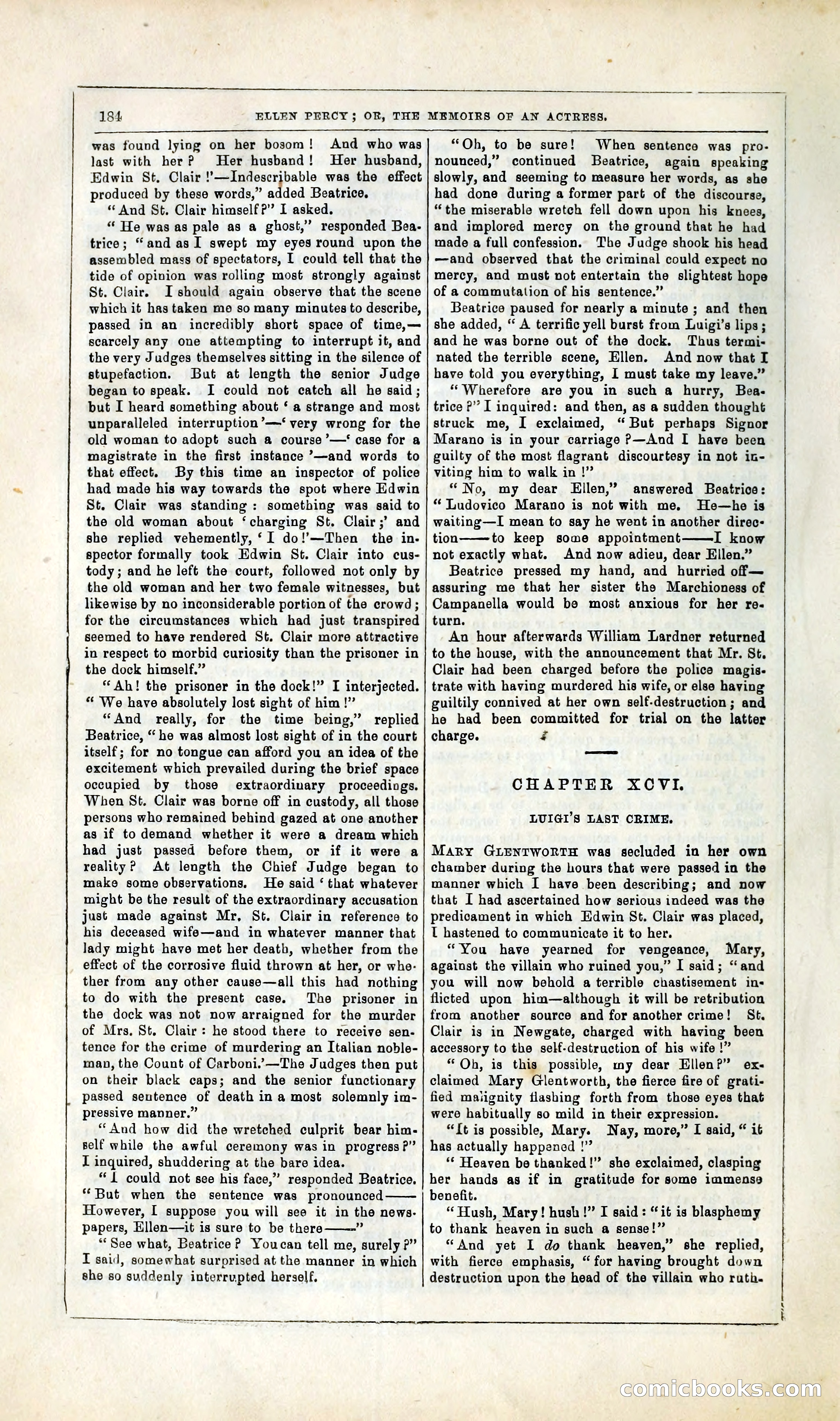
A restored page from Penny Dreadfuls, 1856. Page through the whole issue in the reader above.
📄 Transcribed text from this page (OCR, searchable)
Machine-transcribed from the original scan — historical spelling and the odd misread are preserved.
184 —--—-_- Fe OC FOU ELLEN PERCY; OR, THE MEMOIRS OF AN ACTRESS, was found lying on her bosom! And who was last with herP Her husband! MHer husband, Edwin St. Clair !’—Indescribable was the effect produced by these words,” added Beatrice. “ And St. Clair himself?” I asked. ‘‘ He was as pale as a ghost,” responded Bea- trice; “and as I swept my eyes round upon the assembled mags of spectators, I could tell that the tide of opinion was rolling most strongly against St. Clair. I should again observe that the scene which it has taken mo so many minutes to describe, passed in an incredibly short space of time,— scarcely any one attempting to interrupt it, and the very Judges themselves sitting in the silence of stupefaction. But at length the senior Judge began to speak. I could not catch all he said; but I heard something about ‘ a strange and most unparalleled interruption’—‘ very wrong for the old woman to adopt such a course ’—‘ case for a magistrate in the first instance ’—and words to that effect. By this time an inspector of police had made his way towards the spot where Edwin St. Clair was standing : something was said to the old woman about ‘charging St. Clair ;’ and she replied vehemently, ‘I do!’—Then the in- spector formally took Edwin St. Clair into cus- tody; and he left the court, followed not only by the old woman and her two female witnesses, but likewise by no inconsiderable portion of the crowd; for the circumstances which had just transpired seemed to have rendered St. Clair more attractive in respect to morbid curiosity than the prisoner in the dock himself.” “Ah! the prisoner in the dock!” I interjected. “We have absolutely lost sight of him !” “And really, for the time being,’ replied Beatrice, “he was almost lost sight of in the court itself; for no tongue can afford you an idea of the excitement which prevailed during the brief space occupied by those extraordinary proceedings. When St. Clair was borne off in custody, all those persons who remained behind gazed at one another as if to demand whether it were a dream which had just passed before them, or if it were a reality? At length the Chief Judge began to make some observations. He said ‘ that whatever might be the result of the extraordinary accusation just made against Mr, St. Clair in reference to his deceased wife—and in whatever manner that lady might have met her death, whether from the effect of the corrosive fluid thrown at her, or whe- ther from any other cause—all this had nothing to do with the present case. The prisoner in the dock was not now arraigned for the murder of Mrs. St. Clair: he stood there to receive sen- tence for the crime of murdering an Italian noble- man, the Count of Carboni.’—The Judges then put on their black caps; and the senior functionary passed sentence of death in a most solemnly im- pressive manner.” “And how did the wretched culprit bear him- Belf while the awful ceremony was in progress P” I inquired, shuddering at the bare idea. “I could not see his face,” responded Beatrice. * But when the sentence was pronounced However, I suppose you will see it in the news- papers, Hllen—it is sure to be there 4 ‘See what, Beatrice P Youcan tell me, surely ?” IT said, somenbat surprised at the manner in which she so suddenly interrupted herself, TT , /O “Oh, to be sure! When sentence was pro- nounced,” continued Beatrice, again speaking slowly, and seeming to measure her words, as she had done during a former part of the discourse, “the miserable wretch fell down upon his knees, and implored mercy on the ground that he had made a full confession. The Judge shook his head —and observed that the criminal could expect no mercy, and must not entertain hp slightest hope of a commutation of his sentence.” Beatrice paused for nearly a minute; and then she added, “ A terrific yell burst from Luigi’s lips ; and he was borne out of the dock. Thus termi- nated the terrible scene, Ellen. And now that I have told you everything, I must take my leave.” “Wherefore are you in such a hurry, Bea- trice P’’ I inquired: and then, as a sudden thought struck me, I exclaimed, “ But perhaps Signor Marano is in your carriage P—And I have been guilty of the most flagrant discourtesy in not in- viting him to walk in !” “No, my dear LHllen,” answered Beatrice: “‘ Ludovico Marano is not with me. He—he is waiting—I mean to say he went in another direc: tion to keep some appointment I know not exactly what. And now adieu, dear Ellen.” Beatrice pressed my hand, and hurried off— assuring me that her sister the Marchioness of Campanella would be most anxious for her re- turn. An hour afterwards William Lardner returned to the house, with the announcement that Mr. St. Clair had been charged before the police magis- trate with having murdered his wife, or else having guiltily connived at her own self-destruction; and he had been committed for trial on the latter charge. £ CHAPTER XCVI. LUIGI’S LAST CRIME. MARY GLENTWORTH was secluded in her own chamber during the hours that were passed in the manner which I have been describing; and now that I had ascertained how serious indeed was the predicament in which Edwin St. Clair was placed, U hastened to communicate it to her. “You have yearned for vengeance, Mary, against the villain who ruined you,” I said; “and you will now behold a terrible Shastiedinerrae ins flicted upon him—although it will be retribution from another source and for another crime! St. Clair is in Newgate, charged with having been accessory to the self-destruction of his wife !” “Oh, is this possible, my dear Ellen?” ex- claimed Mary Glentworth, the fierce fire of grati- fied maiignity flashing forth from those eyes that were habitually so mild in their expression. “{t is possible, Mary. Nay, more,” I said, “ it has actually happened !” ‘“* Heaven be thanked!” she exclaimed, clasping her hands as if in gratitude for some immense benefit. “Hush, Mary! hush!” I said: “it is blasphemy to thank heaven in such a sense!” “And yet L do thank heaven,” she replied, with fierce emphasis, “ for having brought down destruction upon the head of the villain who ruth. ; SS ‘2. com (E(e) JOO