
Penny Dreadfuls, 1856 · page 186 of 399
Ellen Percy; or, The Memoirs of an Actress — page 186: what you’re looking at
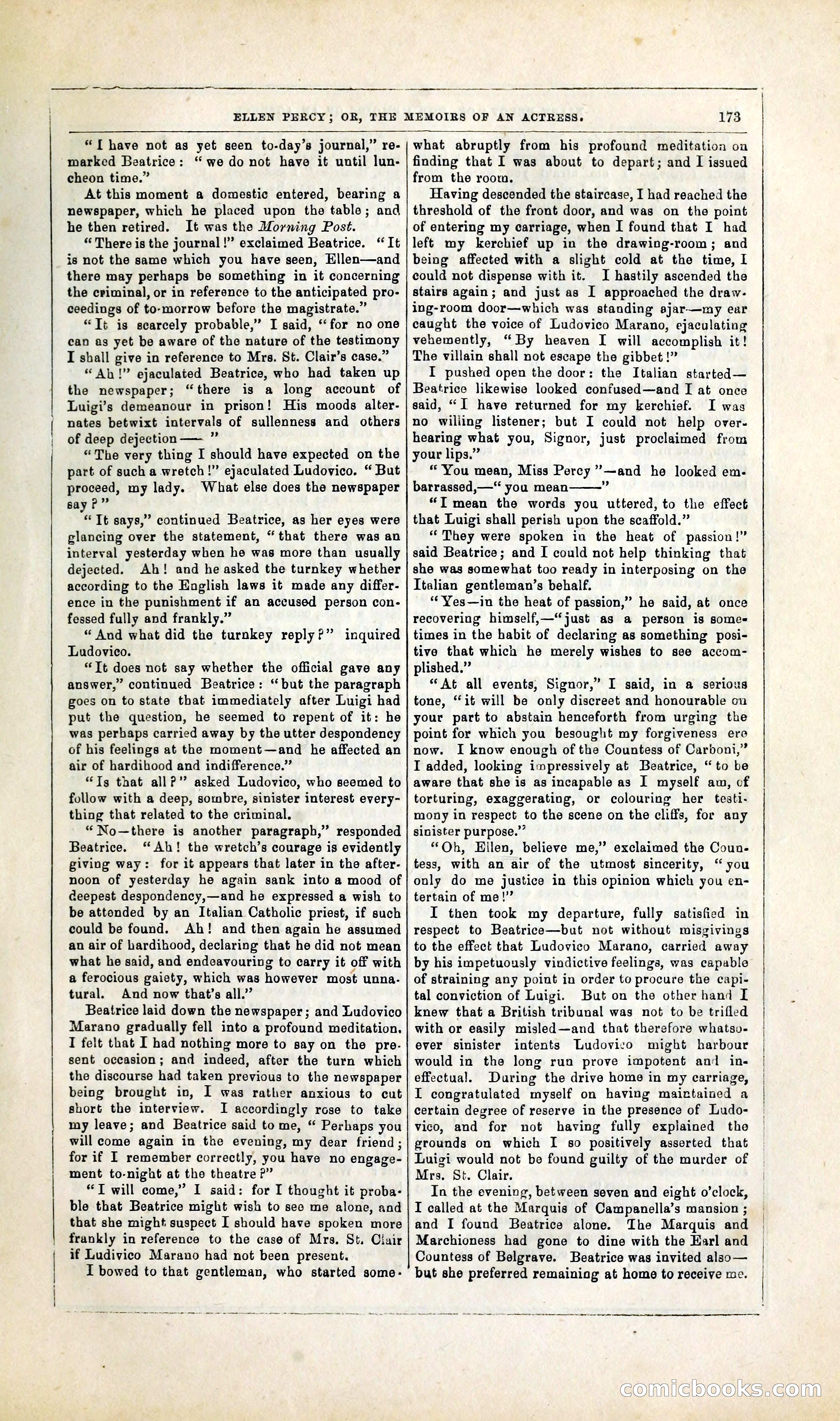
A restored page from Penny Dreadfuls, 1856. Page through the whole issue in the reader above.
📄 Transcribed text from this page (OCR, searchable)
Machine-transcribed from the original scan — historical spelling and the odd misread are preserved.
| ! | ELLEN PERCY; OR, THE MEMOIRS OF AN ACTRESS. “[T have not as yet seen to-day’s journal,” re- marked Beatrice: “we donot have it until lun- cheon time.” At this moment a domestic entered, bearing a newspaper, which he placed upon the table; and he then retired. It was the Morning Post. “There is the journal!” exclaimed Beatrice. “It is not the same which you have seen, Ellen—and there may perhaps be something in it concerning the criminal, or in reference to the anticipated pro- ceedings of to-morrow before the magistrate.” “Ti is scarcely probable,” I said, ‘for no one can as yet be aware of the nature of the testimony I shall give in reference to Mrs. St. Clair’s case.” “Ah!” ejaculated Beatrice, who had taken up the newspaper; “there is a long account of Luigi’s demeanour in prison! His moods alter- nates betwixt intervals of sullenness and others of deep dejection — ” “The very thing I should have expected on the part of such a wretch!” ejaculated Ludovico. “ But proceed, my lady. What else does the newspaper say Pp” “Tt says,” continued Beatrice, as her eyes were glancing over the statement, “that there was an interval yesterday when he was more than usually dejected. Ah! and he asked the turnkey whether according to the Knglish laws it made any differ- ence in the punishment if an accused person con- fessed fully and frankly.” “ And what did the turnkey reply?” inquired Ludovico. “Tt does not say whether the official gave any answer,” continued Beatrice: ‘but the paragraph goes on to state that immediately after Luigi had put the question, he seemed to repent of it: he was perbaps carried away by the utter despondency of his feelings at the moment—and he affected an air of hardibood and indifference.” “Ts that alle?” asked Ludovico, who seemed to follow with a deep, sombre, sinister interest every- thing that related to the criminal. “ No—there is another paragraph,” responded Beatrice. ‘Ah! the wretch’s courage is evidently giving way: for it appears that later in the after- noon of yesterday he again sank into a mood of deepest despondency,—and he expressed a wish to be attonded by an Italian Catholic priest, if such could be found. Ah! and then again he assumed an air of bardibood, declaring that he did not mean what he said, and endeavouring to carry it off with a ferocious gaicty, which was however most unna.- tural. And now that’s all.” Beatrice laid down the newspaper; and Ludovico Marano gradually fell into a profound meditation. I felt that I had nothing more to say on the pre- sent occasion; and indeed, after the turn which the discourse had taken previous to the newspaper being brought in, I was rather anxious to cut short the interview. I accordingly rose to take my leave; and Beatrice said to me, “ Perhaps you will come again in the evening, my dear friend; for if I remember correctly, you have no engage- ment to-night at the theatre P” “T will come,” I said: for I thought it proba- ble that Beatrice might wish to seo me alone, and that she might suspect I should have spoken more frankly in reference to the case of Mrs. St. Ciair if Ludivico Marano had not been present. I bowed to that gentleman, who started some- rr em a a a re ee ete oe 173 a what abruptly from his profound meditation oa finding that I was about to depart; and I issued from the roox. Having descended the staircase, I had reached the threshold of the front door, and was on the point of entering my carriage, when I found that I had left my kerchief up in the drawing-room; and being affected with a slight cold at the time, I could not dispense with it. I hastily ascended the stairs again; and just as [ approached the draw- ing-room door—which was standing ajar—my ear caught the voice of Ludovico Marano, ejaculating vehemently, “By heaven I will accomplish it! The villain shall not escape the gibbet !” I pushed open the door: the Italian started— Beatrice likewise looked confused—and I at once said, “I have returned for my kerchief. I was no wiliing listener; but I could not help over. hearing what you, Signor, just proclaimed from your lips.” “You mean, Miss Percy ”—and he looked em- barrassed,—“ you mean ‘1 “T mean the words you uttered, to the effect that Luigi shall perish upon the scaffold.” “They were spoken in the heat of passion!” said Beatrice; and I could not help thinking that she was somewhat too ready in interposing on the Italian gentleman’s behalf. “‘'Yes—in the heat of passion,” he said, at once recovering himself,—“ just as a person is somes times in the habit of declaring as something posi- tive that which he merely wishes to see accom- plished.” “At all events, Signor,” I said, in a serious tone, “it will be only discreet and honourable cu your part to abstain henceforth from urging the point for which you besought my forgiveness ere now. I know enough of the Countess of Carboni,” I added, looking impressively at Beatrice, “to be aware that she is as incapable as 1 myself am, of torturing, exaggerating, or colouring her testi- mony in respect to the scene on the cliffs, for any sinister purpose.” “Oh, Hilen, believe me,” exclaimed the Coun. tess, with an air of the utmost sincerity, “ you only do me justice in this opinion which you en- tertain of me!” I then took my departure, fully satisfied in respect to Beatrice—but not without misgivings to the effect that Ludovico Marano, carried away by his impetuously vindictive feelings, was capable of straining any point in order to procure the capi- tal conviction of Luigi. But on the other hand [ knew that a British tribunal was not to be trifled with or easily misled—and that therefore whatso- ever sinister intents Ludovico might harbour would in the long run prove impotent and in- effectual. During the drive home in my carriage, I congratulated myself on having maiztained a certain degree of reserve in the presence of Ludo- vico, and for not having fully explained the grounds on which I so positively asserted that Luigi would not be found guilty of the murder of Mrs. St. Clair. In the evening, between seven and eight o’clock, I called at the Marquis of Campanella’s mansion ; and I found Beatrice alone. The Marquis and Marchioness had gone to dine with the Earl and Countess of Belgrave. Beatrice was invited also— i i eT ee | but she preferred remainiog at home to receive me. | ———_——— eee i se em err et es 6)(0)(6) Com O SS (G(O)