
Penny Dreadfuls, 1856 · page 169 of 399
Ellen Percy; or, The Memoirs of an Actress — page 169: what you’re looking at
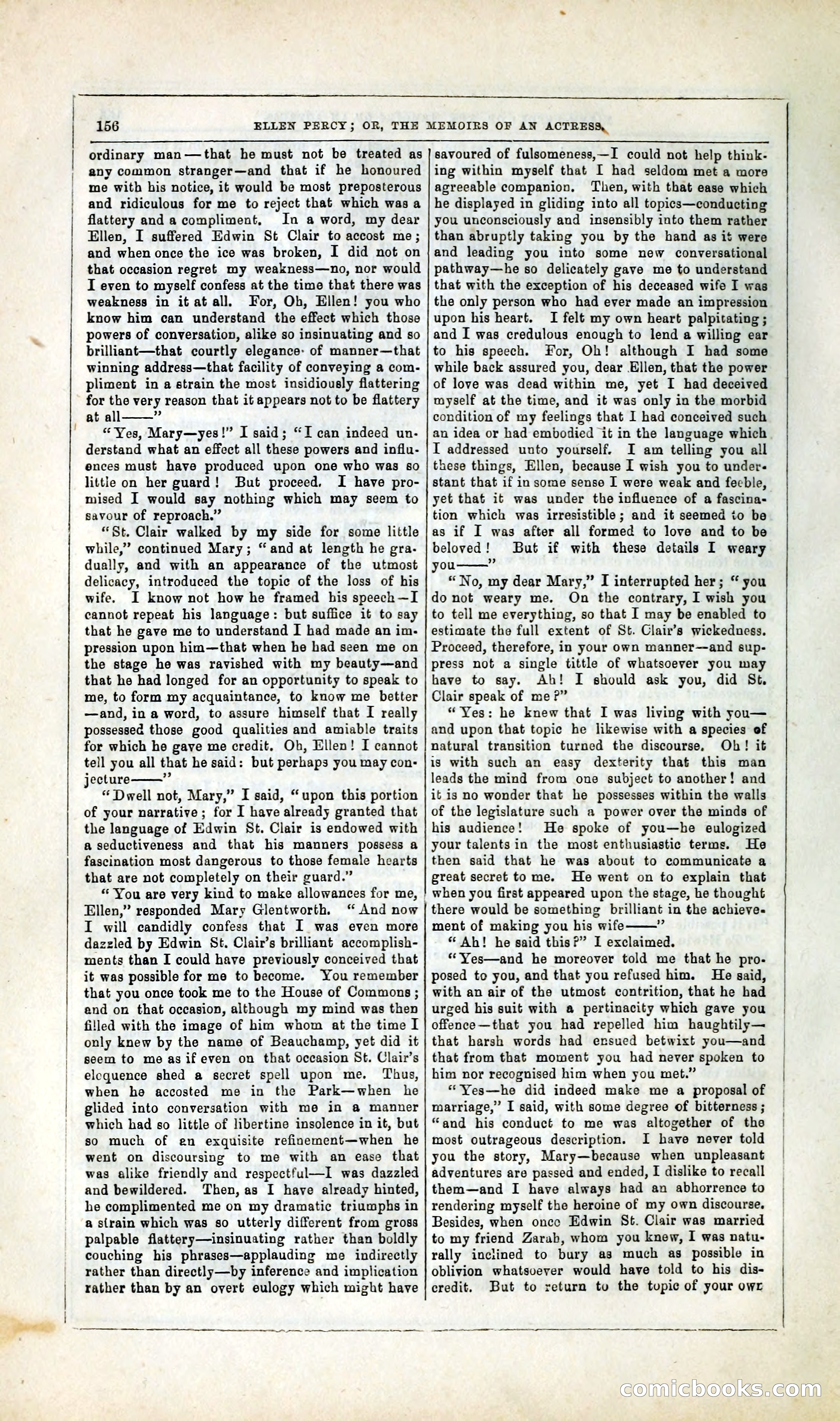
A restored page from Penny Dreadfuls, 1856. Page through the whole issue in the reader above.
📄 Transcribed text from this page (OCR, searchable)
Machine-transcribed from the original scan — historical spelling and the odd misread are preserved.
pares | | ) 156 ordinary man—that he must not be treated as any common stranger—and that if he honoured me with his notice, it would be most preposterous and ridiculous for me to reject that which was a flattery and a compliment, In a word, my dear Ellen, I suffered Edwin St Clair to accost me; and when once the ice was broken, I did not on that occasion regret my weakness—no, nor would I even to myself confess at the time that there was weakness in itatall. For, Oh, Ellen! you who know him can understand the effect which those powers of conversation, alike so insinuating and so brilliant—that courtly elegance: of manner—that winning address—that facility of conveying a com- pliment in a strain the most insidiously flattering for the very reason that it appears not to be flattery at all 4 “Yes, Mary—yes!” I said; “I can indeed un- derstand what an effect all these powers and influ- ences must have produced upon one who was s0 little on her guard! But proceed, I have pro- mised I would say nothing which may seem to savour of reproach.” “St. Clair walked by my side for some little while,” continued Mary; “and at length he gra- dually, and with an appearance of the utmost delicacy, introduced the topic of the loss of his wife. I know not how he framed his speech—I cannot repeat his language: but suffice it to say that he gave me to understand I had made an im- pression upon him—that when he had seen me on the stage he was ravished with my beauty—and that he had longed for an opportunity to speak to me, to form my acquaintance, to know me better —and, in a word, to assure himself that I really possessea those good qualities and amiable traits for which he gave me credit. Ob, Ellen! I cannot tell you all that he said: but perhaps you may con- jecture 2 “ Dwell not, Mary,” I said, “upon this portion of your narrative ; for I have already granted that the language of Edwin St. Clair is endowed with a seductiveness and that his manners possess a fascination most dangerous to those female hearts that are not completely on their guard.” “ You are very kind to make allowances for me, | Ellen,” responded Mary Glentworth “And now I will candidly confess that I was even more dazzled by Edwin St. Clair’s brilliant accomplish- ments than I could have previously conceived that it was possible for me to become. You remember that you once took me to the House of Commons ; end on that occasion, although my mind was then filled with the image of him whom at the time I only knew by the name of Beauchamp, yet did it seem to me as if even on that occasion Sf. Clair’s eloguence shed a secret spell upon me. Thus, when he accosted me in the Park—when he glided into conversation with me in a manner which had so little of libertine insolence in it, but so much of en exquisite refinement—when he went on discoursing to me with an ease that was alike friendly and respectful—I was dazzled and bewildered. Then, as I have already hinted, he complimented me on my dramatic triumphs in a strain which was so utterly different from gross palpable flattery—insinuating rather than boldly couching his phrases—applauding me indirectly rather than directly—by inference and implication rather than by an overt eulogy which might have c“-_—_—_—_—_ a — —— en a ee ee ae eae eee eee ELLEN PERCY; OR, THE MEMOIRS OF AN ACTRESS, savoured of fulsomeness,—I could not help think- ing within myself that I had seldom met a more agreeable companion, Then, with that ease which he displayed in gliding into all topics—conducting you unconsciously and insensibly into them rather than abruptly taking you by the hand as it were and leading you into some new conversational pathway—he so delicately gave me to understand that with the exception of his deceased wife I was the only person who had ever made an impression upon his heart. I felt my own heart palpitating; and I was credulous enough to lend a willing ear to his speech. For, Oh! although I had some while back assured you, dear Ellen, that the power of love was dead within me, yet I had deceived myself at the time, and it was only in the morbid condition of my feelings that I had conceived such an idea or had embodied it in the language which I addressed unto yourself. I am telling you all these things, Ellen, because I wish you to under. stant that if in some sense I were weak and feeble, yet that it was under the influence of a fascina- tion which was irresistible; and it seemed io be as if I was after all formed to love and to be beloved! But if with these details I weary you ? “No, my dear Mary,” I interrupted her; “ you do not weary me. On the contrary, I wish you to tell me everything, so that I may be enabled to estimate the full extent of St. Clair’s wickedness. Proceed, therefore, in your own manner—and sup- press not a single tittle of whatsoever you may have to say. Ah! I should ask you, did St. Clair speak of me?” “Yes: he knew that I was living with you— and upon that topic he likewise with a species of natural transition turned the discourse. Ob! if is with such an easy dexterity that this man leads the mind from one subject to another! and it is no wonder that he possesses within the walls of the legislature such a power over the minds of his audience! He spoke of you—he eulogized your talents in the most enthusiastic terms. He then said that he was about to communicate a great secret to me. He went on to explain that when you first appeared upon the stage, he thought there would be something brilliant in the achieve- ment of making you his wife 3 *“ Ah! he said this?” I exclaimed. “Yes—and he moreover told me that he pro- posed to you, and that you refused him. He said, with an air of the utmost contrition, that he had urged his suit with a pertinacity which gave you offence—that you had repelled him haughtily— that harsh words had ersued betwixt you—and that from that moment you had never spoken to him nor recognised him when you met.” “Yes—he did indeed make me a proposal of marriage,” I said, with some degree of bitterness ; “and his conduct to me was altogether of the most outrageous description. I have never told you the story, Mary—because when unpleasant adventures are passed and ended, I dislike to recall them—and I have always had an abhorrence to rendering myself the heroine of my own discourse, Besides, when once Edwin St. Clair was married to my friend Zarab, whom you knew, I was natu- rally inclined to bury as much as possible in oblivion whatsoever would have told to his dis- credit. But to return tu the tupic of your owr ec ee (C (E@)