
Penny Dreadfuls, 1856 · page 15 of 399
Ellen Percy; or, The Memoirs of an Actress — page 15: what you’re looking at
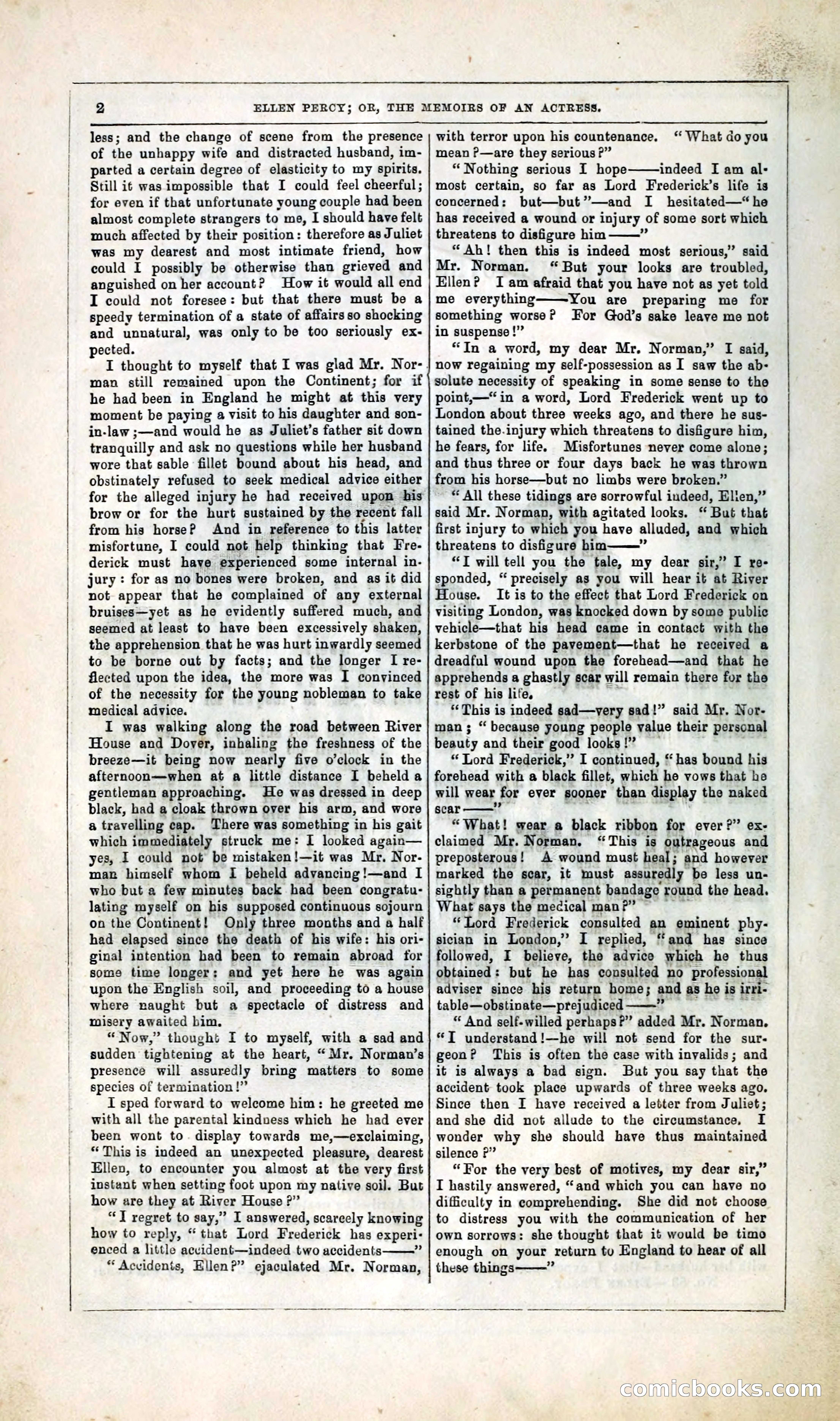
A restored page from Penny Dreadfuls, 1856. Page through the whole issue in the reader above.
📄 Transcribed text from this page (OCR, searchable)
Machine-transcribed from the original scan — historical spelling and the odd misread are preserved.
2 ELLEN PERCY; OR, THE MEMOIRS OF AN ACTRESS. less; and the change of scene from the presence of the unhappy wife and distracted husband, im- parted a certain degree of elasticity to my spirits. Still ié was impossible that I could feel cheerful; for even if that unfortunate young couple had been almost complete strangers to me, I should have felt much affected by their position: therefore as Juliet was my dearest and most intimate friend, how could I possibly be otherwise than grieved and anguished on her account? How it would all end I could not foresee: but that there must be a speedy termination of a state of affairs so shocking and unnatural, was only to be too seriously ex- pected. I thought to myself that I was glad Mr. Nor-. man still remained upon the Continent; for if he had been in England he might at this very moment be paying a visit to his daughter and son- in-law ;—and would he as Juliet’s father sit down tranquilly and ask no questions while her husband wore that sable fillet bound about his head, and obstinately refused to seek medical advice either for the alleged injury he had received upon bis brow or for the hurt sustained by the recent fall from his horse? And in reference to this latter misfortune, I could not help thinking that Fre- derick must haye experienced some internal in- jury : for as no bones were broken, and as it did not appear that he complained of any external bruises—yet as he evidently suffered much, and seemed at least to have been excessively shaken, the apprehension that he was hurt inwardly seemed to be borne out by facts; and the longer I re- flected upon the idea, the more was I convinced of the necessity for the young nobleman to take medical advice. I was walking along the road between River House and Doyer, inhaling the freshness of the breeze—it being now nearly five o’clock in the afternoon—when at a little distance I beheld a gentleman approaching. He was dressed in deep black, had a cloak thrown over his arm, and wore a travelling cap. There was something in his gait which immediately struck me: I looked again— yes, I could not be mistaken!—it was Mr. Nor- mar himself whom I beheld advancing!—and I who but a few minutes back had been congratu- lating myself on his supposed continuous sojourn on the Continent! Only three months and a half had elapsed since the death of his wife: his ori- ginal intention had been to remain abroad for some time longer: and yet here he was again upon the English soil, and proceeding to a house where naught but a spectacle of distress and misery awaited bim, “ Now,” thought I to myself, with a sad and sudden tightening at the heart, “Mr. Norman’s presence will assuredly bring matters to some species of termination!” I sped forward to welcome him: he greeted me with all the parental kindness which he had ever been wont to. display towards me,—exclaiming, “This is indeed an unexpected pleasure, dearest Ellen, to encounter you almost at the very first instant when setting foot upon my native soil. But how are they at River House ?” “J regret to say,” I answered, scareely knowing how to reply, “ that Lord Frederick has experi- enced a little acvident—indeed two accidents 43 * Acvidents, Ellen?” ejaculated Mr. Norman, i re oe with terror upon his countenance. mean P—are they serious P” “Nothing serious I hope indeed I am al- most certain, so far as Lord Frederick’s life is concerned: but—but”—and I hesitated—“ he has received a wound or injury of some sort which threatens to disfigure him R * Ah! then this is indeed most serious,” said Mr. Norman. “But your looks are troubled, Ellen? Iam afraid that you have not as yet told me everything You are preparing me for something worse? For God’s sake leave me not in suspense!” “In a word, my dear Mr. Norman,” I said, now regaining my self-possession as I saw the ab- solute necessity of speaking in some sense to the point,—“in a word, Lord Frederick went up to London about three weeks ago, and there he sus- tained the.injury which threatens to disfigure him, he fears, for life. Misfortunes never come alone; and thus three or four days back he was thrown from his horse—but no limbs were broken.” * All these tidings are sorrowful indeed, Elien,” said Mr. Norman, with agitated looks. “ But that first injury to which you have alluded, and which threatens to disfigure him “T will tell you the tale, my dear sir,’ I re- sponded, “ precisely as you will hear it at River House. It is to the effect that Lord Frederick on visiting London, was knocked down by some public vehicle—that his head came in contact with the kerbstone of the payement—that he received a dreadful wound upon the forehead—and that he apprehends a ghastly scar will remain there for the rest of his life. This is indeed sad—very sad!” said Mr. Nor- man ; “ because young people value their personal beauty and their good looks!” ‘Lord Frederick,” I continued, ‘‘ has bound his forehead with a black fillet, which he vows that he will wear for ever sooner than display the naked scar ——" “What! wear a black ribbon for ever?” ex- claimed Mr. Norman. “This is outrageous and preposterous! A wound must heal; and however marked the scar, it must assuredly be less un- sightly than a permanent bandage round the head. What says the mecical man?” © “Tord Frederick consulted an eminent phy- sician in London,’ I replied, — ‘and has since followed, I believe, the advice which he thus obtained: but he has consulted no professional adviser since his return home; and as he is irri- table—obstinate—prejudiced ——” “ And self-willed perhaps?” added Mr. Norman. *T understand!—he will not send for the sur- geon? This is often the case with invalids; and it is always a bad sign. But you say that the accident took place upwards of three weeks ago. Since then I have received a letter from Juliet; and she did not allude to the circumstance, If wonder why she should have thus maintained silence P” “For the very best of motives, my ay sir,” I hastily answered, “and which you can have no difficulty in comprehending. She did not choose to distress you with the communication of her own sorrows: she thought that it would be timo enough on your return to England to hear of all these things——” “What do you ee Gomichboo (E(@)