
Penny Dreadfuls, 1856 · page 145 of 399
Ellen Percy; or, The Memoirs of an Actress — page 145: what you’re looking at
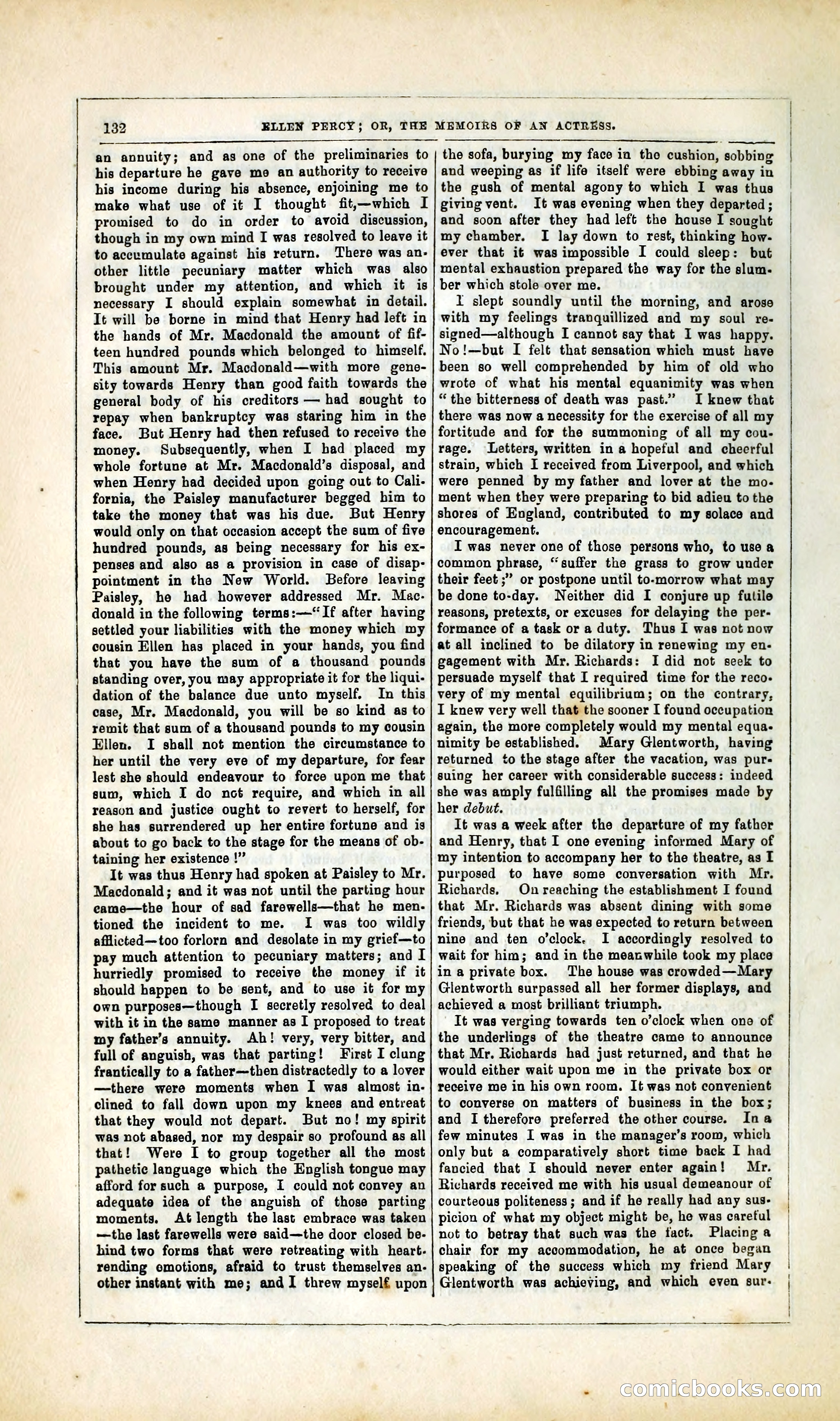
A restored page from Penny Dreadfuls, 1856. Page through the whole issue in the reader above.
📄 Transcribed text from this page (OCR, searchable)
Machine-transcribed from the original scan — historical spelling and the odd misread are preserved.
as — an annuity; and as one of the preliminaries to his departure he gave me an authority to receive his income during his absence, enjoining me to make what use of it I thought fit,—which I promised to do in order to avoid discussion, though in my own mind I was resolved to leave it to accumulate against his return. There was an- other little pecuniary matter which was also brought under my attention, and which it is necessary I should explain somewhat in detail. It will be borne in mind that Henry had left in the hands of Mr. Macdonald the amount of fif- teen hundred pounds which belonged to himself. This amount Mr. Macdonald—with more gene- sity towards Henry than good faith towards the general body of his creditors — had sought to repay when bankruptcy was staring him in the face. But Henry had then refused to receive the money. Subsequently, when I had placed my whole fortune at Mr. Macdonald’s disposal, and when Henry had decided upon going out to Cali- fornia, the Paisley manufacturer begged him to take the money that was his due. But Henry would only on that occasion accept the sum of five hundred pounds, as being necessary for his ex- penses and also as a provision in case of disap- pointment in the New World. Before leaving Paisley, he had however addressed Mr. Mac. donald in the following terms:—‘“If after having settled your liabilities with the money which my cousin Ellen has placed in your hands, you find that you have the sum of a thousand pounds standing over, you may appropriate it for the liqui- dation of the balance due unto myself. In this case, Mr. Macdonald, you will be so kind as to remit that sum of a thousand pounds to my cousin Ellen. I sball not mention the circumstance to her until the very eve of my departure, for fear lest she should endeavour to force upon me that sum, which I do not require, and which in all reason and justice ought to revert to herself, for she has surrendered up her entire fortune and is about to go back to the stage for the means of ob- taining her existence !” It was thus Henry had spoken at Paisley to Mr. Macdonald; and it was not until the parting hour eame—the hour of sad farewells—that he men- tioned the incident to me. I was too wildly afflicted—too forlorn and desolate in my grief—to pay much attention to pecuniary matters; and I hurriedly promised to receive the money if it should happen to be sent, and to use it for my own purposes—though I secretly resolved to deal with it in the same manner as I proposed to treat my father’s annuity. Ah! very, very bitter, and full of anguish, was that parting! First I clung frantically to a father—then distractedly to a lover —there were moments when I was almost in- clined to fall down upon my knees and entreat that they would not depart. But no! my spirit was not abased, nor my despair so profound as all that! Were I to group together all the most pathetic language which the English tongue may afford for such a purpose, I could not convey an adequate idea of the anguish of those parting moments. At length the last embrace was taken —the last farewells were said—the door closed be- hind two forms that were retreating with heart- rending emotions, afraid to trust themselves an- other instant with me; andI threw myself upon o_o ELLEN PERCY; OR, THE MEMOIRS OF AN ACTRESS. the sofa, burying my face in tho cushion, sobbing and weeping as if life itself were ebbing away in the gush of mental agony to which I was thus giving vent. It was evening when they departed ; and soon after they had left the house I sought my chamber. I lay down to rest, thinking how- ever that it was impossible I could sleep: but mental exhaustion prepared the way for the slum. ber which stole over me. Y slept soundly until the morning, and arose with my feelings tranquillized and my soul re- signed—although I cannot say that I was happy. No!—but I felt that sensation which must have been so well comprehended by him of old who wrote of what his mental equanimity was when “the bitterness of death was past.” I knew that there was now a necessity for the exercise of all my fortitude and for the summoning of all my cou- rage. Letters, written in a hopeful and cheerful strain, which I received from Liverpool, and which were penned by my father and lover at the mo- ment when they were preparing to bid adieu tothe shores of England, contributed to my solace and encouragement. I was never one of those persons who, to use a common phrase, “suffer the grass to grow under their feet ;” or postpone until to-morrow what may be done to-day. Neither did I conjure up futile reasons, pretexts, or excuses for delaying the per- formance of a task or a duty. Thus I was not now at all inclined to be dilatory in renewing my en- gagement with Mr. Richards: I did not seek to persuade myself that I required time for the reco- very of my mental equilibrium; on the contrary, I knew very well that the sooner I found occupation again, the more completely would my mental equa- nimity be established. Mary Glentworth, having returned to the stage after the vacation, was pur- suing her career with considerable success: indeed she was amply fulfilling all the promises made by her debut. It was a week after the departure of my fathor and Henry, that I one evening informed Mary of my intention to accompany her to the theatre, as I purposed to have some conversation with Mr. Richards, On reaching the establishment I found that Mr. Richards was absent dining with some friends, but that he was expected to return between nine and ten o’clock. I accordingly resolved to wait for him; and in the meanwhile took my place in a private box. The house was crowded—Mary Glentworth surpassed all her former displays, and achieved a most brilliant triumph. It was verging towards ten o’clock when ono of the underlings of the theatre came to announce that Mr. Richards had just returned, and that he would either wait upon me in the private box or receive me in his own room. It was not convenient to converse on matters of business in the box; and I therefore preferred the other course. Ina few minutes I was in the manager’s room, which only but a comparatively short time back I had fancied that I should never enter again! Mr. Richards received me with his usual demeanour of courteous politeness; and if he really had any sus- picion of what my object might be, he was careful not to betray that such was the tact. Placing a chair for my accommodation, he at once began speaking of the success which my friend Mary Glentworth was achieving, and which even sur: "SS GCOmichbooks | (E(0)