
Penny Dreadfuls, 1856 · page 128 of 399
Ellen Percy; or, The Memoirs of an Actress — page 128: what you’re looking at
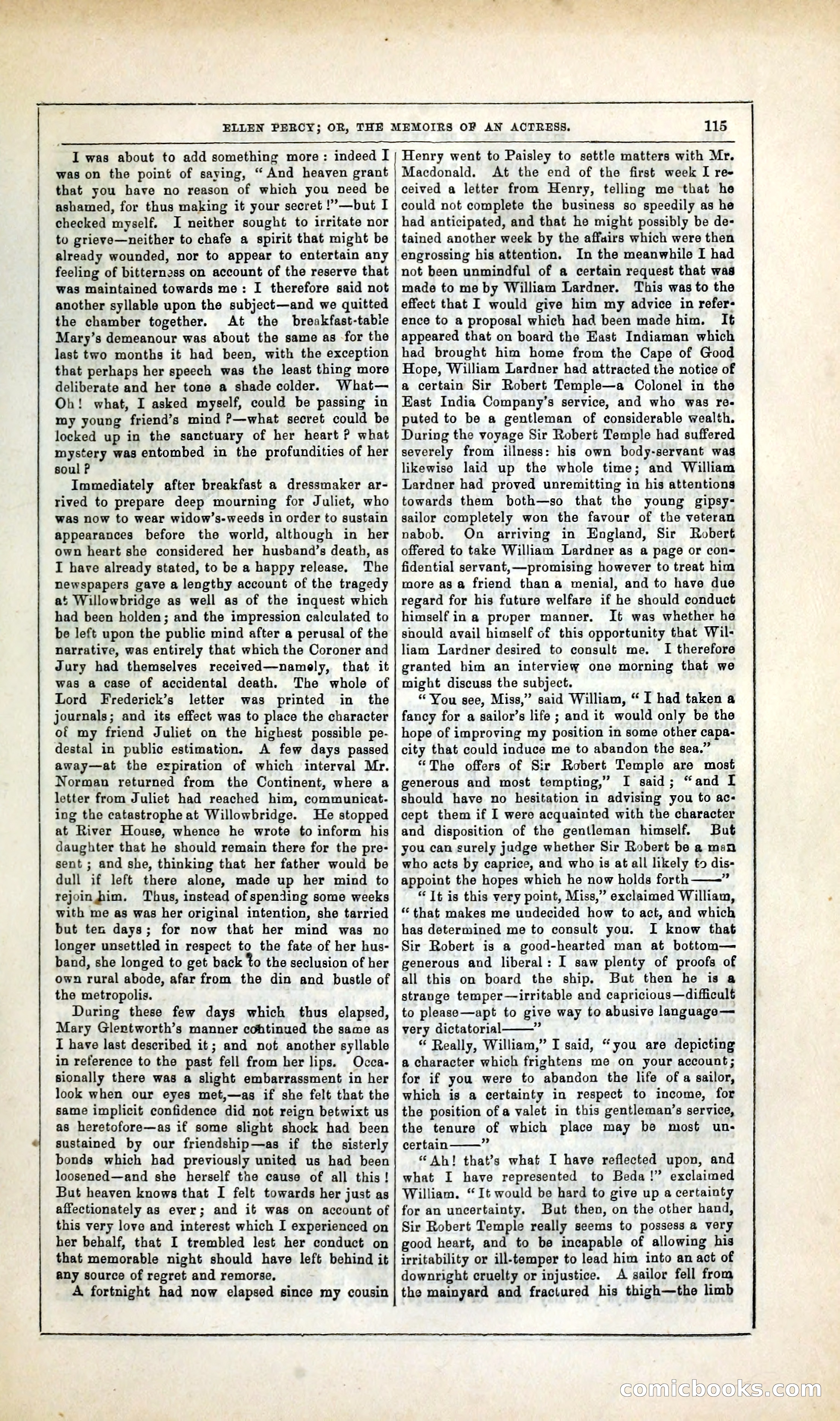
A restored page from Penny Dreadfuls, 1856. Page through the whole issue in the reader above.
📄 Transcribed text from this page (OCR, searchable)
Machine-transcribed from the original scan — historical spelling and the odd misread are preserved.
ELLEN PERCY; OR, THE MEMOIRS OF AN ACTRESS. 115 I was about to add something more: indeed I was on the point of saying, “And heaven grant that you have no reason of which you need be ashamed, for thus making it your secret !’’—but I checked myself. I neither sought to irritate nor to grieve—neither to chafe a spirit that might be already wounded, nor to appear to entertain any feeling of bitterness on account of the reserve that was maintained towards me: I therefore said not another syllable upon the subject—and we quitted the chamber together. At the breakfast-tabie Mary’s demeanour was about the same as for the last two months it had been, with the exception that perhaps her speech was the least thing more deliberate and her tone a shade colder. What— Oh! what, I asked myself, could be passing in my young friend’s mind P—what secret could be locked up in the sanctuary of her heart P what mystery was entombed in the profundities of her soul P Immediately after breakfast a dressmaker ar- rived to prepare deep mourning for Juliet, who was now to wear widow’s-weeds in order to sustain appearances before the world, although in her own heart she considered her husband’s death, as I have already stated, to be a happy release, The newspapers gave a lengthy account of the tragedy at Willowbridge as well as of the inquest which had been holden; and the impression calculated to be left upon the public mind after a perusal of the narrative, was entirely that which the Coroner and Jury had themselves received—namely, that it was a case of accidental death. The whole of Lord Frederick’s letter was printed in the journals; and its effect was to place the character of my friend Juliet on the highest possible pe- destal in public estimation. A few days passed away—at the expiration of which interval Mr. Norman returned from the Continent, where a letter from Juliet had reached him, communicat- ing the catastrophe at Willowbridge. He stopped at River House, whence he wrote to inform his daughter that he should remain there for the pre- sent ; and she, thinking that her father would be dull if left there alone, made up her mind to rejoinhim. Thus, instead of spending some weeks with me as was her original intention, she tarried but ten days; for now that her mind was no longer unsettled in respect to the fate of her hus- band, she longed to get back to the seclusion of her own rural abode, afar from the din and bustle of the metropolis. During these few days which thus elapsed, Mary Glertworth’s manner cohtinued the same as I have last described it; and not another syllable in reference to the past fell from her lips. Occa- sionally there was a slight embarrassment in her look when our eyes met,—as if she felt that the same implicit confidence did not reign betwixt us as heretofore—as if some slight shock had been sustained by our friendship—as if the sisterly bonds which had previously united us had been loosened—and she herself the cause of all this! But heaven knows that I felt towards her just as affectionately as ever; and if was on account of this very love and interest which I experienced on her behalf, that I trembled lest her conduct on that memorable night should have left behind it any source of regret and remorse, A fortnight had now elapsed since my cousin Henry went to Paisley to settle matters with Mr. Macdonald. At the end of the first week I ree ceived a letter from Henry, telling me that he could not complete the business so speedily as he had anticipated, and that he might possibly be de- tained another week by the affairs which were then engrossing his attention. In the meanwhile I had not been unmindful of a certain request that was made to me by William Lardner. This was to the effect that I would give him my advice in rofer- ence to a proposal which had been made him. It appeared that on board the East Indiaman which had brought him home from the Cape of Good Hope, William Lardner had attracted the notice of a certain Sir Robert Temple—a Colonel in the East India Company’s service, and who was ré- puted to be a gentleman of considerable wealth. During the voyage Sir Robert Temple had suffered severely from illness: his own body-servant was likewiso laid up the whole time; and William Lardner had proved unremitting in his attentions towards them both—so that the young gipsy- sailor completely won the favour of the veteran nabob. On arriving in England, Sir Robert offered to take William Lardner as a page or con- fidential servant,—promising however to treat him more as a friend than a menial, and to have due regard for his future welfare if he should conduct himself in a proper manner. It was whether he should avail himself of this opportunity that Wil- liam Lardner desired to consult me. I therefore granted him an interview one morning that we might discuss the subject. “You see, Miss,” said William, “ I had taken a fancy for a sailor’s life ; and it would only be the hope of improving my position in some other capa- city that could induce me to abandon the sea.” “The offers of Sir Robert Temple are most generous and most tempting,” I said; “and I should have no hesitation in advising you to ac- cept them if I were acquainted with the character and disposition of the gentleman himself. But you can surely judge whether Sir Robert be a man who acts by caprice, and who is at all likely fo dis- appoint the hopes which he now holds forth oe “ It is this very point, Miss,” exclaimed William, ‘that makes me undecided how to act, and which has determined me to consult you. I know that Sir Robert is a good-hearted man at bottom— generous and liberal: I saw plenty of proofs of all this on board the ship. But then he is a strange temper—irritable and capricious—difficult to please—apt to give way to abusive language— very dictatorial $ “ Really, William,” I said, “you are depicting a character which frightens me on your account; for if you were to abandon the life of a sailor, which is a certainty in respect to income, for the position of a valet in this gentleman’s service, the tenure of which place may be most un- certain ‘ “Ah! that’s what I have reflected upon, and what I have represented to Beda!” exclaimed William. “It would be hard to give up a certainty for an uncertainty. But then, on the other hand, Sir Robert Temple really seems to possess a very good heart, and to be incapable of allowing his irritability or ill-temper to lead him into an act of downright cruelty or injustice. A sailor fell from the mainyard and fractured his thigh—the limb COLA Cc OOK (E©@)