
Penny Dreadfuls, 1856 · page 89 of 399
Ellen Percy; or, The Memoirs of an Actress — page 89: what you’re looking at
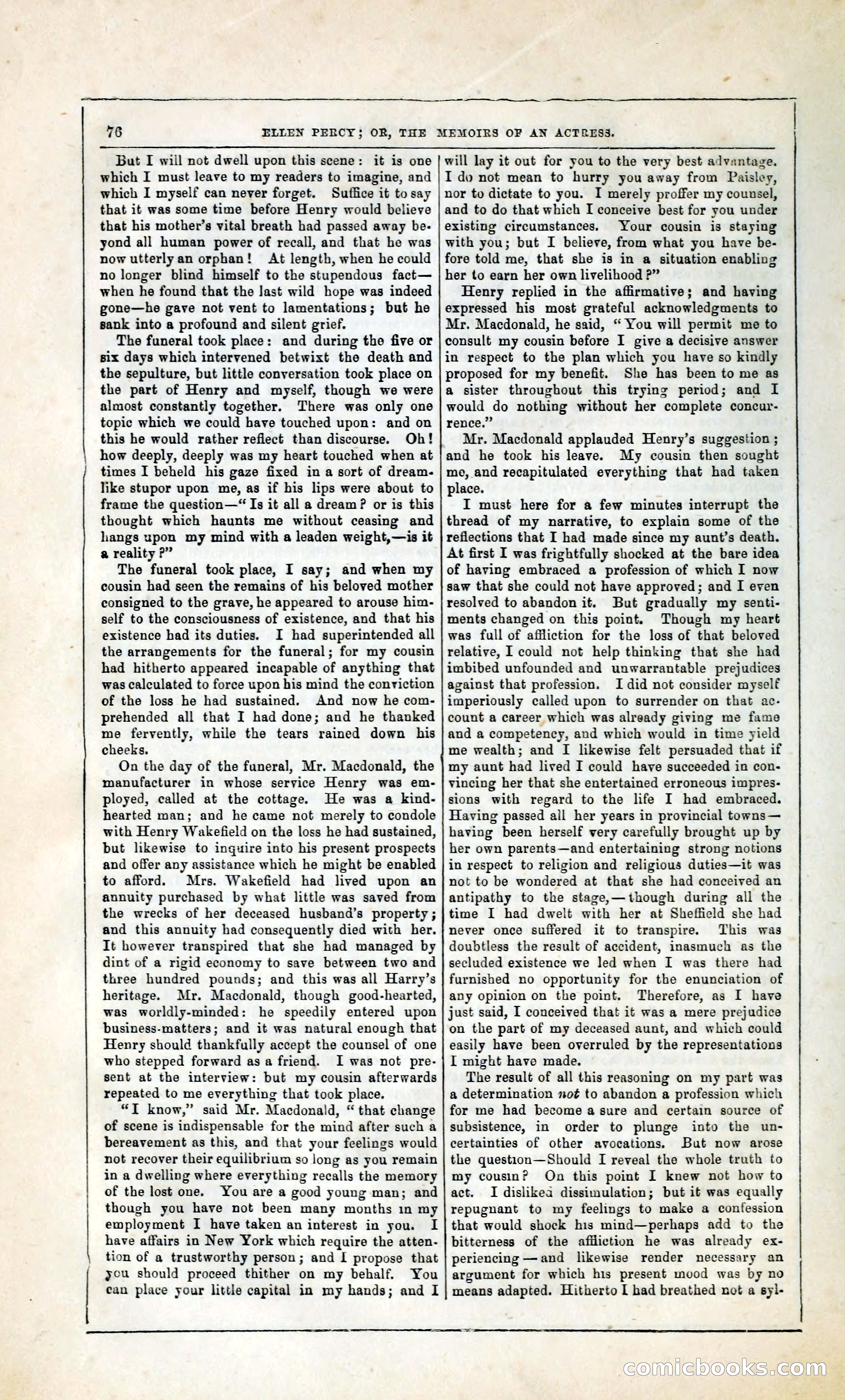
A restored page from Penny Dreadfuls, 1856. Page through the whole issue in the reader above.
📄 Transcribed text from this page (OCR, searchable)
Machine-transcribed from the original scan — historical spelling and the odd misread are preserved.
76 But I wiil not dwell upon this scene: it is one which I must leave to my readers to imagine, and which I myself can never forget. Suflice it to say that it was some time before Henry would believe that his mother’s vital breath had passed away be- yond all human power of recall, and that he was now utterlyan orphan! At length, when he could no longer blind himself to the stupendous fact— when he found that the last wild hope was indeed gone—he gave not vent to lamentations; but he sank into a profound and silent grief. The funeral took place: and during the five or six days which intervened betwixt the death and the sepulture, but little conversation took place on the part of Henry and myself, though we were almost constantly together. There was only one topic which we could have touched upon: and on this he would rather reflect than discourse. Oh! how deeply, deeply was my heart touched when at times I beheld his gaze fixed in a sort of dream- like stupor upon me, as if his lips were about to frame the question—“ Is it all a dream? or is this thought which haunts me without ceasing and hangs upon my mind with a leaden weight,—is it a reality ?” The funeral took place, I say; and when my cousin had seen the remains of his beloved mother consigned to the grave, he appeared to arouse him- self to the consciousness of existence, and that his existence had its duties. I had superintended all the arrangements for the funeral; for my cousin had hitherto appeared incapable of anything that was calculated to force upon his mind the conviction of the loss he had sustained. And now he com- prehended all that I had done; and he thanked me fervently, while the tears rained down his cheeks. On the day of the funeral, Mr. Macdonald, the manufacturer in whose service Henry was em- ployed, called at the cottage. He was a kind- hearted man; and he came not merely to condole with Henry Wakefield on the loss he had sustained, but likewise to inguire into his present prospects and offer any assistance which he might be enabled to afford. Mrs. Wakefield had lived upon an annuity purchased by what little was saved from the wrecks of her deceased husband’s property ; and this annuity had consequently died with her. It however transpired that she had managed by dint of a rigid economy to save between two and three hundred pounds; and this was all Harry’s heritage. Mr. Macdonald, though good-hearted, was worldly-minded: he speedily entered upon business-matters; and it was natural enough that Henry should thankfully accept the counsel of one who stepped forward asa friend. I was not pre- sent at the interview: but my cousin afterwards repeated to me everything that took place. “I know,” said Mr. Macdonald, “ that change of scene is indispensable for the mind after such a bereavement as this, and that your feelings would not recover their equilibrium so long as you remain in a dwelling where everything recalls the memory of the lost one. You are a good young man; and though you have not been many months in my employment I have taken an interest in you. I have affairs in New York which require the atten- tion of a trustworthy person; and I propose that you should proceed thither on my behalf. You ean place your little capital in my hands; and I ELLEN PERCY; OR, THE MEMOIRS OF AN ACTRESS. will lay it out for you to the very best advantaze. I do not mean to hurry you away from Paisley, nor to dictate to you. I merely proffer my counsel, and to do that which I conceive best for you under existing circumstances. Your cousin is staying with you; but I believe, from what you have be- fore told me, that she is in a situation enabling her to earn her own livelihood ?” Henry replied in the affirmative; and having expressed his most grateful acknowledgments to Mr. Macdonald, he said, “ You will permit me to consult my cousin before I give a decisive answer in respect to the plan which you have so kindly proposed for my benefit. She has been to me as a sister throughout this trying period; and I would do nothing without her complete concur- rence.” Mr. Macdonald applauded Henry’s suggestion ; and he took his leave. My cousin then sought mo, and recapitulated everything that had taken place. I must here for a few minutes interrupt the thread of my narrative, to explain some of the reflections that I had made since my aunt’s death. At first I was frightfully shocked at the bare idea of having embraced a profession of which I now saw that she could not have approved; and I even resolved to abandon it. But gradually my senti- ments changed on this point. Though my heart was full of affliction for the loss of that beloved relative, I could not help thinking that she had imbibed unfounded and unwarrantable prejudices against that profession. I did not consider myself imperiously called upon to surrender on that ac- count a career which was already giving me fame and a competency, and which would in time yield me wealth; and I likewise felt persuaded that if my aunt had lived I could have succeeded in con- vincing her that she entertained erroneous impres- sions with regard to the life I had embraced. Having passed all her years in provincial towns— having been herself very carefully brought up by her own parents—and entertaining strong notions in respect to religion and religious duties—it was not to be wondered at that she had conceived an antipathy to the stage,—though during all the time I had dwelt with her at Sheffield she had never once suffered it to transpire. This was doubtless the result of accident, inasmuch as the secluded existence we led when I was there had furnished no opportunity for the enunciation of any opinion on the point. Therefore, as I have just said, I conceived that it was a mere prejudice on the part of my deceased aunt, and which could easily have been overruled by the representations I might have made. The result of all this reasoning on my part was a determination »oé¢ to abandon a profession which for me had become a sure and certain source of subsistence, in order to plunge into the un- certainties of other avocations. But now arose the question—Should I reveal the whole truth to my cousin? On this point I knew not how to act. I dislikea dissimulation; but if was equally repugnant to my feelings to make a confession that would shock his mind—perhaps add to the bitterness of the afiliction he was already ex- periencing —and likewise render necessary an argument for which his present mood was by no means adapted. Hitherto I had breathed not a syi- CONnMIEOO< com